
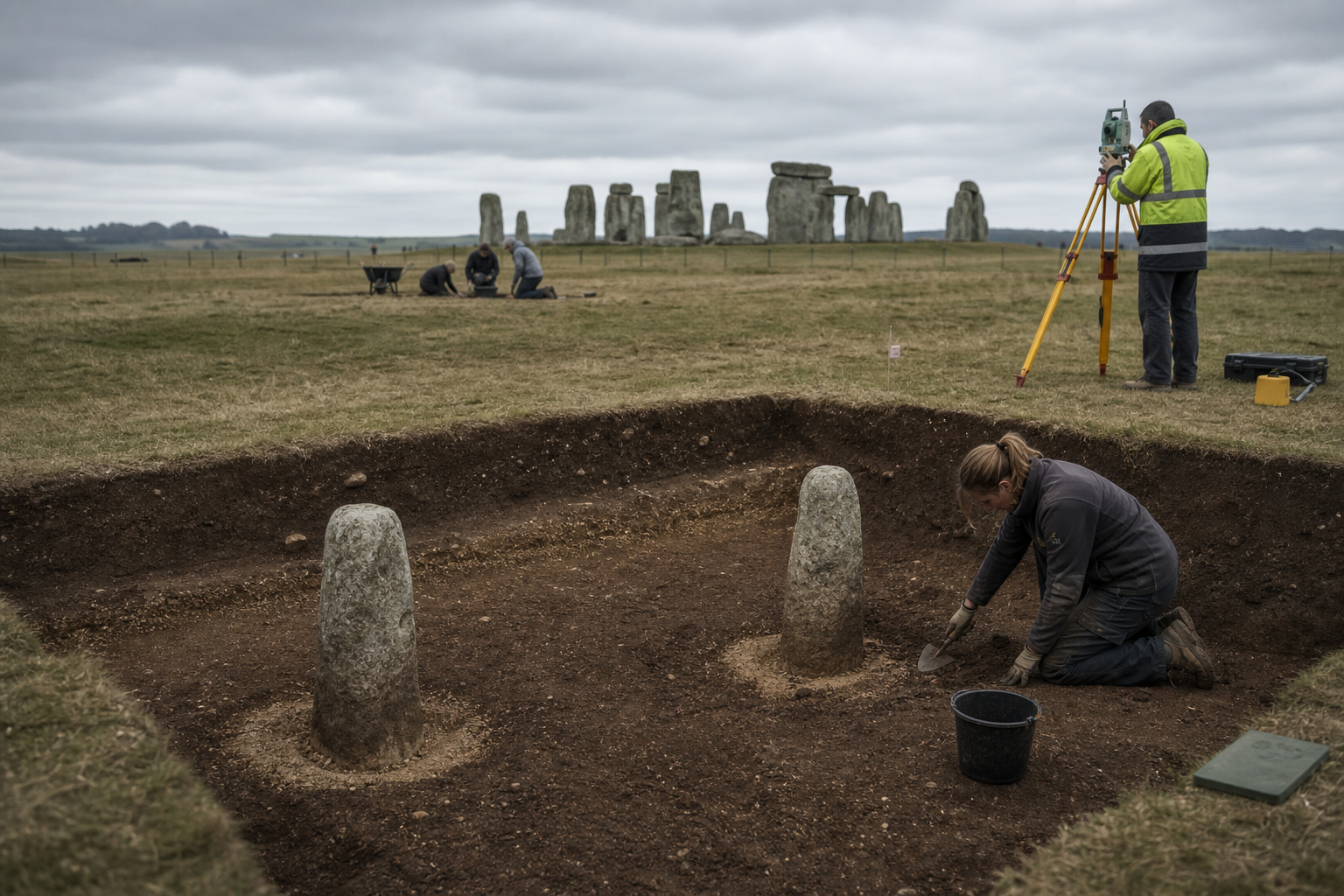
The policy question is straightforward, and it matters far beyond one field season in southern England: should a simple prehistoric structure consisting of two posts, discovered three miles from Stonehenge, receive research funding and public attention equivalent to a major monument site? The answer is yes. Not because all sites are identical, and not because spectacle is irrelevant, but because archaeology is a public knowledge system. If the state funds only the most monumental ruins, it does not merely rank sites by grandeur. It distorts the evidence base from which society understands prehistory.
The newly identified structure is not trivial. It dates to approximately 5,000 years ago. It aligns with the solstices. It predates Stonehenge. Its design is simpler than Stonehenge, but that simplicity is precisely the point. Archaeology is not a beauty contest for stones. It is the reconstruction of human behavior over time. A solstice-aligned pair of posts near Stonehenge is not “lesser history.” It may be early evidence of ritual orientation, landscape use, calendrical knowledge, or the developmental logic that later culminated in monumental architecture. When a simpler site predates a famous megalithic complex, the simpler site is not a footnote to the monument. It is part of the monument’s origin story.
The strongest argument against equivalent funding is the efficiency case. It says that major monument sites like Stonehenge produce more information per dollar, more public engagement per exhibit, more tourism per press release, and more concentrated data per trench. In this view, limited budgets should follow complexity, visibility, and return on investment. This argument deserves respect because public money is finite, and archaeology, like any publicly supported enterprise, must justify allocation.
But the efficiency case rests on a narrow and ultimately misleading metric. It treats archaeological value as a function of immediate density: more stones, more spectacle, more visitors, more funding. That is an understandable accounting method for ticketed attractions. It is a poor method for building reliable historical knowledge. Complex monuments do not interpret themselves. Stonehenge does not become more legible merely because researchers pour resources into the famous ring while underfunding the surrounding prehistoric landscape. A major monument without its simpler antecedents is like a policy report with the executive summary preserved and the underlying data missing. It remains impressive. It becomes less trustworthy.
That is why equivalent funding should be understood not as sentimental parity, but as planned correction of a structural bias. Markets and media attention reward scale, familiarity, and photogenic remains. They overfund what is already visible and underprovide what is foundational. Left alone, public attention clusters around the monument everyone knows, while the less dramatic but historically decisive site struggles for excavation budgets, conservation planning, specialist analysis, and interpretation. This is not an efficient equilibrium. It is a classic failure of fragmented incentives.
The opponents of the resolution repeatedly insist that the simpler structure has lower informational density than Stonehenge. Even if one accepts that premise, it does not follow that the site deserves less support. In public research, significance is not measured only by volume of material. A pair of solstice-aligned posts that predates Stonehenge can change chronology, context, and causation. It can shift the questions scholars ask about ritual practice, astronomical observation, social organization, and the sequence of construction in the landscape around Stonehenge. Small sites often carry decisive explanatory weight. A single earlier layer can reorganize understanding of every later layer built above it.
There is also a democratic argument here. Public attention should not be reserved for prehistoric structures that already fit modern expectations of grandeur. When institutions tell the public that only the biggest monument matters, they reproduce a shallow version of the past: history as spectacle, not history as system. That approach teaches citizens to value culmination over development, celebrity over context, and architecture over evidence. An equitable public archaeology policy does the opposite. It explains that a two-post structure can matter because it reveals process. It invites people to see how monumental sites emerge from earlier, simpler choices, techniques, and beliefs.
Critics hear “equivalent funding” and imagine bureaucratic absurdity: identical budgets for every hole in the ground, regardless of quality. That is a caricature. Equivalent funding in the context of this resolution means a commitment that simpler prehistoric structures should not be systematically discounted because they are visually modest or less commercially marketable than major monument sites. It means excavation, dating, conservation, publication, interpretation, and museum or public-facing attention adequate to their actual historical importance. It means institutional recognition that a simpler design can carry equal research significance when it illuminates a formative chapter in the same prehistoric landscape.
The alternative is to let fame govern inquiry. That approach is especially indefensible around Stonehenge, where the surrounding terrain is inseparable from the monument itself. A two-post structure discovered three miles away is not some unrelated curiosity. It is part of the same regional archive of human intention. Centralized public funding exists precisely to overcome the distortions caused by prestige, tourism, donor preferences, and headline bias. Experts, not crowds, should coordinate the research agenda across entire archaeological landscapes so that precursor sites, ceremonial alignments, habitation traces, and monumental centers are studied as an integrated whole.
This is where state capacity matters. Only coordinated institutions can preserve the integrity of the record across time, across parcels of land, and across public attention cycles. Private enthusiasm is episodic. Media fascination is volatile. Local actors face budget constraints and political pressure. Major monuments can usually defend themselves; they have brand recognition. Simpler prehistoric structures cannot. If public agencies do not step in with deliberate funding parity and interpretive attention, the result is predictable: glamorous sites accumulate grants and visitors while quieter discoveries remain underexamined, unpublished, or poorly conserved. Society then mistakes an artifact of funding inequality for an artifact of the ancient world.
The larger stake is epistemic equity. Archaeology does not merely recover objects; it allocates significance. Those allocations shape textbooks, museums, tourism economies, school curricula, and national narratives about who our ancestors were and how human complexity emerged. If the state privileges only the largest monuments, it teaches a false lesson that history advances only through grand culminations. In reality, cultural systems are built incrementally. The simplest structures often contain the earliest evidence of the ideas later monumentalized in stone.
The two posts near Stonehenge should therefore receive equivalent research funding and public attention not in spite of their simplicity, but because their simplicity, age, and solstice alignment make them indispensable. A serious archaeology policy does not chase only the biggest silhouette on the horizon. It funds the whole landscape of evidence. That is what responsible institutions do when the public good is knowledge rather than spectacle. And in archaeology, as in governance, the record is strongest when the foundation is not neglected for the monument built above it.