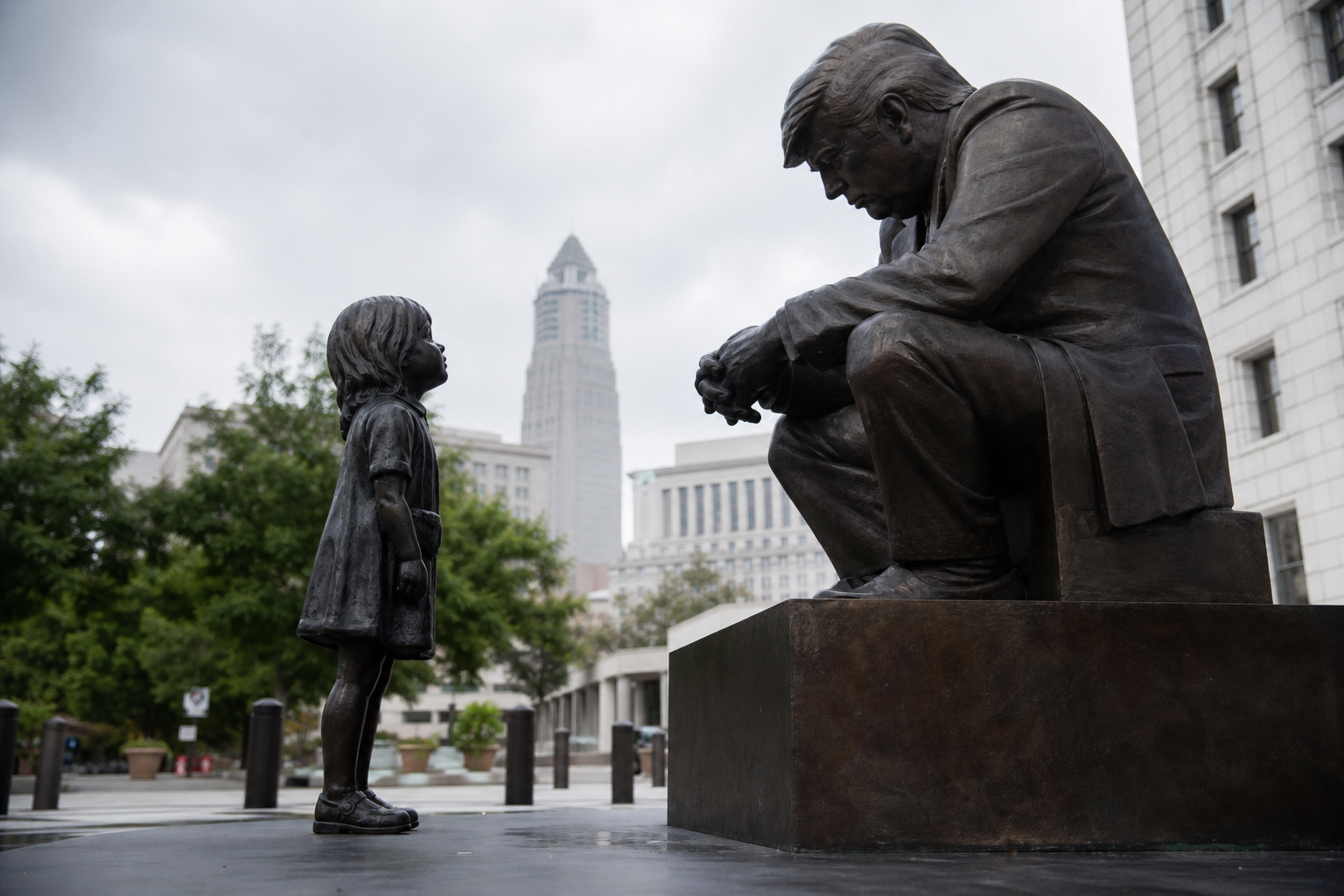
A Banksy artwork in London shows a figure marching with a flag blowing back into his face, near what looks like a precipice. You do not need an art history degree to get the point. The image reads as a critique of society, of leadership, of the danger of marching forward while blind to consequences. That accessibility is not a defect. It is the whole case for why public art should explicitly critique societal issues and political leadership.
The key word in this debate is public. Public art is not hanging in a private dining room, a collector's vault, or a museum wing where people self-select into the experience. It sits in shared space, competes for public attention, and often relies on public tolerance, public permitting, or public money. That means the standard is not simply whether a work is beautiful, or subtle, or open to infinite interpretation. The standard is whether it creates enough civic value to justify occupying scarce common ground.
On that metric, critical public art wins.
The opposition has a serious point, and it deserves respect. Art can become propaganda when officials prescribe a message. Not every mural, statue, or installation should function as a campaign poster. Ambiguity can deepen meaning. Symbolism can outlast the daily news cycle better than didactic slogans. The best criticism of the resolution is not that critique is bad, but that requiring explicit critique risks flattening art into sermonizing, reducing aesthetics to politics, and turning public space into a permanent argument.
All fair. But that critique overstates the cost and understates the upside.
First, explicit does not mean simplistic. Banksy's flag man is explicit in direction while still metaphorical in form. A viewer can disagree on the exact target, nationalism, complacency, performative patriotism, reckless leadership, collective delusion, but the critical function is unmistakable. That is the sweet spot for public art. It should be clear enough to provoke mass recognition, and layered enough to reward thought. Public art does not need to read like a legislative memo. It does need to do more than decorate a wall.
Second, the propaganda objection confuses encouragement with scriptwriting. Saying public art should critique societal issues and political leadership is not the same as saying a ministry should issue talking points to artists. It is a priority rule, not a censorship code. We routinely make priority judgments about public resources. Parks should be safe. Transit should move people efficiently. Public broadcasting should inform. Likewise, public art should contribute something more valuable than visual wallpaper.
And what is that higher value? Accountability.
Political leadership has powerful tools to shape the public narrative: press offices, budgets, ceremonial events, official monuments, and the natural visibility of office itself. Ordinary citizens have fewer. Public art is one of the cheapest counterweights available. A mural, a stencil, or a sculpture can compress a complex criticism into an image thousands of people absorb in seconds. Compared with the cost of a failed policy, a corrupt administration, or a complacent public, the cost of critical art is trivial.
Think in simple cost-benefit terms. A decorative installation may improve a block aesthetically. That has some value. A public artwork that exposes social failure, mocks political vanity, or warns of collective self-deception does that and more. It beautifies for some, irritates others, but above all it creates discussion. It moves people from passive consumption to evaluation. That is a better return on scarce public space.
The strongest cultural argument against this view is that public art also has to unify, commemorate, and elevate. True. Cities need beauty. Shared symbols matter. Not every plaza must become an anti-government seminar. But the resolution does not say public art can only critique. It says it should explicitly critique societal issues and political leadership. In practice, that means critique should be treated as a central civic function of public art, not an occasional indulgence.
Why? Because most public environments already lean toward affirmation. Government buildings praise continuity. Statues honor founders. Civic branding sells optimism. Commercial signage floods the eye with private persuasion. In that landscape, one more harmless object is low marginal value. One work that punctures complacency is high marginal value. The market term is straightforward: critique is undersupplied in public space relative to its social benefit.
There is also a democratic point here, but not a romantic one. Critical public art is useful because it lowers the cost of political attention. Most people will not read a policy paper or attend a council meeting. They will walk past an image on the way to work. If that image captures a truth they have felt but not articulated, it sharpens public judgment. The Banksy figure with the flag in his face, heading toward an edge, does exactly that. It externalizes a fear that leadership can become pageantry detached from reality.
Some opponents say ambiguity is where art's power lives. Fine, up to a point. But too much ambiguity becomes a luxury product for people with time, education, and institutional access. Public art needs enough clarity to work at street level. If the message can only be extracted through curatorial essays, it has failed the medium. Shared space demands legibility.
Others argue that making critique the norm will create endless negativity. This assumes the status quo needs protection from scrutiny more than citizens need protection from bad leadership. That is backward. A healthy society can survive being criticized in paint, stone, or steel. It may not survive leadership insulated from criticism because public culture was told to stay tasteful.
There is, however, one practical guardrail worth keeping. Explicit critique should not mean merely partisan art, calibrated to this week's outrage and forgotten next month. The highest-value public critique works at two levels. It addresses an immediate social or political problem, and it points to a recurring structural failure, arrogance, conformity, corruption, spectacle, denial, drift. That is why the Banksy image works. It is timely without being disposable.
So the real choice is not between beauty and politics, or between freedom and mandate. It is between high-yield public art and low-yield public art. One uses common space to challenge power, reveal risk, and force civic attention. The other mainly fills visual emptiness.
In a world of abundant entertainment, abundant branding, and abundant official messaging, what is scarce is honest public friction. That is why public art should explicitly critique societal issues and political leadership. Not because every artist must become an activist, and not because the state should choreograph dissent, but because shared space should do some work for the people who share it.
The figure with the flag in his face is close to the edge. That image should not be an exception in public life. It should be the benchmark. If leadership is marching blind, public art should say so where everyone can see it.