
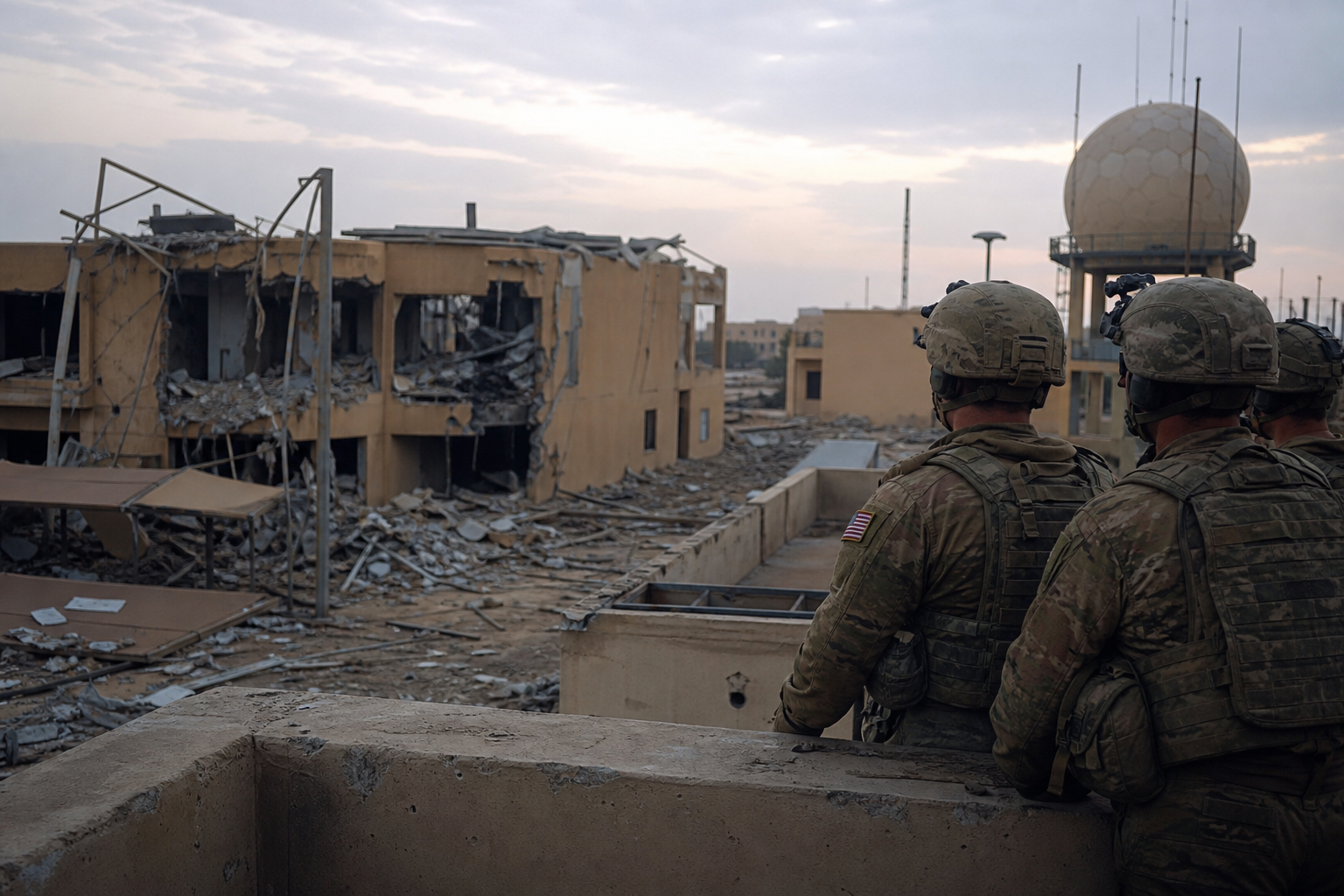
The question is not whether Iran's attacks on US infrastructure in Kuwait and Bahrain are serious. They are. The question is whether direct US military strikes against Iranian targets are a responsible answer. On the facts we have, they are not.
A ceasefire existed. The United States conducted strikes on multiple targets located within Iran. Iran then launched attacks on US infrastructure in Kuwait and Bahrain, and described those attacks as retaliatory. Both governments now accuse the other of violating the ceasefire. That sequence matters. It tells us we are not debating an abstract theory of deterrence. We are looking at an active escalation ladder that has already been climbed by both sides.
In that context, calls for more direct military action ask the public to believe something the evidence in front of us does not support. They ask us to believe that one more round of strikes will somehow restore stability where the last round plainly did not. That is not strategic clarity. It is faith-based escalation.
The strongest argument for new strikes deserves to be taken seriously. It says that when Iran attacks US assets in Kuwait and Bahrain, the United States has a duty to respond directly or invite further aggression. It says inaction creates moral hazard. It says adversaries learn from restraint, and that what Washington calls de-escalation, Tehran may read as weakness. It says deterrence is not disproved by one exchange, because deterrence is not a switch you flip once, but a continuing process of recalibrating costs.
There is truth in parts of that. States do have obligations to protect their personnel and installations. Credibility matters. Not every use of force is irrational, and not every restraint is wise. It is also true that a ceasefire does not cancel the inherent right of self-defense.
But those concessions do not get advocates of direct strikes where they need to go. They still must show, not merely assert, that more attacks on Iranian targets are likely to improve the security of Americans in the region. On this record, that burden is unmet.
Why? Because the basic deterrence claim has already run an observable test and produced the opposite of the promised result. The United States struck inside Iran. Iran did not stand down. Iran struck US infrastructure in Kuwait and Bahrain. When a strategy has just generated the very retaliation it was supposed to prevent, prudence requires more than repeating the word deterrence in a firmer tone.
This is where a regulatory, duty-of-care framework matters. Government is not only permitted to defend. It is obligated to choose forms of defense that are proportionate to the evidence, attentive to foreseeable harm, and designed to avoid preventable catastrophe. In domestic policy, we would never accept, as adequate reasoning, that because a risky intervention failed once, the answer is to intensify it and hope the feedback loop turns favorable. We would ask about failure modes, escalation pathways, oversight, and off-ramps. Foreign policy deserves at least that much rigor.
The foreseeable harms here are not speculative. They are immediate and concrete. Direct US strikes on Iranian targets risk another Iranian response against US bases, infrastructure, shipping, or partner states in the Gulf. They risk widening the theater of conflict beyond Iran itself. They risk civilian casualties and infrastructure damage that make de-escalation politically harder for both governments. They risk collapsing what remains of the ceasefire architecture, however damaged it already is. Once each side frames its latest action as retaliation for the other's previous move, the category of "defensive" force expands without limit.
This is the central flaw in the pro-strike case. It treats force as if it operates in a vacuum, as if the only alternatives are dominance or surrender. But the fact sheet does not show a United States facing a first strike with no prior context. It shows reciprocal action under a disputed ceasefire. In that setting, another direct military strike is not a clean signal. It is one more contested act in a sequence where each side claims legal and strategic justification. That makes miscalculation more likely, not less.
Some advocates reply that a more decisive strike could succeed where earlier strikes failed, that insufficient force, not force itself, is the problem. This is the oldest temptation in crisis management, and one of the most dangerous. It always imagines that the next increment of pressure will finally clarify boundaries. Often it merely shifts the burden of response onto the other side's prestige, domestic politics, and command structure. The result is not restored order but reciprocal compulsion. No government wants to look domestically as if it absorbed a blow and accepted the new normal.
The better reading of the current crisis is not that Washington has been too cautious, but that both sides are already trapped in a rapidly self-validating logic of retaliation. Iran says it retaliated. The United States says it is responding to attacks on its infrastructure. Both accuse the other of violating the ceasefire. That is precisely the environment in which governments should distrust arguments for kinetic clarity. Every strike feels legible to the side launching it. The receiving side almost never experiences it that way.
None of this requires passivity. Rejecting direct military strikes is not the same as accepting attacks on US infrastructure. It means choosing instruments that lower the odds of irreversible error. It means immediate force protection for US personnel and installations in Kuwait, Bahrain, and elsewhere. It means urgent third-party verification of ceasefire claims, because mutual accusation is a recipe for self-serving escalation. It means clear private and public communication of red lines tied to specific behaviors, not theatrical vows of punishment untethered from realistic end states. It means building pressure through means short of another strike inside Iran unless and until a genuinely imminent threat leaves no alternative.
That approach will be denounced as weak by those who equate responsibility with visible explosions. But serious statecraft is not measured by how quickly leaders can order a strike package. It is measured by whether they can protect lives without expanding the circle of harm. The burden of proof lies with those who would remove the guardrails that still exist. A ceasefire, even one both sides say the other violated, is a guardrail. Regional containment is a guardrail. The distinction between protecting assets and pursuing punishment is a guardrail.
The United States should be very wary of crossing those lines in the name of re-establishing deterrence. Deterrence that repeatedly produces retaliation is not yet deterrence. It is a slogan attached to an escalatory pattern. In moments like this, the asymmetry matters. A prevented regional war rarely generates a triumphant headline. A widened war produces many. But government is not in the business of satisfying the emotional demand that every injury be answered in kind. It is in the business of exercising disciplined power under conditions of uncertainty.
On the facts available, direct US military strikes against Iranian targets would not represent disciplined power. They would represent the failure to learn from a cycle already underway, and the choice to risk a broader conflict on the thinnest possible evidence that another round of force will restore order. That is not resolve. It is recklessness dressed up as strategy.