
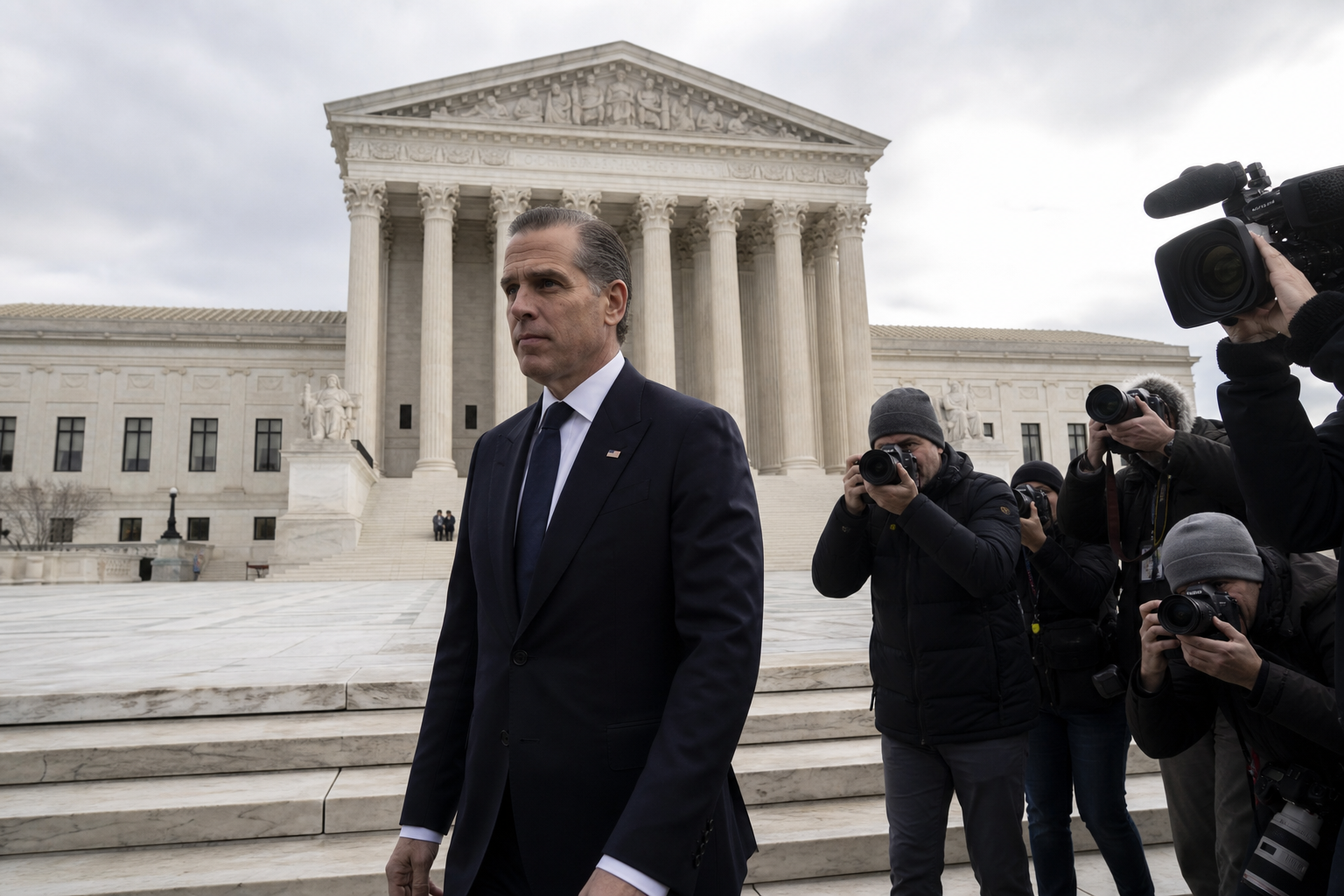
A criminal case called Hunter v. United States is before the Supreme Court in the current term. We know only a few hard facts from the public description. It is a criminal matter, not civil litigation. The United States is a party. And the case is being discussed as one of the term's consequential disputes. That spare record is enough to frame the real argument, because the resolution does not ask whether Hunter is the best known case, the most politically charged case, or the most legally intricate case. It asks whether Hunter v. United States represents the most consequential criminal case of the term.
My answer is yes, but for a reason that requires some care. Not every consequential Supreme Court criminal case changes doctrine for generations. Some instead test whether the public still believes that criminal law is administered by rules rather than by rank. In the long history of Anglo American law, that distinction matters. Courts do not live by precedent alone. They live by accepted authority, by the belief that even painful judgments emerge from a legitimate process. Once that belief frays, even technically narrow opinions can have effects out of proportion to their formal holding.
The strongest objection to this claim came from the institutional and historical side of the debate, and it deserves to be taken seriously. We do not know the specific legal question presented in Hunter v. United States. Without that knowledge, it is hazardous to announce that it outranks every other criminal case on the docket. History is littered with cases that looked explosive at the time and faded into footnotes, while apparently modest disputes over procedure, federal power, sentencing, search and seizure, or the right to counsel became the real landmarks. Gideon v. Wainwright did more than many headline grabbing prosecutions. Miranda v. Arizona reached far beyond the parties before it. On that view, consequence should be measured by doctrinal reach and aggregate effect. Which case will govern the conduct of police, prosecutors, trial courts, and defendants across thousands or millions of future cases? That is a disciplined standard, and ordinarily it is the right one.
I concede the core of that point. If all we were measuring were the eventual contents of the United States Reports, the soundest answer might well be agnosticism. It is wise, especially when facts are thin, not to confuse notoriety with legal significance. Courts have often been over read in the moment and under read in the long arc.
But that is not the whole picture, and pretending otherwise ignores a lesson as old as the republic. The Supreme Court is not merely a machine for generating legal rules. It is also a constitutional actor whose authority depends on public confidence that the same law binds the obscure and the connected. Criminal law is where that confidence is tested most sharply, because it is where the state seeks to punish a named person. Civil cases distribute money and power; criminal cases put the sovereign's coercive force on display. When the caption reads Hunter v. United States, the state is not an abstract background presence. It is the prosecuting power of the nation itself.
That is why the best counterargument ultimately fails. My opponents correctly insisted that Dred Scott became historically catastrophic not just because people distrusted the Court, but because the Court announced a monstrous constitutional rule. True enough. Substance matters. Yet the precedent of Dred Scott still teaches a broader lesson about institutional legitimacy. A court can magnify national fracture when it appears to decide a politically loaded dispute in a way that confirms the suspicion that law has become an instrument of faction. The formal holding and the public meaning interact. One does not cancel the other.
American history offers many such warnings. Ex parte Milligan mattered because it restored a boundary against emergency power, but also because it reminded the country that constitutional order survives crisis. United States v. Nixon mattered because it compelled production of evidence under law, but also because it reassured the public that the presidency was not above judicial process. Bush v. Gore, though not a criminal case, remains a standing example of how a narrowly bounded decision can cast a very long shadow over institutional legitimacy. In each instance, doctrine and public confidence were intertwined.
That is the right frame for Hunter v. United States. Even without embellishing facts we do not have, this much is plain: a criminal case involving the United States as a party, arriving at the Supreme Court in a climate of intense suspicion about selective prosecution, favoritism, and double standards, is uniquely situated to affect confidence in legal neutrality. The key point is not celebrity. It is not voyeuristic interest in a defendant. It is the structural place of criminal adjudication in a constitutional system. If citizens come to think that criminal law is rigid for some and negotiable for others, then every future prosecution inherits that doubt.
Some will say this is too impressionistic, that public trust is a mood while legal precedent is concrete. I disagree, and history disagrees. Public trust in courts is not a decorative extra. It is part of the operating capital of the legal system. Judges do not command armies. They issue opinions that other officials and the public accept as authoritative because institutions have accumulated legitimacy over time. That legitimacy is hard won and easily squandered. The most durable institutions in Anglo American government survived not because they were always loved, but because enough people believed they were bounded by law.
Notice what this argument does not claim. It does not say Hunter v. United States must produce a sweeping constitutional rule. It does not say every high profile prosecution is automatically more important than a case about sentencing guidelines or the Fourth Amendment. It does not confuse media attention with jurisprudence. Rather, it makes a narrower and stronger claim. In this particular term, with this particular criminal case, consequence lies in the collision between criminal process and institutional credibility. Other criminal cases may prove more influential in law schools a decade from now. Hunter may nevertheless be the case with the greatest immediate significance for the Court's standing as an impartial guardian of the rule of law.
That distinction between immediate significance and long run doctrinal sweep is not a dodge. It is an old historical truth. Some cases change the law. Others change what the public thinks the law is for. A republic needs both sound rules and faith that the rules are honestly applied. Lose the first, and liberty erodes through precedent. Lose the second, and liberty erodes through cynicism, disengagement, and retaliatory politics.
So yes, Hunter v. United States represents the most consequential criminal case of the current Supreme Court term. Not because we should surrender to the urgency of the news cycle, and not because every case with a charged name deserves inflation, but because criminal justice derives its authority from equal application, and this case places that principle under the brightest possible light. The Court can survive controversial holdings. What it cannot casually survive is a broad public conclusion that, in criminal law, there are really two constitutions, one for ordinary people and one for the well situated. If Hunter v. United States clarifies anything this term, it will be whether the Court still understands that ancient danger.