
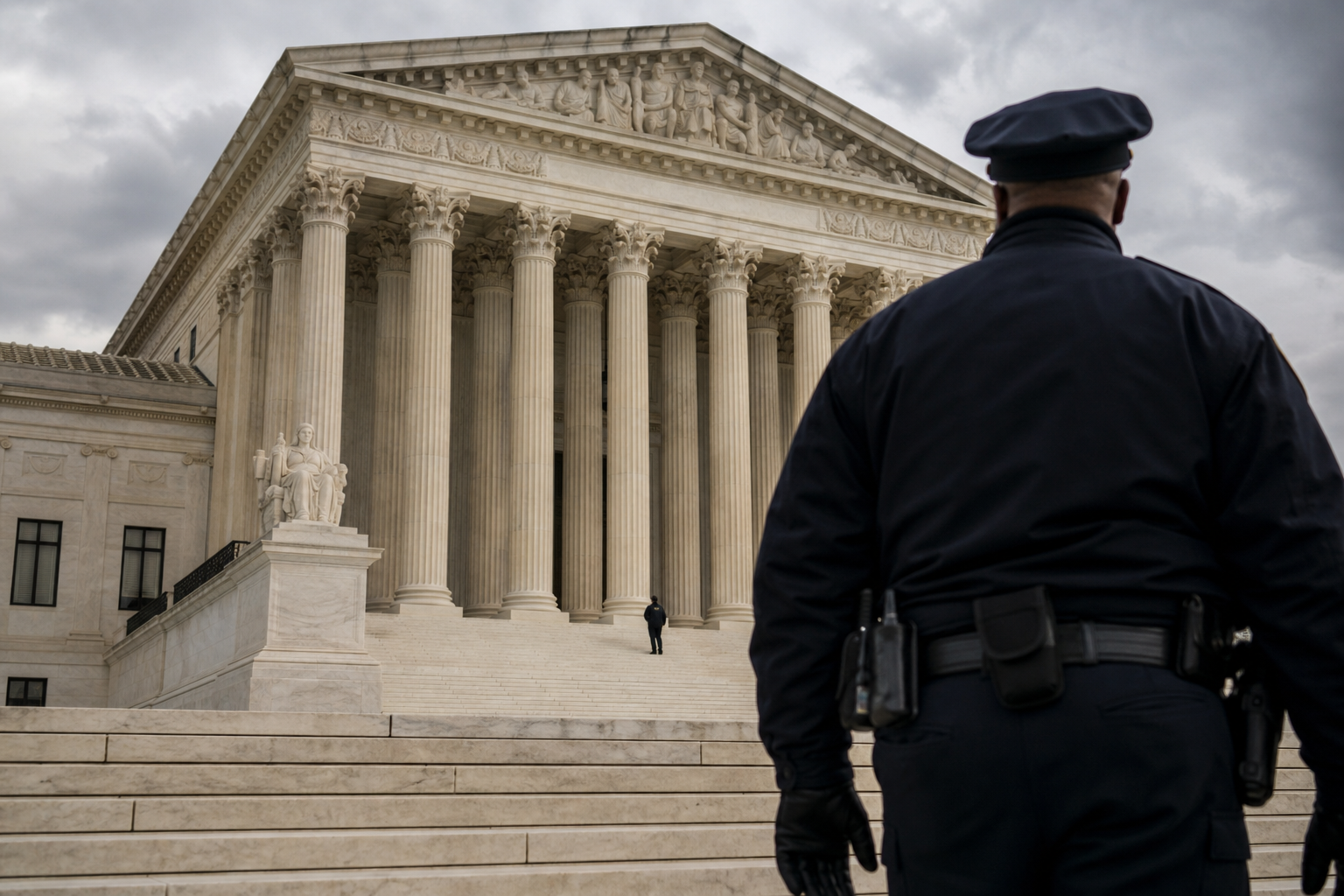
Calling Hunter v. United States the most consequential criminal law case of the current Supreme Court term invites an obvious objection. We know only a few hard facts from the public frame before us: Hunter v. United States is a criminal case, it is on the current term’s docket, and it has been described as unusually important. Skeptics therefore ask a fair question. How can anyone rank consequence without a full comparative ledger of every criminal case, every doctrinal issue, every downstream effect?
That skepticism has force. It is also incomplete.
In public law, especially criminal law, consequence is not measured only after the smoke clears. A mature legal system cannot wait for damage, drift, or disorder to become fully countable before deciding which cases matter most. The state has to govern prospectively. Courts, prosecutors, defenders, legislatures, police departments, prison systems, and communities all operate within one interdependent architecture. The most consequential Supreme Court criminal law case in a given term is often the one that most clearly tests that architecture, not merely the one that can be most easily reduced to a spreadsheet on day one.
That is why Hunter v. United States deserves the label.
The strongest case against this conclusion came in several forms across the debate. One line of argument emphasized subjectivity. “Most consequential,” on this view, depends on who is asking. For the defendant, any criminal case involving the power of the United States to punish is existential. For historians, the true importance of a Supreme Court ruling may not be visible until years later. For operational analysts, consequence should mean clear and immediate changes in prosecutorial behavior, sentencing, workload, or legal incentives. And for institutional skeptics, public attention can be a poor proxy for real legal impact.
Each of these cautions improves the analysis. None defeats the resolution.
Start with the narrowest point. Yes, a criminal case is always intensely consequential for the individual defendant. But the resolution is plainly comparative and systemic. It asks whether Hunter v. United States represents the most consequential criminal law case of the current term, not whether criminal cases are serious in the abstract. The relevant question is therefore which case best concentrates national stakes in criminal law. Individual liberty matters here, but not as a freestanding moral anecdote. It matters because criminal law is the state’s sharpest instrument, backed by arrest, conviction, and incarceration, and any Supreme Court intervention in that field can reverberate through every level of government.
The more substantial objection is the pragmatic one. We should, critics say, reserve the title “most consequential” for the case with the most demonstrable and quantifiable impact. That sounds disciplined, but it is too cramped for the work criminal law actually does. Some Supreme Court criminal law decisions do produce obvious immediate effects. Others matter because they resolve a deeper uncertainty in the state’s authority, or because they alter the terms on which institutions coordinate. Those effects may not be fully measurable in advance, but they are still legible to experienced observers.
This is where the institutional perspective matters. The Supreme Court’s docket is not random. A case reaches the Court because lower courts, litigants, and the justices themselves recognize tension serious enough to warrant national resolution. A criminal law case before the Court is not merely a dispute between one defendant and the federal government. It is a signal that some rule governing coercive public power may need clarification, contraction, or reaffirmation. When a case like Hunter v. United States rises to the level of being widely characterized as one of the term’s major criminal matters, that characterization should not be dismissed as empty hype. It reflects accumulated judgment inside a legal system designed, however imperfectly, to surface systemic conflict.
The historical objection is also worth taking seriously. It is true that legal significance is often misjudged in real time. Cases once treated as technical can later become landmarks, while heavily watched disputes can produce narrow holdings. But that uncertainty is not an argument for agnosticism. It is an argument for structured forecasting. Governments routinely make consequential decisions under uncertainty, and they do so by weighing institutional salience, the breadth of possible effects, and the costs of being wrong. Waiting for retrospective certainty is not prudence. It is passivity.
In criminal justice, passivity has costs. When the Supreme Court is considering a case that may affect the boundaries of criminal liability, procedure, enforcement, or the federal-state balance in punishment, every relevant actor must prepare for change. Defense lawyers revise strategy. U.S. attorneys reassess charging practices. Trial judges anticipate new standards. Congress and state legislatures watch for statutory vulnerabilities. Agencies that collect data on arrests, sentences, and prison populations model possible impacts. That anticipatory work is itself evidence of consequence. A case that compels system-wide attention before a decision arrives is already operating at a scale larger than the individual dispute.
Critics of the resolution repeatedly sought a narrower metric, immediate operational change. But that standard privileges what is easiest to count over what is most important to govern. Some of the gravest failures in criminal justice emerge from fragmentation, from institutions reacting piecemeal to doctrinal shifts they should have anticipated. The state’s obligation is not merely to tally consequences after a ruling. It is to identify which pending cases pose the greatest risk or opportunity for coherent national administration.
Hunter v. United States fits that description better than the alternatives suggested in the debate, which remained abstract and hypothetical. Opponents gestured toward other possible criminal cases involving due process, search and seizure, or federal jurisdiction. Perhaps one of those cases will ultimately cast the longer shadow. But on the record before us, those rivals were placeholders, not demonstrated competitors. By contrast, Hunter v. United States is the case that has already crystallized the argument about consequence itself. It is the case around which observers are organizing expectations about this Supreme Court term’s criminal law docket. In practical institutional life, that matters.
There is a temptation among legal commentators to treat visibility as suspect, as if a case becomes less important when many people notice it. That is backwards. Public salience can distort, but it can also reveal. In criminal law, widespread attention often means that a doctrinal dispute has escaped the law reports and entered the realm of national governance. It means local variation, prosecutorial discretion, constitutional limits, and punishment policy are no longer operating quietly in separate silos. They are colliding in one case before one court whose answer will bind the country.
That is what makes Hunter v. United States the most consequential criminal law case of the term. Not because we can already enumerate every effect with false precision. Not because publicity alone confers greatness. And not because the fate of one defendant should be romanticized into a complete theory of law.
It is most consequential because it sits at the point where uncertainty, state power, and national legal coordination meet. In criminal law, that junction is where consequences become real for millions of people who will never read the opinion but will live under its rule. The mature question is not whether we can prove all impacts in advance. The mature question is which case most demands collective attention because its stakes are broad enough, its institutional signal strong enough, and its potential to reorder the administration of justice large enough.
This term, that case is Hunter v. United States.