
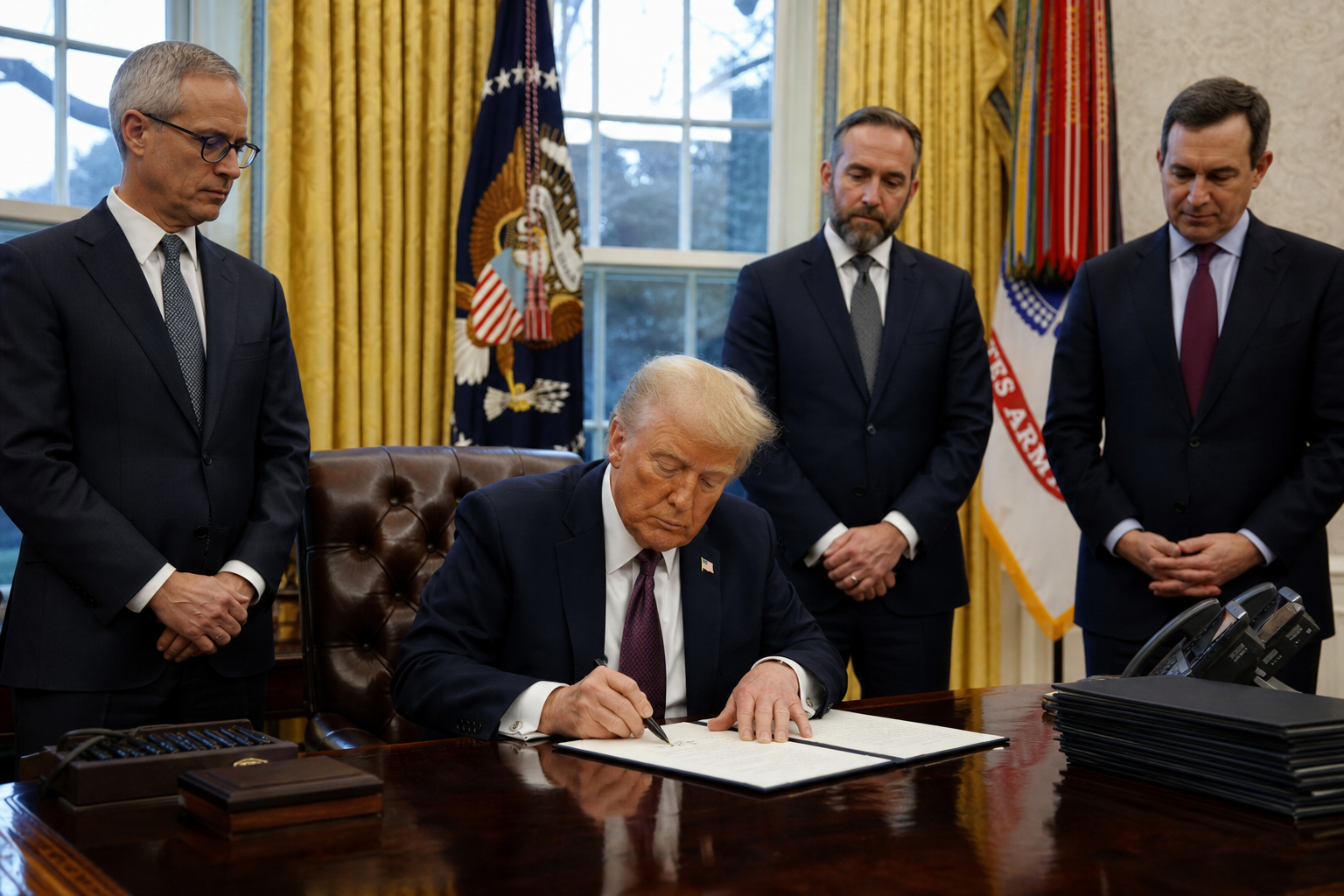
The White House has issued an executive order affecting fintech companies and payment systems, and that has reopened a familiar fight in Washington: should major federal policy changes in a critical economic sector come through Congress or through the president's pen? In theory, this is a civics argument about separation of powers. In practice, it is a decision about speed, coordination, legal durability, and the cost of waiting while technology, fraud, market structure, and infrastructure risk keep moving.
My answer is straightforward: yes, the federal government should use executive orders for major policy changes affecting fintech and payment systems, when the alternative is drift, fragmentation, or multi-year delay. Not because executive orders are constitutionally romantic, and not because unilateral action is inherently superior. They are not. The case is simpler. In this sector, the cost of inaction is often higher than the cost of imperfect action.
That matters because fintech is not a static industry. Payment systems are not museum pieces. They are live infrastructure. They clear transactions, move payroll, settle bills, connect banks to apps, and increasingly shape who gets access to credit, speed, and lower-cost financial services. If federal policy direction is stale while the market evolves, the result is not some neutral waiting period. The result is regulatory arbitrage, compliance confusion, uneven supervision, and a quiet subsidy for whichever incumbents can navigate ambiguity best.
The strongest critics of executive orders raise real concerns. Selene Ward made the most serious version of that case. Major policy shifts, she argued, should rest on congressional debate, statutory grounding, and broad consensus. Otherwise they become brittle, reversible, and vulnerable to legal challenge. That is not wrong. If your top priority is maximum durability over a 10-year horizon, legislation is usually better than executive action. If your top priority is procedural legitimacy in the Madisonian sense, Congress is the right venue.
But that is not the whole decision. You do not evaluate a tool in a vacuum. You compare it with the actual alternative on offer. In fintech and payment infrastructure, the alternative is often not a beautifully negotiated bipartisan statute delivered on schedule. It is years of deadlock, committee churn, agency hesitation, and market evolution outrunning the rulebook. That delay is expensive.
Take the basic categories of risk without pretending to know the contents of any specific order beyond the fact sheet. Payment systems infrastructure can implicate resilience, fraud, access, interoperability, competition, and national economic capacity. Fintech policy can affect licensing pressure, data handling, compliance expectations, and the boundaries between banks, platforms, and payment intermediaries. In all of those areas, a clear federal signal can change behavior immediately. It can align agencies, reprice compliance planning, force board-level attention, and establish priorities that markets treat as real long before Congress would finish negotiating text.
Critics say this is instability. Sometimes it is. But instability has more than one source. A slow Congress does not create certainty merely by existing. It often creates a fog. And fog favors large players. Theo Voss argued that executive orders invite capture by incumbents with access to the administration. Fair point, up to a point. But legislative processes are not magically immune to capture. In fact, long, complex lawmaking often advantages the best-funded lobbyists, the largest compliance departments, and the firms patient enough to shape details over years. Delay itself is a form of policy. Usually it protects whoever is already winning.
That is why the anti-EO camp often overstates the virtue of process while understating the market effects of paralysis. In a fast-moving sector, waiting is not prudent by default. Waiting can lock in bad equilibria. It can let fraud patterns scale. It can preserve outdated infrastructure. It can force innovative firms to operate under contradictory signals from multiple agencies. It can also deter investment, because businesses hate not just strict rules, but unclear rules.
The best pro-executive-order argument is not that the presidency should dominate financial policy. It is that executive orders are an efficient way to do three useful things quickly: coordinate the federal bureaucracy, signal national policy direction, and trigger action under existing statutory authority. Those are meaningful outputs. An executive order can tell agencies what matters now. It can reduce fragmentation. It can create a single federal posture in a sector where fragmented oversight is itself a cost.
Notice the narrower and more defensible claim here. An executive order should not be treated as a permanent constitutional shortcut for every major rewrite of the financial system. It is a bridge, a forcing mechanism, and a coordination device. If Congress later wants to codify, refine, or replace the policy, good. That is often the ideal sequence: executive action first, legislation later if the issue matures into stable consensus. The mistake is assuming that because legislation is superior in permanence, executive action is therefore inferior in all cases. It is not.
There is also a practical advantage that critics rarely credit enough: reversibility. Yes, opponents call that fragility. Sometimes it is better understood as option value. In fintech and payment systems, where technology and market structure can change quickly, not every policy should be frozen immediately into statute. A reversible federal policy can be a feature, not a bug, when policymakers need to adapt to new risks, revise guidance, or correct overreach without waiting another full legislative cycle. Flexibility has value. So does learning.
The constitutional concern still deserves respect. Major policy should stay within existing presidential and agency authority. Executive orders cannot repeal statutes or invent powers from thin air. If an order tries to do that, courts should stop it. But that is an argument for lawful executive action, not for executive paralysis. The resolution is about whether the federal government should implement major policy changes affecting fintech companies and payment systems through executive order. Given the facts, the answer is yes, because this mechanism can move faster than Congress, coordinate more effectively than scattered agencies acting alone, and deliver immediate market-relevant direction in a sector where delay compounds costs.
The anti-EO side has one emotionally attractive story: that restraint protects legitimacy. Sometimes true. But in this context, restraint can also mean a payment system policy vacuum, slower modernization, and a federal posture too sluggish for the market it regulates. That is not noble. It is expensive.
The better governing principle is practical. Use Congress when you can get timely, durable law. Use executive orders when you need to align agencies, shift federal policy direction, and act before the damage from waiting exceeds the downside of impermanence. Fintech and payment systems are exactly the kind of domain where that trade-off often points toward executive action.
That will offend institutional purists. Fine. They can have cleaner process. Markets, consumers, and infrastructure operators need usable policy. On balance, executive orders are not the perfect tool here. They are the tool with the best cost-benefit ratio. In government, that is usually what should count.