
The cleanest argument against prioritizing foreign conflicts in a Democratic primary is also the most intuitive one. New York City voters live with rent, transit delays, school quality, street safety, sanitation, and zoning. City government touches these things directly. A war overseas does not determine whether the trash gets collected on time or whether a housing permit gets approved. So, the objection goes, primary voters should judge candidates mainly on local governance issues, because that is where the officeholder has the clearest power and where the voter gets the highest return on electoral attention.
That case is serious, and it should not be waved away. It is true that local officials often have more immediate leverage over housing than over Hamas, more influence over bus lanes than over Benjamin Netanyahu, more responsibility for city services than for cease-fire negotiations. It is also true that politics can become performative, that candidates can substitute moral theater for administrative competence, and that voters can indulge in symbolic politics while the machinery of local government decays.
If the resolution were that Democratic primary voters should ignore local governance issues, it would be absurd. But that is not the resolution. The question is whether they should prioritize candidates' positions on foreign conflicts over local governance issues. In this news cycle, in this electorate, in this city, the answer is yes.
The reason starts with what a primary is actually for. A primary is not only a hiring process for a municipal manager. It is a sorting mechanism for power, ideology, coalition, and moral direction. General elections often ask, who can administer? Primaries ask, what kind of politics are we authorizing? That distinction matters. In a Democratic primary, especially in New York City, voters are not just choosing a clerk of local systems. They are selecting a representative of a political identity, a governing coalition, and a worldview that will travel upward and outward through the party.
That is why the Israel-Gaza war became a point of division among voters in the race. Not because New Yorkers are confused about jurisdiction, but because they understand how parties work. A candidate's position on a defining foreign conflict is not random decoration. It is a high-signal test of judgment, coalition alignment, moral seriousness, and willingness to oppose or accommodate entrenched power. When Brad Lander defeated Dan Goldman, and when candidates backed by Mamdani won their races, voters were not simply freelancing on an issue beyond city limits. They were using a conflict of global significance to read the deeper code of the candidates standing before them.
Opponents of this view make a practical point: foreign policy is a heuristic, a shortcut. It can tell you something about values, but it is not proof that someone can run a city. Fair enough. But politics is unavoidably heuristic. Most voters do not and cannot become expert auditors of every procurement process, every transit capital plan, every line item in a city budget. They infer. They look for signal. They ask which issue reveals the most about the person seeking power.
On that score, foreign conflict can reveal more than local white papers ever do. A housing platform can be consultant-polished. A sanitation plan can be boilerplate. A statement on a live war, especially one as morally and politically charged as Israel-Gaza, is harder to fake. It exposes which constituencies a candidate fears, which human lives they center, how they think about state violence, whether they can resist orthodoxies, and whether they grasp the consequences of force. These are not niche concerns. They are core tests of governance. Anyone can memorize talking points about affordability. It takes a different kind of political character to stake out a position when the pressure is national, donor networks are activated, and the costs of dissent are real.
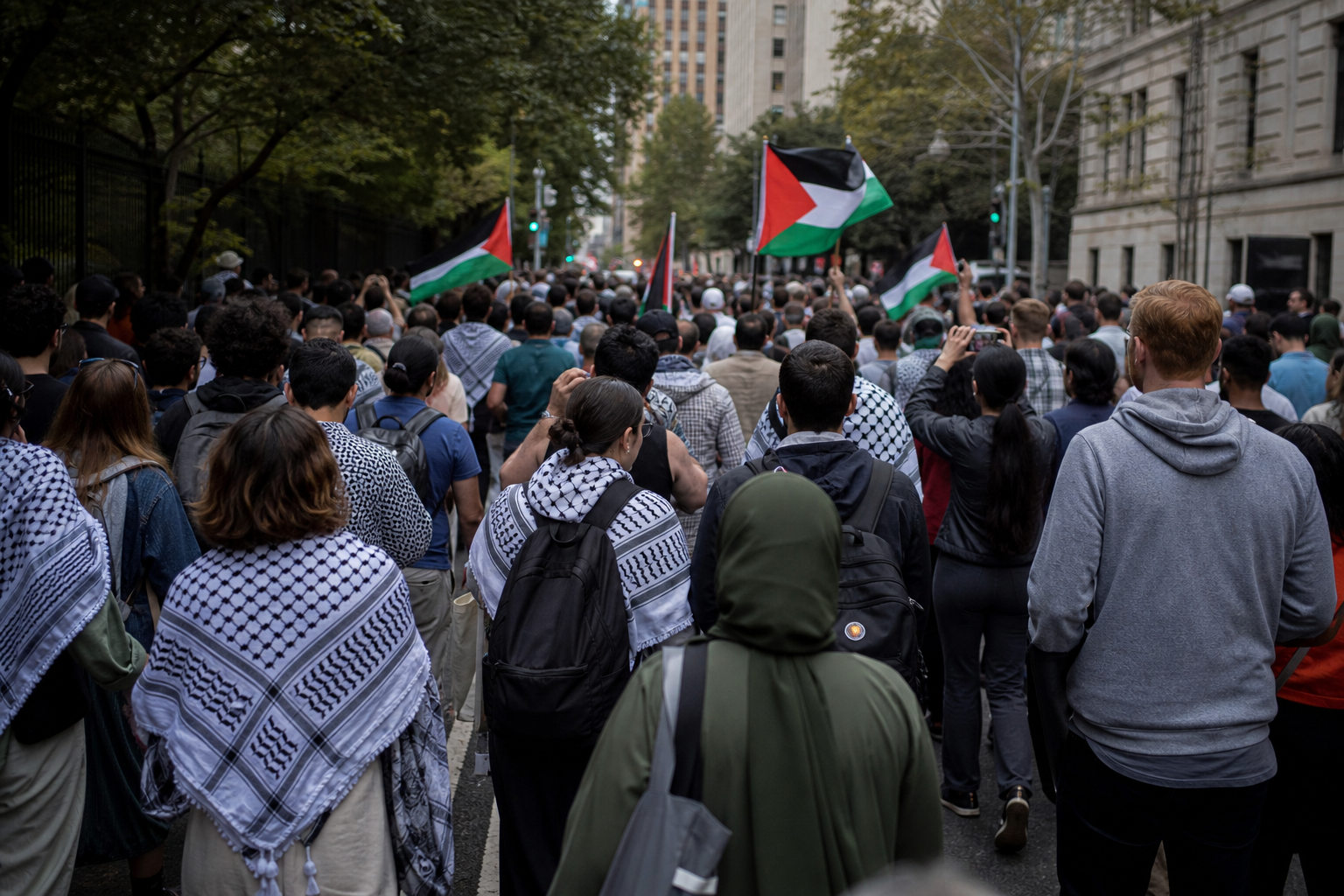
There is also a deeper mistake in the localist critique. It assumes a stable wall between foreign conflict and local governance that no longer exists. New York City is not a sealed municipal container. It is a global city, knitted together by migration, capital, media, diaspora networks, protest movements, philanthropy, policing practices, and identity coalitions that are directly shaped by world events. The Israel-Gaza war did not enter the primary as an imported distraction. It was already here, in households, neighborhoods, campuses, synagogues, mosques, unions, and civic organizations. To say voters should bracket it off in favor of narrower local management is to ask them to pretend their political community is less interconnected than it is.
And interconnectedness is not some fashionable abstraction. It changes what competence means. A candidate who cannot think clearly about an international conflict that polarizes their own city may also struggle to govern a city whose social peace depends on navigating exactly those tensions. A candidate whose foreign policy posture reflects incuriosity, tribalism, or moral evasiveness is not likely to become wise, brave, and independent when faced with local interests back home. Character does not stop at the water's edge, and it does not magically begin at City Hall.
The strongest opposing argument remains accountability. Voters can hold local officials accountable for local outcomes more directly than for war overseas. That is true, and it is why local governance issues should remain central. But accountability is not only about matching officeholders to formal jurisdictions. It is also about deciding what kind of political class advances through the pipeline. Primaries are where parties train and promote future statewide and national leaders. The person you elect for a city role today may become the member of Congress, governor, or attorney general of tomorrow. To treat foreign conflict positions as irrelevant until the job description formally requires them is to miss where power compounds.
This is the accelerative case in democratic terms. Delay has a cost. If voters refuse to use primaries to reward moral clarity and systemic thinking on the world's hardest conflicts, parties drift into a two-track politics, managerial at home, evasive abroad. That split is corrosive. It produces officials who know how to optimize bus schedules but not how to confront organized cruelty, mass suffering, or the geopolitical fractures that increasingly shape domestic life. The cost of that timidity is not theoretical. It shows up in mistrust, fragmentation, and a political class unable to integrate ethics with power.
None of this means foreign conflict should erase competence. If a candidate has a compelling position on Gaza but no idea how to govern New York City, voters should hesitate. Prioritization is not exclusivity. It means that when voters weigh close choices among broadly capable Democrats, they should give extra weight to positions on defining foreign conflicts because those positions illuminate deeper truths than many local issue checklists do.
That is what this primary suggested. The debate over Israel-Gaza was not noise contaminating local democracy. It was democracy revealing what many analysts still miss: voters increasingly understand that the old border between foreign policy and local politics has collapsed. In a city like New York, and in a party still deciding what it stands for, a candidate's stance on war is not a side issue. It is an x-ray.
Primary voters should use it.