
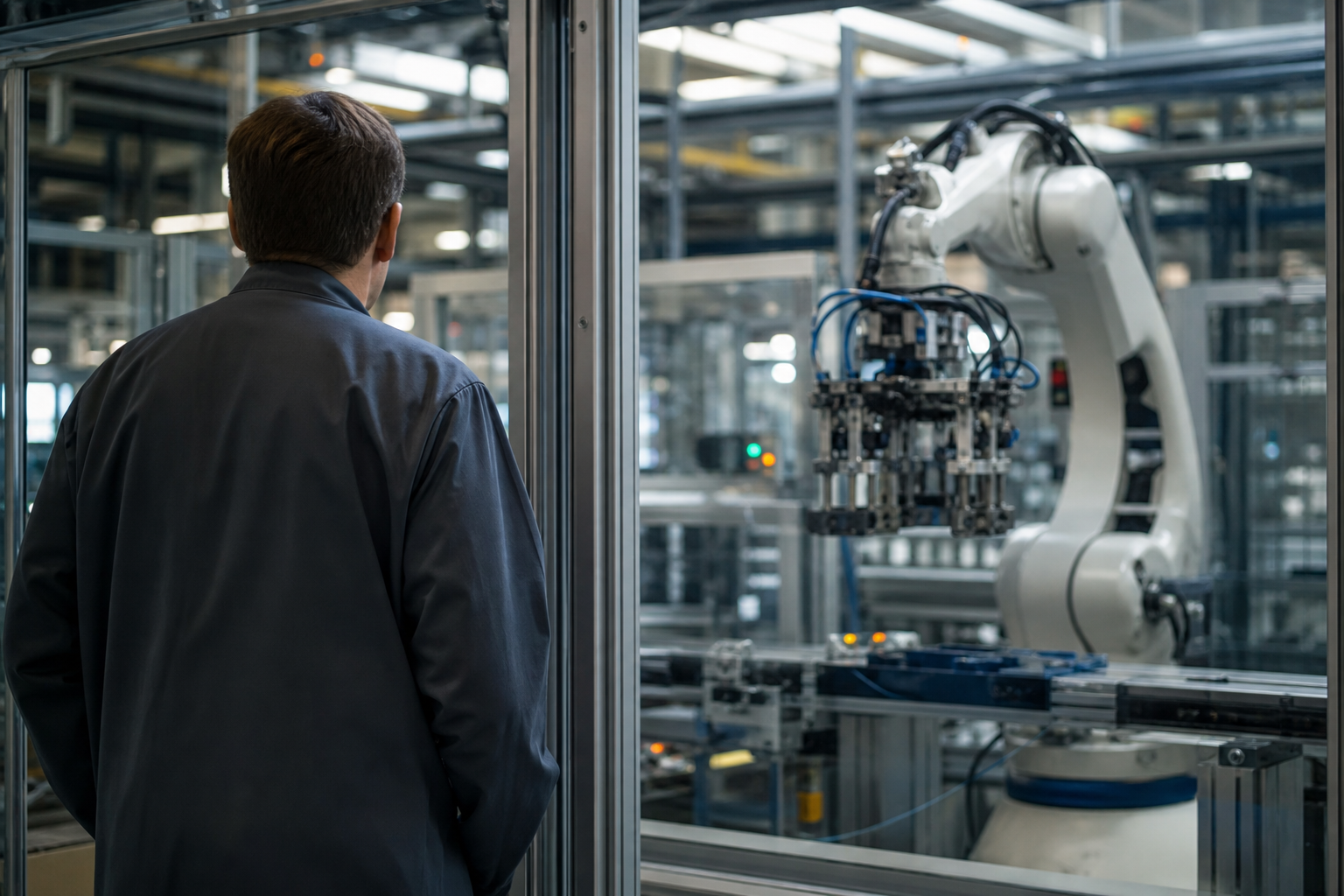
The policy question is straightforward even if the politics are not: should corporations be restricted from implementing automation technologies that directly displace existing workers? The recent facts surrounding General Motors sharpen the issue. At a flagship electric vehicle factory, GM laid off 1,300 workers. After those layoffs, the company installed robots. A US autoworkers union then warned that robot automation threatens factory workers’ future employment. That sequence does not settle every causal question. It does settle the moral and governing one. When a corporation restructures production in ways that foreseeably eliminate livelihoods, society is entitled to impose rules.
The strongest case against restrictions on automation is not frivolous. Opponents argue that robots, software, and labor-saving machinery raise productivity, help firms compete, and may create different jobs later. They note, correctly, that the GM layoffs occurred before the robot installation. They caution that if government blocks automation, companies could become less efficient, lose market share, invest elsewhere, or fail altogether. Some frame any restriction as a species of Luddism: an attempt to stop technological progress by freezing the economy in place.
Those concerns deserve an answer, not a slogan. A serious defense of restrictions cannot rest on nostalgia for every existing job description or on the fantasy that every production line should remain unchanged forever. Nor should it deny that technological progress can increase output. The question is whether private firms should be free to capture the gains from automation while offloading the losses onto workers, towns, public budgets, and social institutions. On that question, the answer is no.
The central mistake in the anti-restriction argument is that it treats displacement as a private business decision with only private consequences. It is not. When a major employer automates work that existing employees once performed, the costs spill outward. Workers lose wages, health coverage, bargaining power, and often the accumulated value of firm-specific skills. Families reduce spending. Local tax bases shrink. Public systems absorb higher burdens through unemployment insurance, retraining programs, Medicaid, housing instability, and other social supports. In economic terms, this is a classic externalization problem. In plain language, corporations book the savings while the public inherits the bill.
That is why the timeline in the GM case, while important, does not absolve the broader pattern. Critics of restrictions insist that because the 1,300 layoffs came before robot installation, automation cannot be blamed. But public policy is not a parlor game of temporal sequencing. If a company pares down its workforce and then installs robots in a flagship EV production facility, workers and their union are rational to see a direction of travel. The concern is future employment, not merely the legal classification of a single event. Modern automation often arrives through phases: restructuring, attrition, outsourcing, software integration, robotics deployment. To pretend that only a same-day replacement counts as displacement is to narrow the issue until it disappears.
The deeper issue is power. Corporations make automation choices according to return on investment, not according to employment stability, regional resilience, or fair distribution of gains. Markets do many things. They do not spontaneously protect communities from concentrated labor shocks. They do not guarantee that a laid-off assembly worker in an auto plant becomes a beneficiary of some future “higher-skilled job.” They do not ensure that electric vehicle production, robotics investment, and workforce transition happen on compatible timelines. The market signal says reduce labor costs if possible. It does not say preserve social cohesion.
This is precisely where the state must act. Not because government can or should design every factory floor, but because only public authority can set economy-wide rules that internalize social costs and discipline a race to the bottom. Restrictions on job-displacing automation are best understood not as a ban on innovation, but as a condition on how innovation is introduced. Corporations that want to automate functions performed by existing workers can be required to meet clear obligations: prove that displacement cannot reasonably be avoided, fund retraining before implementation, provide wage insurance or severance at meaningful levels, phase in technology through attrition where possible, bargain with worker representatives, and share productivity gains with the workforce that helped build the firm.
Opponents say this would make firms uncompetitive. That claim is always delivered with maximal certainty and minimal proof. Businesses are not weightless entities floating above any jurisdiction with labor standards. They operate within infrastructure systems, supplier networks, trained labor markets, legal protections, and public subsidies. In sectors like auto manufacturing and electric vehicles, these anchors are substantial. The same corporations that warn regulation will ruin them routinely accept public investment, tax credits, research support, land use approvals, and transportation infrastructure. It is entirely reasonable for the public to ask, in return, that automation not function as a one-way transfer from workers to shareholders.
History also cuts against the fatalism of the anti-regulatory view. Civilized economies have long restricted the terms under which firms pursue efficiency. We do not allow every cost-saving measure simply because it increases output. We regulate workplace safety, overtime, child labor, emissions, securities disclosure, and product standards. These rules did not end growth; they shaped it. The same logic applies here. The policy choice is not between progress and paralysis. It is between planned adaptation and unmanaged displacement.
The phrase “help people learn to swim” is often offered as a humane alternative to restriction. But that metaphor conceals a governance failure. Too often, workers are pushed into the water after the decision has already been made, after the jobs are gone, after the town has weakened, after the company has claimed the savings. Public retraining alone is not enough when private actors control the timing and scale of disruption. If society is expected to finance adjustment, society is entitled to govern disruption at the source.
This is especially urgent in the current transition to EV manufacturing, where public rhetoric celebrates the jobs of the future while automation threatens to narrow who actually gets to inhabit that future. A flagship electric vehicle factory should not become a model in which advanced production coexists with mass insecurity. If the clean-energy economy is to be politically durable, it must also be a labor-stable economy. Workers cannot be asked to applaud modernization that treats them as expendable inputs.
The resolution is therefore correct. Corporations should be restricted from implementing automation technologies that directly displace existing workers. Not because machines are evil, not because efficiency is irrelevant, and not because every current role can be preserved indefinitely. The case is simpler and stronger than that. When the gains of automation are private and the losses are social, public rules are not an intrusion. They are the minimum condition of fairness, order, and democratic legitimacy.
A society that can plan industrial policy, subsidize electric vehicles, and build the infrastructure of advanced manufacturing can also insist that robots and automation serve the public interest. That is not fear of the future. It is governance worthy of it.