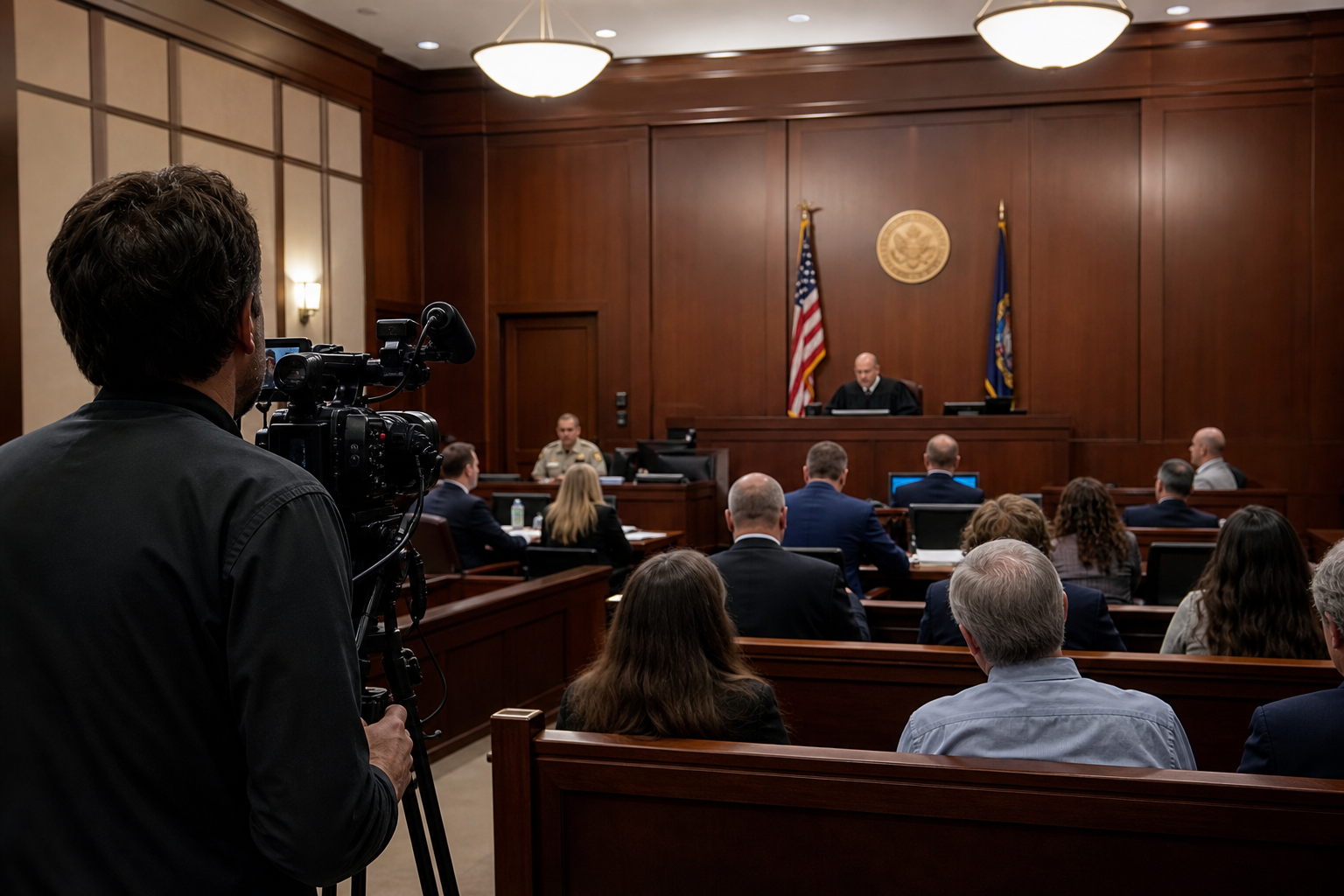
The case for cameras in courtrooms is not moral theater, and it is not a tech fetish. It is a basic cost-benefit judgment. Courts exercise state power over liberty, property, reputation, and sometimes life itself. When that power is visible, the public gets a better read on whether the system works. When it is hidden, everyone relies on secondhand summaries, selective excerpts, and institutional trust that has been wearing thin for years. On those facts alone, the default should be simple: cameras should be permitted in courtrooms during legal proceedings.
This debate matters because legal proceedings are where abstract rights become concrete outcomes. The recent Supreme Court ruling involving the Second Amendment and laws concerning habitual drunkards is a good example. Most people will never read the full opinion, let alone trace the historical arguments or doctrinal logic behind it. They will absorb the ruling through clips, articles, advocates, and commentary. That mediation is unavoidable. But there is a large difference between commentary built on an accessible primary record and commentary built on a room the public cannot see.
Cameras do not make the public legally sophisticated overnight. They do something more practical and more valuable: they widen access to the raw material. That lowers information costs. It gives journalists a fuller record, gives scholars and watchdogs something to review, and gives ordinary citizens a chance to see how judges, lawyers, and witnesses actually behave. In market terms, opacity creates monopoly pricing on attention and interpretation. If only a handful of insiders can observe the product, everyone else overpays for filtered versions.
The strongest argument against cameras is not crazy. Serious critics warn that a courtroom can become a stage. Lawyers may posture. Judges may grandstand. Witnesses may freeze or perform. Sensitive testimony can be amplified beyond what fairness requires. Jury contamination is a real risk. And difficult rulings, including cases touching constitutional rights or contested categories like habitual drunkards, can be clipped into partisan fragments that generate more heat than light. That concern deserves respect because incentives matter, and cameras change incentives.
But notice what follows from that argument and what does not. It supports rules. It does not support a blanket ban.
Every institution that handles consequential information has learned this the hard way. The answer to distortion is not secrecy. The answer is governance. Courts already regulate decorum, testimony, sealing, sidebars, evidentiary limits, witness protection, juvenile cases, and jury exposure. Adding camera protocols is administratively ordinary compared with the complexity courts already manage. Fixed camera angles, no close-ups of jurors, delayed broadcast where needed, limits in cases involving minors or sexual violence, judicial authority to suspend coverage for specific testimony, and clear pooling rules for media access are not utopian ideas. They are operational controls.
That is the key practical distinction in this debate. Opponents often present the choice as if it were between a pristine courtroom and a circus. In reality, the choice is between managed visibility and unmanaged opacity. Opacity has costs too, and they are not theoretical. It increases mistrust. It rewards selective leaks. It turns a few written descriptions into the entire market for public understanding. It leaves the most important state action in the country vulnerable to caricature by people who know their audience will never check the tape because there is no tape.
There is also a deeper efficiency argument. Courtrooms are public institutions, but for most citizens, attending proceedings in person is functionally impossible. Geography, work, disability, cost, and timing turn nominal access into elite access. Cameras convert formal openness into real openness. That is an unusually high-return reform. The infrastructure cost is small. Most courthouses do not need moon-shot technology; they need competent audiovisual systems and clear rules. Compared with the money governments spend on almost anything else in the legal system, this is cheap transparency.
Critics are right that not every broadcast creates understanding. Some viewers will watch for drama. Some outlets will mine clips for outrage. But this objection overstates the counterfactual. The public sphere already rewards simplification. The question is whether simplification should occur with a fuller evidentiary record or without one. If a Supreme Court ruling about the Second Amendment and historical restrictions on habitual drunkards is destined to become a public controversy, better that the underlying arguments, questions, and judicial reasoning be visible than left to dueling summaries.
There is a privacy objection that deserves separate treatment. Defendants, victims, and witnesses are not content. They are people whose worst day may become searchable forever. This is the hardest objection because the cost is borne asymmetrically. Public transparency produces diffuse civic benefits, while exposure can impose concentrated personal harm. The right response is not denial but targeting. Courts should permit cameras as a general rule while carving out strong exceptions for minors, sexual assault victims, confidential informants, certain family matters, and situations where live coverage would materially impair safety or testimony. A system that cannot distinguish among case types is a bad system. But a system that uses the hardest cases to justify secrecy in all cases is also a bad system.
Some proponents talk as if cameras will revolutionize civic life overnight. That is overstated. The payoff is more modest and more credible. Cameras improve accountability at the margin, improve the quality of reporting at the margin, improve public understanding at the margin, and improve trust at the margin. In institutions as consequential as courts, those margins matter. A few percentage points less distortion, a few percentage points more confidence, and a few percentage points more deterrence against misconduct are meaningful returns from a relatively inexpensive change.
There is also value in making judicial work legible. Many Americans think courts are either neutral machines or partisan black boxes. Both views are wrong. Legal proceedings are human, contested, procedural, disciplined, and often slow for reasons that become clearer when watched rather than described. Visibility can puncture both cynicism and romanticism. That is useful. Democracies function better when citizens can see the machinery that acts in their name.
The anti-camera position ultimately asks the public to trust that less evidence will produce better understanding. That is a hard sell. Yes, a camera can distort. But so can every intermediary standing between a courtroom and the public. The practical question is which system produces better average outcomes. A permitted-camera regime with guardrails beats a no-camera regime that relies on selective access and retrospective narrative control.
So permit cameras in courtrooms. Start with clear statewide rules. Protect jurors. Protect vulnerable witnesses. Preserve judicial discretion in exceptional cases. Use fixed feeds, neutral framing, and archival access. Then measure results and adjust. That is how competent systems improve: not by waiting for a perfect design, and not by banning tools because they can be misused, but by adopting low-cost reforms whose upside is large and whose downside is manageable.
Justice does not need better branding. It needs better observability. Cameras are not a cure-all. They are simply the cheapest, fastest, most workable way to let the public see more of what courts are doing when rights, including rights as contested as those in the Supreme Court’s habitual drunkards decision, are on the line. In a country this litigious, this polarized, and this distrustful, that is reason enough.