
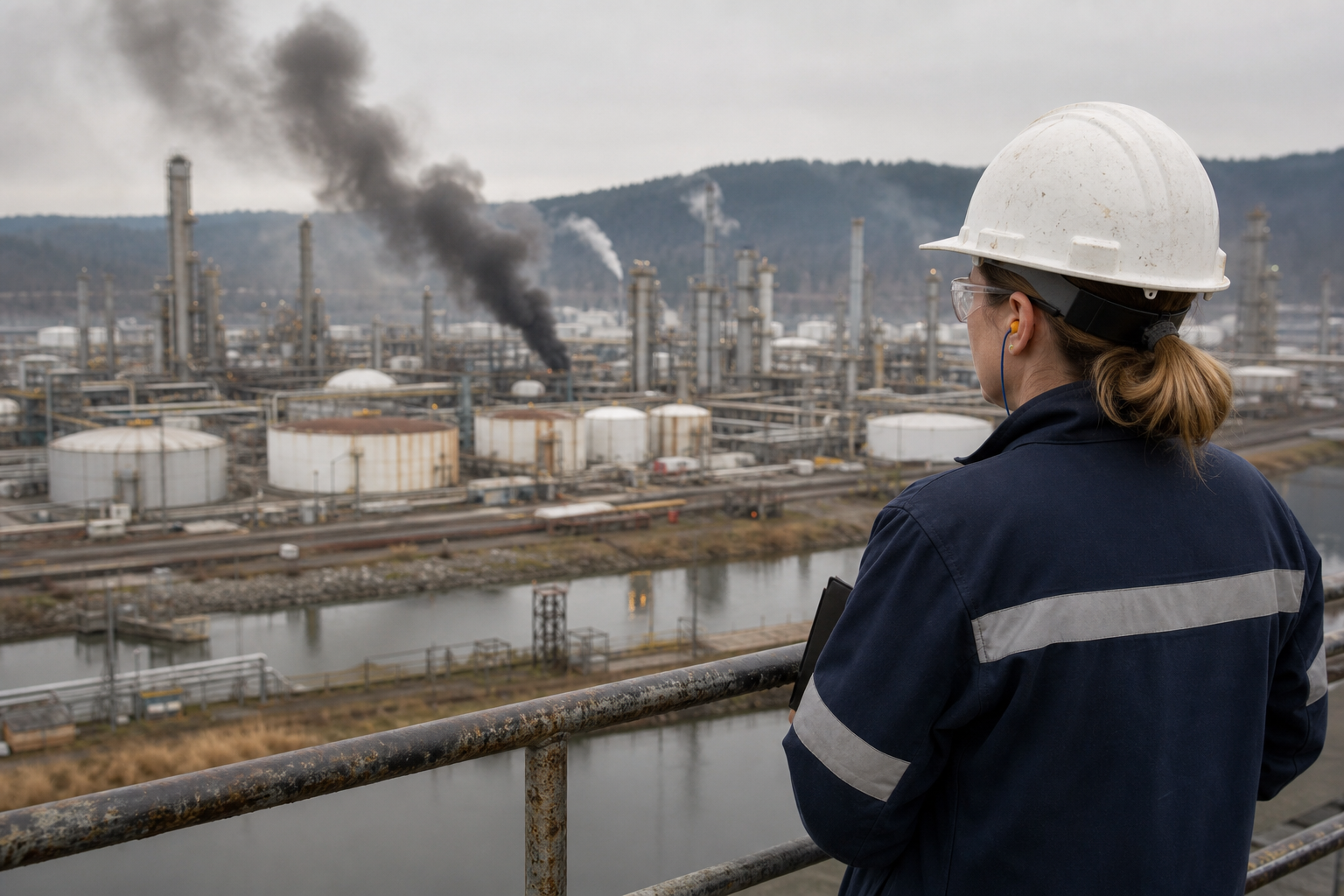
The question is not whether every federal regulation is wise, elegant, or perfectly enforced. It is whether the federal government should weaken chemical safety regulations at a moment when chemical accidents causing injuries or fatalities have risen by approximately 50 percent. On that question, the prudent answer is no.
Start with the stakes. Chemical safety rules exist because when hazardous substances are mishandled, the losses do not stop at a factory gate. Workers are burned or poisoned. Nearby residents inhale fumes. First responders are put at risk. Water and soil can be contaminated for years. The economic argument for deregulation is always immediate and legible on a balance sheet. The human cost of preventable accidents is delayed, dispersed, and often borne by people who never consented to the risk. That asymmetry is exactly why federal safety regulation developed in the first place.
The fact sheet is spare, but it tells us enough. Chemical accidents resulting in injury or death increased significantly in recent years. During an overlapping period, the Trump administration proposed changes that would weaken existing chemical safety regulations. We should be careful here. Overlap is not proof of causation. The rise in accidents cannot simply be pinned on a proposal that had not yet been fully realized. Critics of regulation are correct to insist on that distinction, and serious analysis should concede it.
But that concession does not rescue the deregulatory case. If anything, it sharpens the real question. When accidents are already rising under existing conditions, what reason do we have to believe weaker safeguards are the remedy? The strongest defense of weakening regulations is not the crude slogan that all rules are bad. It is the more sophisticated claim that current rules may be too complex, too prescriptive, poorly enforced, or misaligned with actual industrial practice; simplify them, the argument goes, and firms will comply more readily, innovation will improve processes, and safety may even improve.
That argument deserves respect because there are historical cases in which law became cluttered, obsolete, or administratively self-defeating. Not every line in the Code of Federal Regulations is sacred. Some rules do divert attention from results to paperwork. Some agencies do confuse activity with accomplishment. A mature defense of regulation must admit as much.
Still, one must judge a proposal by the policy category it inhabits and by the historical pattern surrounding it. Chemical safety is not a field where the consequences of error are trivial, localized, or easily reversed. It is a field shaped by disasters, by the repeated discovery that private incentives alone do not fully price catastrophic risk, and by the recurring temptation to treat prevention as excess until the next explosion or toxic release reminds everyone why the rules existed. In hazardous industries, regulation is rarely the product of abstract paternalism. More often, it is the statute book memorializing prior negligence.
This is where the anti-regulatory case often smuggles in an unwarranted assumption. It notes that accidents rose while regulations were in place, then suggests the regulations therefore failed and may properly be weakened. But a seatbelt that does not prevent every death is not thereby refuted. A fire code that coexists with fires is not therefore pointless. The existence of bad outcomes under a regulatory regime may show inadequate enforcement, aging infrastructure, workforce strain, corner-cutting, gaps in coverage, new industrial risks, or simple noncompliance. It does not naturally imply that fewer legal constraints will improve behavior.
Indeed, history more often points the other way. When oversight is visibly relaxed, actors throughout a regulated sector take signals from it. Not every company becomes reckless, but the margin for cutting corners widens. Investment in prevention is easiest to postpone because its payoff is the absence of a headline. Compliance staff lose internal battles. Maintenance is deferred. Emergency planning becomes more theoretical. The public is then asked, after the fact, to subsidize cleanup, medical care, litigation, and the restoration of trust. We have run this experiment many times in many sectors. It is almost never sold to the public as indifference to safety. It is sold as streamlining.
The constitutional and institutional case for federal involvement is also stronger than deregulators admit. Chemical hazards do not respect municipal boundaries. Supply chains cross state lines. Communities have unequal bargaining power, unequal technical expertise, and unequal willingness to trade safety for investment. A purely local or fragmented approach invites a race to the bottom, where one jurisdiction lowers standards to attract industry and others absorb the downstream costs. The federal role is not to manage every valve and pipe from Washington. It is to establish minimum national standards where the harms are interstate, severe, and prone to externalization.
That does not mean every existing rule should remain untouched. Here the best critique from Marcus Hale in the debate transcript usefully pressures complacency. If a regulation is so convoluted that it impedes compliance without improving outcomes, revise it. If a reporting requirement duplicates another, consolidate it. If performance-based rules can achieve the same or better level of safety than rigid design mandates, agencies should consider them. Reform is not heresy. But that is not the resolution before us. The resolution is to weaken chemical safety regulations, and in the context supplied, that means lowering the force of protections during a period of rising accidents.
This is precisely when institutional memory matters. The federal government did not acquire chemical safety authority because markets spontaneously demanded more friction. It acquired it because the costs of failure kept being socialized. Workers and neighboring families do not negotiate as equals with hazardous industry. They depend on law to set a floor below which profit-seeking cannot sink. Every durable regulatory institution in this space is built on the same lesson: after enough preventable harm, the public decides that some risks may not be treated as mere operating choices.
The deeper error in the case for weakening these rules is its confidence that the present moment is uniquely agile, uniquely capable of replacing law with smarter incentives before damage occurs. That confidence is ahistorical. Each generation imagines it can deregulate more cleverly than the last. Then the same old facts return, only with new stationery: accident reports, funerals, contamination maps, emergency appropriations, and retrospective promises to restore the safeguards that were dismissed as burdensome.
So yes, ask whether current chemical safety regulations are effective. Audit them. Simplify where simplification truly preserves protection. Enforce them where enforcement is lacking. Update them where industrial reality has changed. But do not weaken them simply because the status quo is imperfect. In dangerous industries, imperfect protection is usually the argument for better governance, not thinner guardrails.
The old mistake is not regulation. The old mistake is forgetting why it was written.