
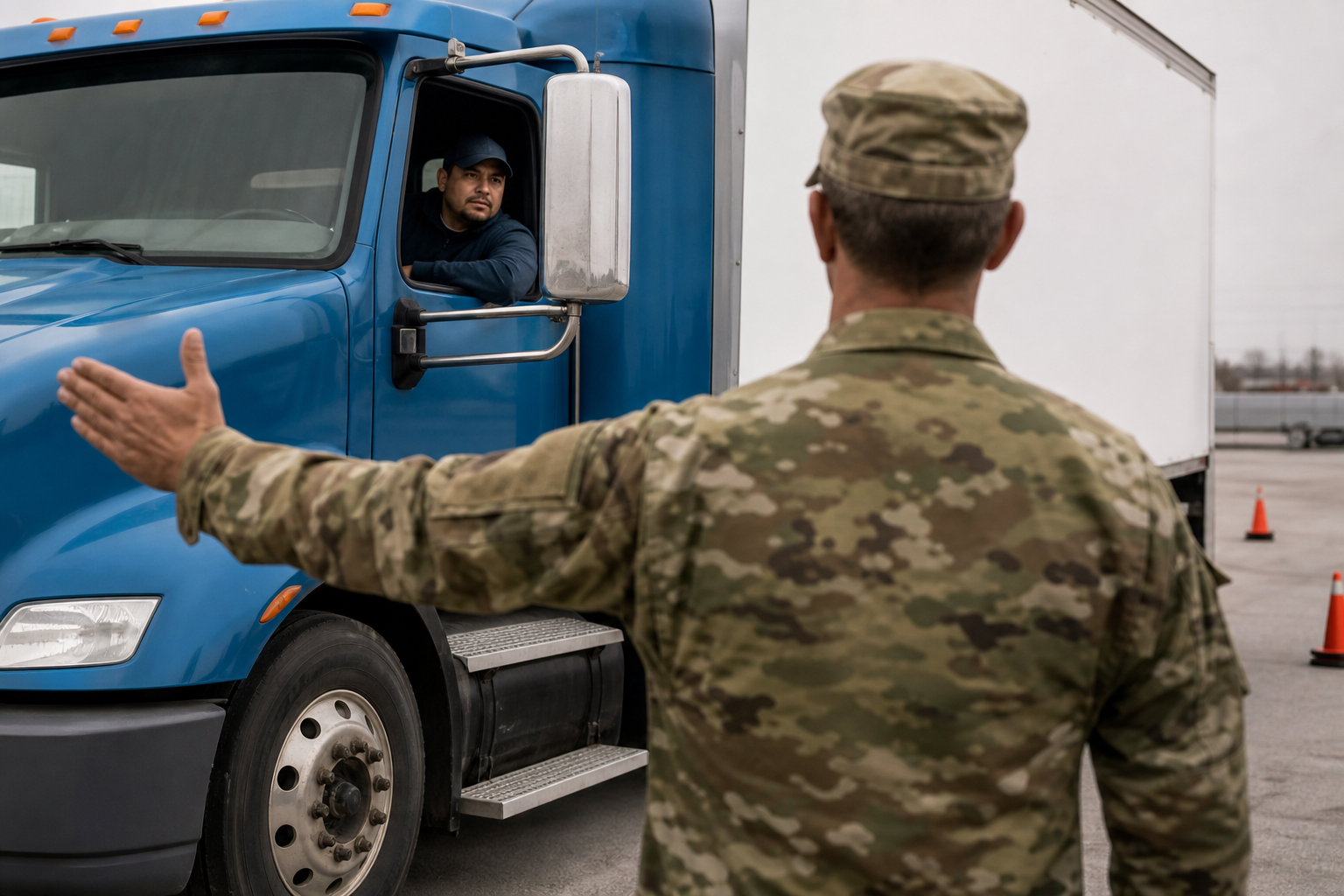
President Trump has said he will seek to replace immigrant truck drivers with veterans. The policy conflict is not abstract. It would affect immigrants who already hold commercial driver's licenses, including legal residents; it reportedly involves curtailing commercial licenses for certain immigrant populations; and it is justified in part by administration claims that some traffic crashes are attributable to immigrant drivers. In plain terms, the federal government would be using licensing power and labor preference to displace one set of qualified workers in favor of another.
That matters for three reasons immediately. First, commercial truck driving is not a symbolic occupation. It is a safety-sensitive job that moves freight, medicine, food, and industrial inputs across the country. Second, a commercial driver's license is not a casual credential. It is a state-recognized gateway to a livelihood, earned through testing, training, and compliance. Third, veterans are not props in a political messaging campaign. If government wants to support veterans entering the trucking industry, it should do so in ways that are lawful, evidence-based, and durable, not by stripping opportunity from legal workers on the basis of origin.
The strongest argument for prioritizing veterans deserves to be stated fairly. The nation owes veterans meaningful support when they return to civilian life. Many veterans have skills that can translate well to trucking, including discipline, logistics experience, and comfort with demanding operational environments. There is nothing wrong with targeted recruitment, transition assistance, apprenticeship programs, or hiring incentives that help veterans move into commercial driving. A serious pro-veteran agenda could include subsidized CDL training, streamlined credential recognition for military driving experience, mental health support, retention bonuses, and better scheduling standards so that trucking jobs are actually sustainable.
But that is not the same policy as the one on offer. The policy described in the fact sheet does not simply help veterans. It curtails commercial licenses for certain immigrant populations, including legal residents, while steering jobs toward veterans. That shift is not veteran support standing alone. It is government-sponsored displacement.
Defenders of the proposal make two main claims. One is pragmatic: veterans are a deserving demographic, and trucking is a practical path to work. The other is precautionary: if immigrant drivers are linked to some crashes, the government should act before harm grows. Both claims collapse on inspection.
Start with safety. If the administration has evidence that particular licensing pathways, training gaps, language comprehension failures, fraud patterns, or carrier practices are contributing to truck crashes, then regulators should address those problems directly. Audit the testing regime. Tighten verification. Enforce hours-of-service rules. Improve road sign comprehension standards where legally appropriate. Increase carrier accountability. Suspend or revoke licenses based on demonstrated noncompliance or unsafe driving history, regardless of birthplace.
That is what a safety system looks like. It identifies the risk factor and regulates it with precision.
What the administration appears to offer instead is attribution by group. Some traffic crashes have been attributed to immigrant drivers, but the public has not been shown a robust factual basis that immigrant status itself predicts unsafe operation. That distinction is everything. In a licensed profession, the government cannot leap from anecdote or perception to categorical labor exclusion without inviting foreseeable harm. The foreseeable harm here is not theoretical. Legal residents could lose the ability to work. Carriers could lose trained drivers. Freight networks could absorb disruption. And the public could be distracted from the real causes of truck crashes by a politically convenient story.
This is where the precautionary principle is routinely misunderstood. Precaution does not mean regulators may target a politically vulnerable group whenever risk is asserted. It means the burden of proof lies with those seeking to remove protections or impose harm in the name of preventing danger. Here, the government seeks to take away or curtail an earned license, and therefore a livelihood, from certain immigrant populations. That is coercive state action. It requires evidence, due process, and tailoring. You do not get to cite public anxiety, call it a safety concern, and bypass those safeguards.
The opposing side in this debate often says, in effect, that perception is enough. If voters or officials perceive immigrant truck drivers as risky, then policy may legitimately respond to that perception, even if the evidence is incomplete. That is an argument for panic government. It would allow licensing systems to become instruments of stereotype instead of competence. Today the target is immigrant workers with CDLs. Tomorrow it could be any group that becomes politically expendable after a high-profile accident.
There is also a basic fairness problem that should trouble anyone who believes in equal treatment under law. The fact sheet makes clear that legal residents are among those affected. These are not unauthorized workers outside the licensing system. They are people who obtained commercial driver's licenses and entered a regulated labor market through established channels. If the government now curtails their licenses or prospects not because of individualized misconduct but because of group identity, it is not rewarding merit or protecting the public. It is changing the rules after the fact, selectively.
Some critics of the proposal go further and say the federal government should never prioritize any group for private sector jobs. That libertarian objection contains a useful warning about labor market distortion, but it is too broad for this case. Government already shapes labor markets all the time through licensing, procurement, training subsidies, and veteran preference in defined contexts. The question is not whether government may act. The question is how it acts, against whom, and on what evidentiary basis. A veteran-support policy built on opportunity expansion can be justified. A veteran-support policy built on immigrant exclusion without robust proof cannot.
Nor should anyone accept the claim that because trucking companies and markets will adapt, the disruption does not matter. Commercial trucking is part of the country's economic circulatory system. Deliberately shrinking one segment of the qualified driver pool by curtailing immigrant commercial licenses is not a trivial nudge. It risks higher turnover, recruitment churn, regional shortages, and more pressure on carriers to fill seats quickly. In safety-sensitive industries, rushed replacement is itself a hazard.
The deeper issue is governmental character. Do we want a federal labor and licensing policy that treats veterans as deserving of serious investment, or one that treats veterans as the public-facing justification for punitive action against another workforce? Those are not the same thing. Veterans deserve better than symbolic preference tied to weakly supported scapegoating. Immigrant workers who followed the rules deserve better than collective suspicion. And the public deserves a trucking safety policy grounded in crash data, training quality, carrier enforcement, and individual accountability.
If the administration believes there is a problem with commercial driver safety, it should show its work. If it wants to help veterans become truck drivers, it should fund that pathway directly. What it should not do is collapse those two questions into a single blunt instrument that curtails legal residents' licenses and calls the result common sense.
A government committed to duty of care does not govern by hunch, resentment, or political aesthetics. It regulates dangerous work with evidence. It protects livelihoods with due process. It supports veterans with real programs, not borrowed jobs. On those standards, prioritizing veterans over immigrant workers for commercial truck driving positions, especially by curtailing licenses for certain immigrant populations, fails both the safety test and the fairness test.