
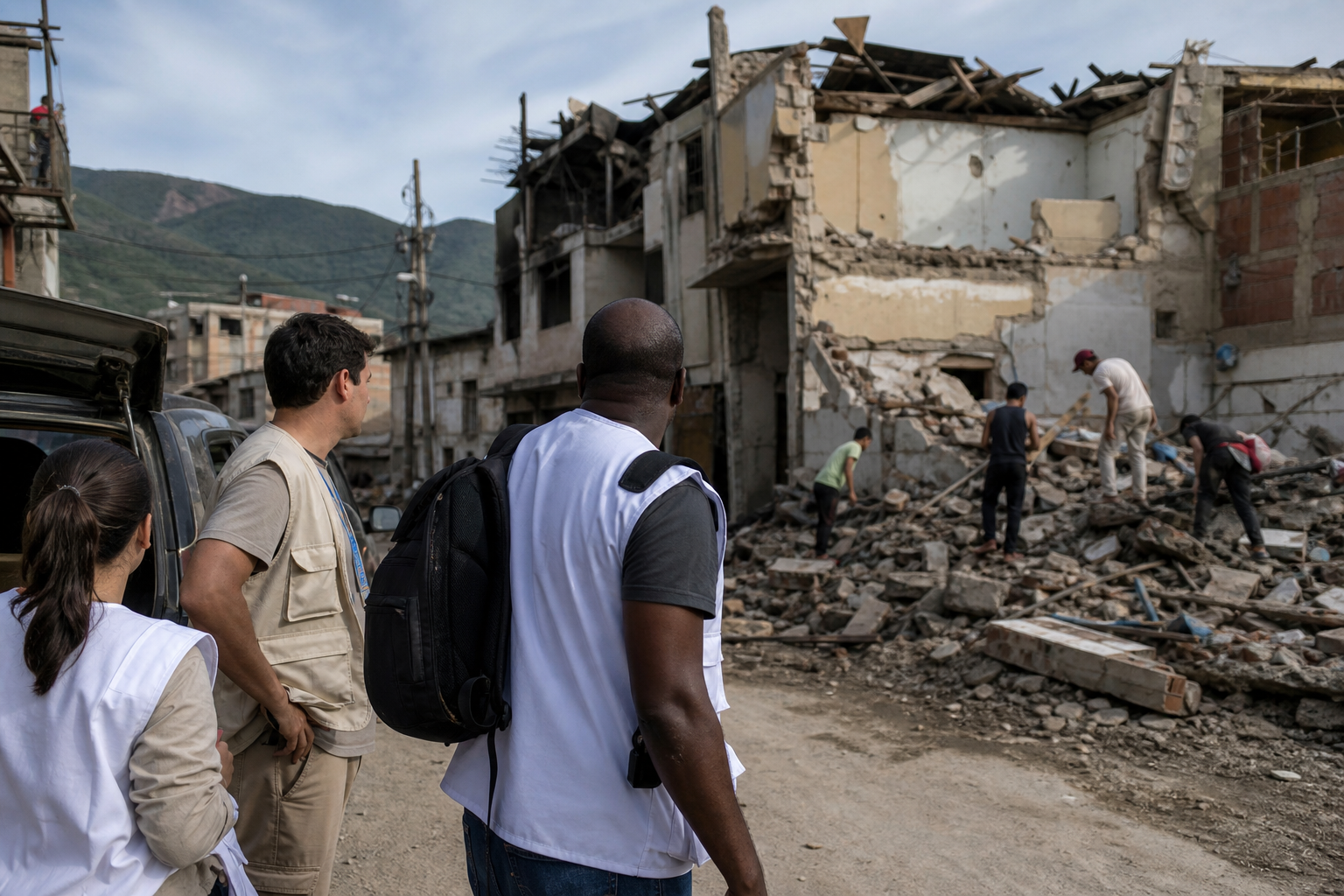
The argument over earthquake relief in Venezuela should begin with the facts that matter most. Two earthquakes above magnitude 7.0 struck seconds apart. They were shallow, which usually means more destructive shaking at the surface. At least 235 people are dead. At least 4,300 are injured. Rescue crews are still searching rubble for survivors.
That is not a context for procedural elegance. It is a context for speed.
The resolution says international aid organizations should be granted unrestricted access to Venezuela for earthquake disaster relief operations. That phrase, unrestricted access, triggered the central dispute of the debate. Critics warned about sovereignty, chaos, corruption, duplication, foreign influence, and the risk of an uncoordinated influx of NGOs, medical teams, search and rescue units, aircraft, and supplies. Those are not frivolous objections. In slower crises, or in long-term state-building exercises, they can be decisive.
But in a live mass-casualty earthquake response, they are outweighed by a simpler and harsher truth. Delay kills in a way miscoordination usually does not.
This is the core asymmetry the opposition never fully escaped. If you are trapped under concrete after two shallow major earthquakes, the relevant variable is not whether the paperwork was geopolitically tidy. It is whether heavy rescue equipment, trauma surgeons, field hospitals, blood products, water systems, satellite communications, helicopters, and logistics crews can get to you now. The value of each hour is not linear. It compounds. Survival odds fall. Crush injuries worsen. Infection risk rises. Roads clog. Hospitals overflow. Families scatter. Information degrades. The system loses coherence with every passing cycle.
That is why unrestricted access is not a slogan here. It is an operating principle for compressing time.
The strongest opposing argument was not the cynical one that all aid is a cover for influence, nor the abstract one about precedent. It was the pragmatic claim that unrestricted access could create a free-for-all. Multiple organizations might duplicate efforts, overwhelm airports, cluster in visible urban zones, and neglect remote communities. A sovereign government, opponents argued, is needed to coordinate equitable distribution and preserve basic order.
There is a real point embedded there. Disaster response does require coordination. Airspace has to be managed. Triage has to be disciplined. Supply chains have to be mapped. Search grids have to be assigned. No serious defender of unrestricted access should pretend otherwise.
But this concession does not save the anti-access case. It actually sharpens the pro-access one.
Coordination is necessary. Government bottlenecking is not.
The mistake opponents made, again and again, was treating unrestricted access as if it meant no coordination, no standards, no command structure, no local integration. It does not. It means no political choke point standing between willing responders and urgent human need. It means the Venezuelan state should not be able to slow-roll visas, block aircraft clearances, ration movement permits, monopolize customs inspection, or force all aid through patronage channels before rescue teams can move. You can have operational coordination without discretionary obstruction. In fact, the fastest disaster systems do exactly that. They standardize entry, deconflict missions, share situational awareness, and get assets moving, instead of waiting for a full hierarchy of permissions to catch up with the emergency.
This matters especially in Venezuela, where any added layer of administrative control carries an obvious risk. Not because one must assume bad faith in every act, but because disaster bureaucracy is fragile even in high-capacity states. In a country already under stress, friction is more dangerous, not less. The burden of proof should fall on anyone proposing gatekeeping. What exact restriction saves more lives than it costs in the first critical days after two major shallow earthquakes? The opposition never answered that with specificity.
Sovereignty also deserves a serious answer, because it was the most emotionally resonant objection after coordination. States do have rights. Borders do matter. No country should lightly normalize outside penetration under humanitarian language. But sovereignty is a tool for protecting a population, not a sacrament that outranks the population. When people are buried, bleeding, and cut off, the state vindicates its sovereignty by enabling rescue, not by preserving exclusive control over access points.
There is also a deeper practical reason not to fetishize control in this moment. International aid organizations are not abstractions. In earthquake response, they bring specialized urban search and rescue teams, canine units, structural engineers, burn and trauma care, portable operating capacity, shelter systems, water purification, and logistics expertise that many national systems cannot surge instantly at scale. The relevant question is not whether foreign responders are perfect. It is whether excluding or delaying them improves outcomes. In a mass casualty earthquake, the answer is almost always no.
Some critics raised corruption and diversion. Again, this is not imaginary. Aid can be misallocated. Supplies can be stolen. Visibility politics can distort distribution. But these are arguments for transparency, shared tracking, independent needs assessment, and multiple channels of delivery. They are not arguments for restriction at the border while survivors remain in rubble. If anything, a broader field of authorized humanitarian actors reduces the danger of single-channel capture. Monopolies are easier to divert than plural pipelines.
Others warned that unrestricted access could undermine local capacity or create dependency. That concern makes more sense in prolonged reconstruction than in immediate rescue operations. The resolution is about disaster relief after a double earthquake, not indefinite foreign management of Venezuelan society. In the rescue and acute medical phase, the highest form of respect for local communities is reinforcement. Local responders are almost always first on scene, but they are often exhausted, under-equipped, and overwhelmed. The moral and operational task of international aid is not to replace them. It is to multiply them.
That distinction matters because acceleration is not the opposite of coordination. It is the opposite of dead time. The anti-access side repeatedly treated caution as if it were neutral, as if every hour spent filtering organizations, negotiating modalities, and preserving administrative order had no body count attached. But the cost of delay in earthquake response is concrete. It appears in morgues, amputations, untreated infections, collapsed clinics, and families who could have been reached one operational cycle earlier.
In a disaster like this, abundance is not rhetorical. It is oxygen cylinders, trauma beds, diesel, excavators, antibiotics, field kitchens, temporary shelters, and bandwidth. Human flourishing begins with keeping people alive long enough to recover. That requires opening the system wide enough for capable actors to enter fast.
So yes, coordinate. Yes, map needs. Yes, share information, verify organizations, and route air traffic intelligently. But do not confuse those necessities with restriction. The right model is maximal humanitarian access with lean operational discipline, not state gatekeeping disguised as order.
Venezuela has been struck by two devastating shallow earthquakes within seconds of each other. Hundreds are dead, thousands are injured, and rescuers are still racing the clock under broken concrete. In that environment, unrestricted access for international aid organizations is not an indulgence, not an affront, and not a utopian fantasy. It is the fastest path to turning global capacity into saved Venezuelan lives.
When the ground has already failed, the worst remaining choice is to make help wait.