
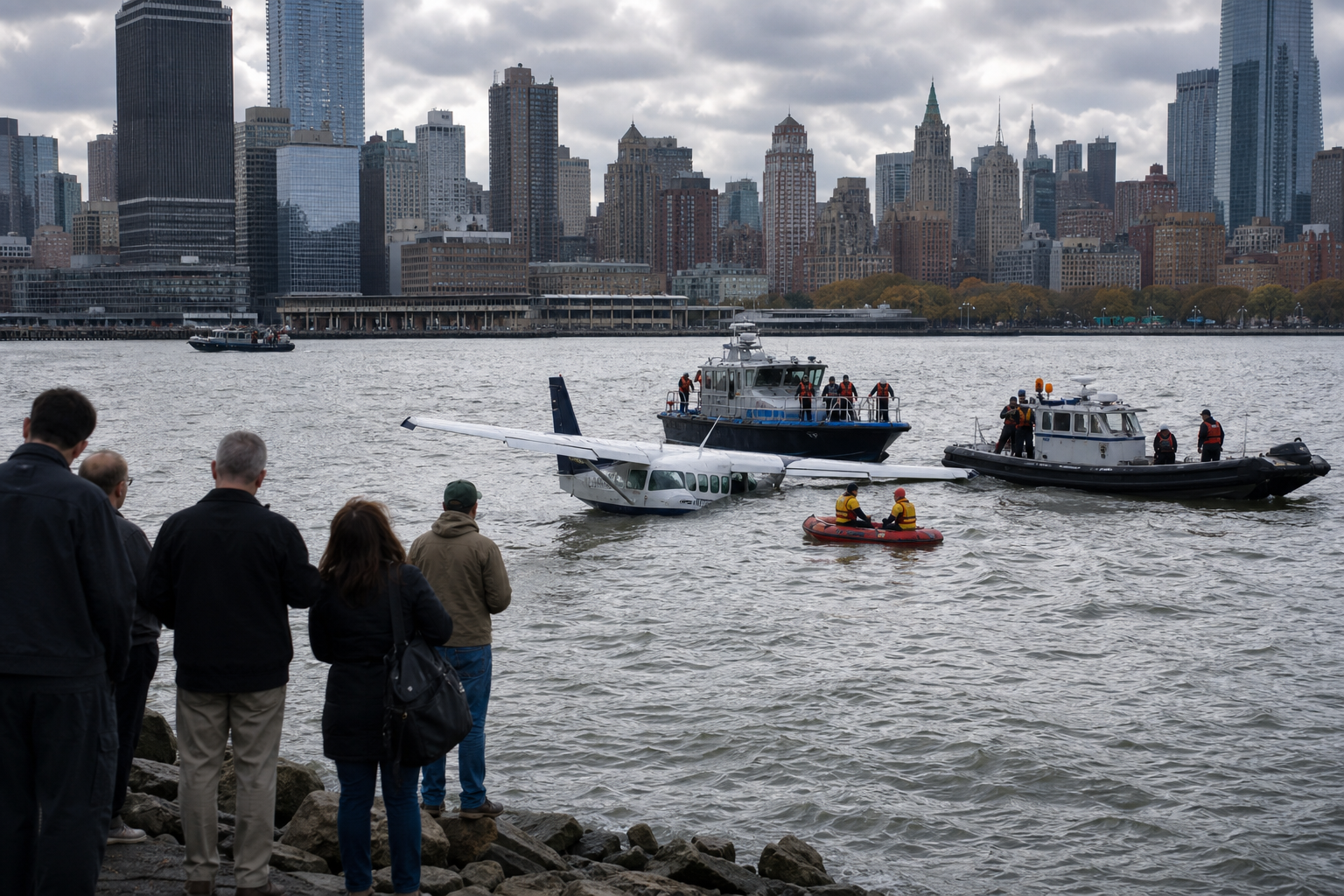
The case for prohibiting seaplane operations in urban waterways next to dense populations sounds stronger than the evidence actually supports. A Kodiak 100 made a hard landing in a river in Manhattan. Eight people were on board. Fire department units conducted the rescue. All eight occupants were removed. Two people sustained minor injuries. Six had no reported injuries.
That is the entire fact pattern we have, and policy should start there, not with disaster movie extrapolation. The stakes are real: public safety, emergency response costs, use of shared urban waterways, and whether cities should ban a niche mode of transportation because one incident ended with a successful rescue and limited harm.
My answer is no. A prohibition is the wrong tool for the problem as described.
The strongest argument for a ban is not crazy. Dense cities compress risk. A seaplane operating in a river near towers, bridges, ferries, recreational traffic, and crowded shorelines creates externalities beyond the passengers who bought the ticket. If something goes wrong, public agencies respond. Taxpayers bear part of the cost. The consequences of a bad outcome could be much larger than in a remote inlet. That is all true.
But “could be worse” is not enough to justify “must be banned.” In transportation policy, if hypothetical tail risk alone settles the issue, you ban helicopters over cities, fuel barges near apartments, sightseeing boats in busy harbors, and probably half the truck traffic entering Manhattan. Urban life runs on managed risk, not purified risk.
The anti-seaplane case leaned heavily on the precautionary principle, the idea that when stakes are high, the burden should fall on operators to prove safety. Fine. Put the burden on them. Demand data, certifications, route constraints, weather minima, pilot requirements, emergency float and egress standards, dispatch rules, and insurance adequate to cover public costs. But that still does not get you automatically to prohibition. It gets you to regulation calibrated to actual danger.
This is where pragmatism beats moral theater. The question is not whether seaplanes are perfectly safe. Nothing in an urban transportation system is. The question is whether the marginal safety gain from a ban exceeds the economic and operational loss from eliminating the activity, compared with cheaper alternatives like tighter operating windows, designated corridors, mandatory standby rescue coordination, congestion pricing for waterway use, and liability rules that stop operators from socializing their downside.
On the facts we have, the marginal gain from a ban looks small. One aircraft, eight people, two minor injuries, six uninjured, all rescued. That does not prove seaplane operations are harmless. It does show that this event was survivable and manageable inside the existing emergency system. Opponents call that proof of intolerable danger. More plausibly, it is proof that the risk, while real, is not obviously unmanageable.
A serious advocate of prohibition has to clear a higher bar than invoking catastrophe in the abstract. Show repeated incidents. Show that urban waterway operations have accident rates or consequence profiles that are materially worse than comparable aviation or marine activity. Show that targeted regulation failed. Show that insurance and operator capitalization cannot cover expected public costs. Show that the service delivers so little value that even modest risk is not worth carrying. None of that is in the fact sheet.
The pro-ban side also argued that emergency rescues themselves are evidence of an unacceptable burden on public resources. That point is emotionally potent and analytically weak. Fire departments respond to private mishaps constantly, from car crashes to construction accidents to boating incidents. The existence of public response does not by itself justify banning the underlying activity. If public burden is the issue, price it. Charge operators for specialized permits. Require rescue cost recovery. Mandate higher insurance floors. Make operators fund incident readiness the way ports, utilities, and hazardous industries fund oversight around their operations.
That is the market-friendly answer because markets are good at one thing regulators often avoid: forcing people to pay the real cost of what they do. If seaplane operations in a dense urban river truly impose large expected costs, proper insurance, permit fees, and liability exposure will make many routes uneconomic. The market will shrink or relocate the activity without a blunt ban. If, on the other hand, the activity can bear those costs and still survive, that is strong evidence the net benefit is not trivial.
This is also where some of the futuristic rhetoric from seaplane defenders needs trimming. Urban air mobility is not a magic phrase that wins the argument. Seaplanes are niche. Their economic upside in Manhattan or similar places is likely modest, concentrated in tourism, specialized transport, and premium convenience. I am happy to concede that the total public benefit is not enormous. But that concession cuts both ways. If the sector is niche, then regulators can manage it with highly specific rules at relatively low administrative cost. You do not need a sweeping prohibition to control a small market.
The better framework is simple. First, separate location risk from mode risk. A seaplane in a remote harbor is not the same policy problem as a seaplane in a crowded urban waterway. Second, price externalities instead of pretending they disappear under either deregulation or panic bans. Third, use least cost interventions first. Restrict takeoff and landing zones. Limit operations by weather, visibility, tide, and traffic density. Cap frequency. Require pilots with specialized urban waterway qualifications. Coordinate with harbor traffic control and emergency services. Impose strict maintenance and reporting rules. Fourth, revisit prohibition only if the data show persistent unpriced danger after these measures.
That last point matters because bans are not free. They destroy option value. Once government learns that every vivid incident should trigger a categorical ban, risk management gets replaced by symbolism. Operators stop investing in safer procedures because the political system will not reward incremental improvement. Public agencies lose the chance to learn which controls work best. And cities become less capable of handling novel or specialized transport uses in a disciplined way.
The Manhattan hard landing should lead to review, not reflex. Investigate what happened. Quantify response costs. Tighten standards if needed. Bill the operator for the public burden where law allows. If operations in a particular river segment are too dangerous under realistic constraints, close that segment. But do not leap from one hard landing with minor injuries to a universal rule that seaplane operations should be prohibited in urban waterways adjacent to densely populated areas.
That is bad economics and lazy governance.
The real divide here is between people who think risk is best handled by banning visible edge cases, and people who understand that prosperous cities work by measuring risk, pricing it, and reducing it with precise tools. One approach feels morally clean. The other actually scales.
Urban waterways should not be treated as free-for-alls, and seaplane operators should not get subsidized access to public rescue capacity. But the evidence in this case supports a harder bill, not a harder ban. If an activity can be made safe enough at reasonable cost, regulate it. If it cannot, the price system and targeted restrictions will tell you soon enough.
That is what serious public safety policy looks like when it is trying to solve the problem rather than perform concern.