
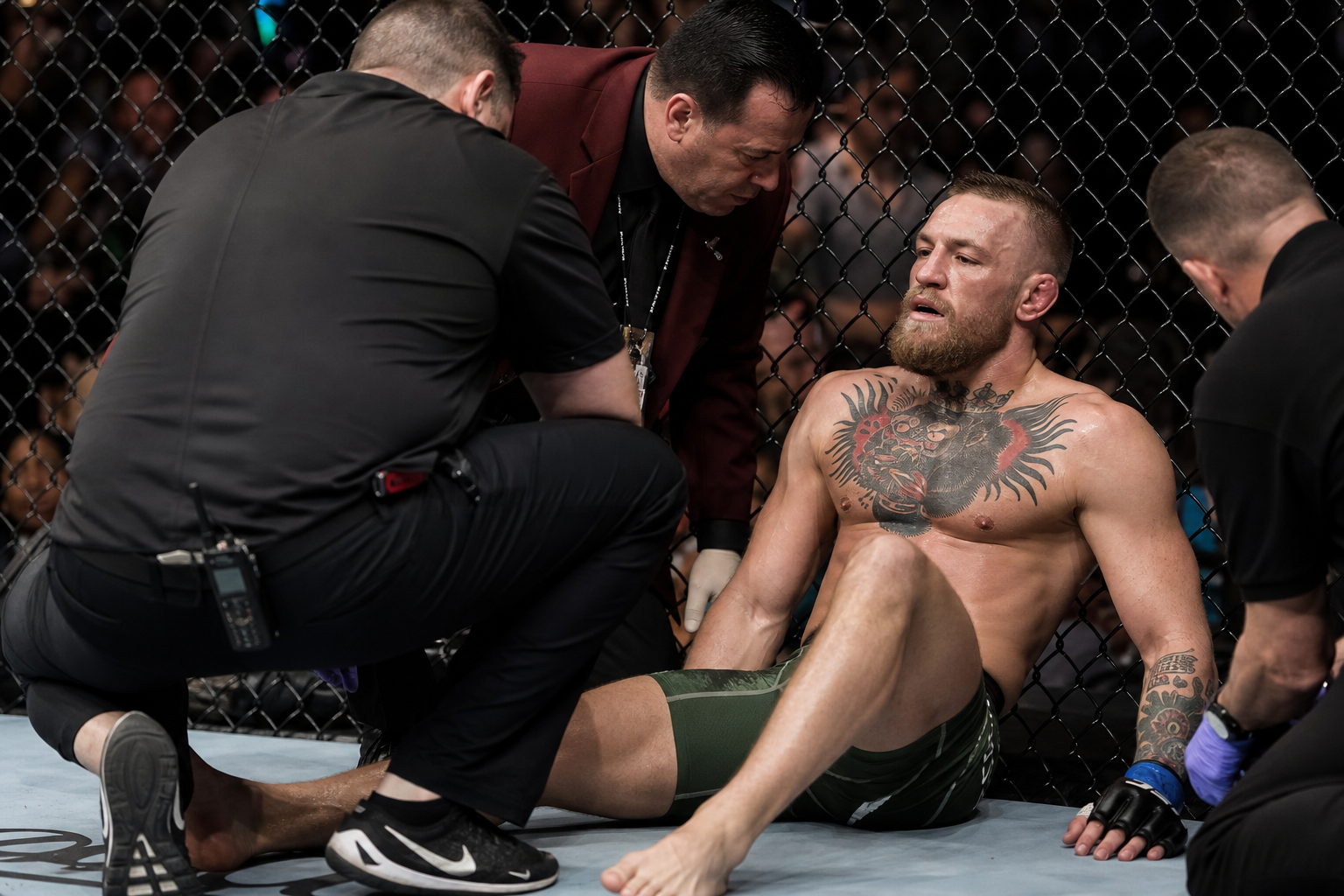
The question after UFC 329 is not whether Conor McGregor remains famous. He does. It is not whether people would still pay attention to a comeback. They would. The real question is narrower and more important: should the UFC keep building pay-per-view main events around a fighter whose last two UFC appearances ended in major injury stoppages, separated by five years, with the latest ending 67 seconds into Round 1 against Max Holloway at T-Mobile Arena in Las Vegas?
The answer should be yes, this is the end of McGregor’s era as a headlining fighter.
That is not a demand for retirement. It is not an insult to a historic star. It is a policy judgment about risk allocation, consumer protection, and the duty of care owed by a promoter that controls matchmaking, event architecture, and the sale of the main event itself. The UFC does not merely host combat. It markets trust. When it asks fans to buy a card built around one fighter, it is making an implicit representation that the fighter is a reasonable headliner, physically reliable enough to justify top billing, and capable of delivering a bona fide contest rather than a medically foreseeable collapse.
At UFC 329, that representation failed almost immediately. Multiple live reports said Holloway won after McGregor suffered an early right knee injury and could not continue. talkSPORT put the stoppage at 67 seconds and described an ACL tear as suspected, pending confirmation. This came in McGregor’s first UFC fight since his July 2021 leg-injury loss to Dustin Poirier. The exact diagnosis can wait for doctors. The policy issue cannot.
The strongest argument against treating this as the end of his main event era is obvious and not frivolous. McGregor still moves the market. Pre-fight betting coverage noted heavy public interest in him, even as sharper money moved toward Holloway. He remains one of the few names in MMA who can make a routine fight week feel like a global event. In a sport where stars are scarce and replacement stars even scarcer, there is a real institutional temptation to say: let him rehab, let the mystery rebuild, and sell one more blockbuster.
That argument deserves to be taken seriously because it identifies a genuine fact. Fame has value. Attention has value. In combat sports, narrative has always mattered alongside merit. It is also true that an injury loss is not the same thing as getting dominated over five rounds. A suspected ACL tear is not, by itself, proof that McGregor can never compete again. If the resolution were whether McGregor should be banned from fighting, the answer would be no. He is entitled to medical evaluation, rehabilitation, and, if properly cleared, the chance to choose his future.
But that is not the resolution. The question is whether the UFC should treat UFC 329 as the end of his era as a headlining fighter. On that question, the burden of proof runs the other way. Those who want to keep him in marquee slots must show more than residual celebrity. They must show that the foreseeable risks of another McGregor main event are acceptable for the fighter, fair to the paying audience, and consistent with the UFC’s own product integrity. Right now, they cannot.
Start with fighter welfare. McGregor is no ordinary veteran coming off a close loss. He is a 38-year-old former champion whose last two UFC appearances ended in severe lower-body trauma, one to the leg in 2021 and now an early knee injury in 2026 after a five-year gap between appearances. You do not need to overstate the medicine to recognize the pattern. The sport is violent, comeback timelines are uncertain, and lower-body injuries are especially consequential in elite striking and movement. The precautionary principle applies most clearly when the potential harm is not speculative but visible. If the UFC headlines him again before he proves durability in a lower-stakes setting, it is externalizing the risk of another breakdown onto McGregor’s body and the audience’s wallet.
Then consider consumer protection. Fans did not buy a main event at UFC 329 to watch an injury stoppage after just over a minute. No promoter can guarantee a full fight, and freak injuries happen. But there is a difference between unavoidable risk and known elevated risk. McGregor had not fought in the UFC since the Poirier injury loss. Pre-fight coverage also included rumors that he might withdraw after missed promotional appearances and afterparty changes, though he did arrive and compete. None of that proves bad faith. It does, however, deepen the concern about reliability. When a fighter’s profile guarantees top billing while his recent record guarantees uncertainty, the organization has a responsibility not to sell volatility as a premium product without accounting for the downside.
The betting story matters here too, not because bookmakers are moral authorities, but because markets can reveal what hype obscures. Heavy public support for McGregor coexisted with sharper movement toward Holloway. In plain language, the broad audience still believed in the brand; more disciplined money appeared to price in the risk. That is exactly when a promoter’s compliance instincts should sharpen, not dull. Consumer enthusiasm is not a waiver of institutional responsibility.
There is also a credibility problem for the UFC itself. A main event slot is the organization’s highest-trust placement. It tells viewers, broadcasters, and sponsors that this is the fight around which the night is built. If that slot becomes a nostalgia exemption for stars whose current athletic reliability is deeply uncertain, the company teaches the audience that it values recognizable names over deliverable competition. That may pay once. It corrodes over time.
Opponents will say this is too cautious, that combat sports are built on comebacks, that all fighters carry injury risk, and that denying McGregor headline opportunities strips him of agency. The first two points are true but incomplete. Yes, comeback stories are part of the sport. Yes, everyone is one bad step from disaster. But regulation exists precisely because some risks are foreseeable in degree, not just in kind. The UFC cannot eliminate danger. It can decide when danger has become too concentrated to justify premier placement. As for agency, McGregor retains it. He can seek a return, train, and fight again if medically cleared. What he is not entitled to is the company’s most valuable promotional slot.
That distinction matters. Saying his headlining era should end is not saying his career must end. It means any return should be earned under stricter conditions: medical transparency, a realistic recovery timetable, and a non-main-event bout that tests competitive readiness without forcing an entire pay-per-view to depend on an all-or-nothing body. That is not disrespect. It is proportionate governance.
The UFC has often acted as though star power can outrun fragility. Sometimes it can, for one cycle. But a sports organization that wants to be treated as a mature global brand cannot keep using the same answer to every Conor McGregor question. There was a time when his name alone justified anything. UFC 329 should close that chapter.
An era ends before a legend stops mattering. It ends when the institution’s duty to safeguard athletes and consumers becomes more important than indulging the possibility of one more giant gate. After Las Vegas, after Holloway, after another catastrophic lower-body failure in a McGregor comeback, that threshold has been crossed.
The UFC should honor McGregor’s legacy, not mortgage its judgment to it. Treat UFC 329 as the end of Conor McGregor’s headlining era, and if he returns, make it on terms that protect everyone involved.