
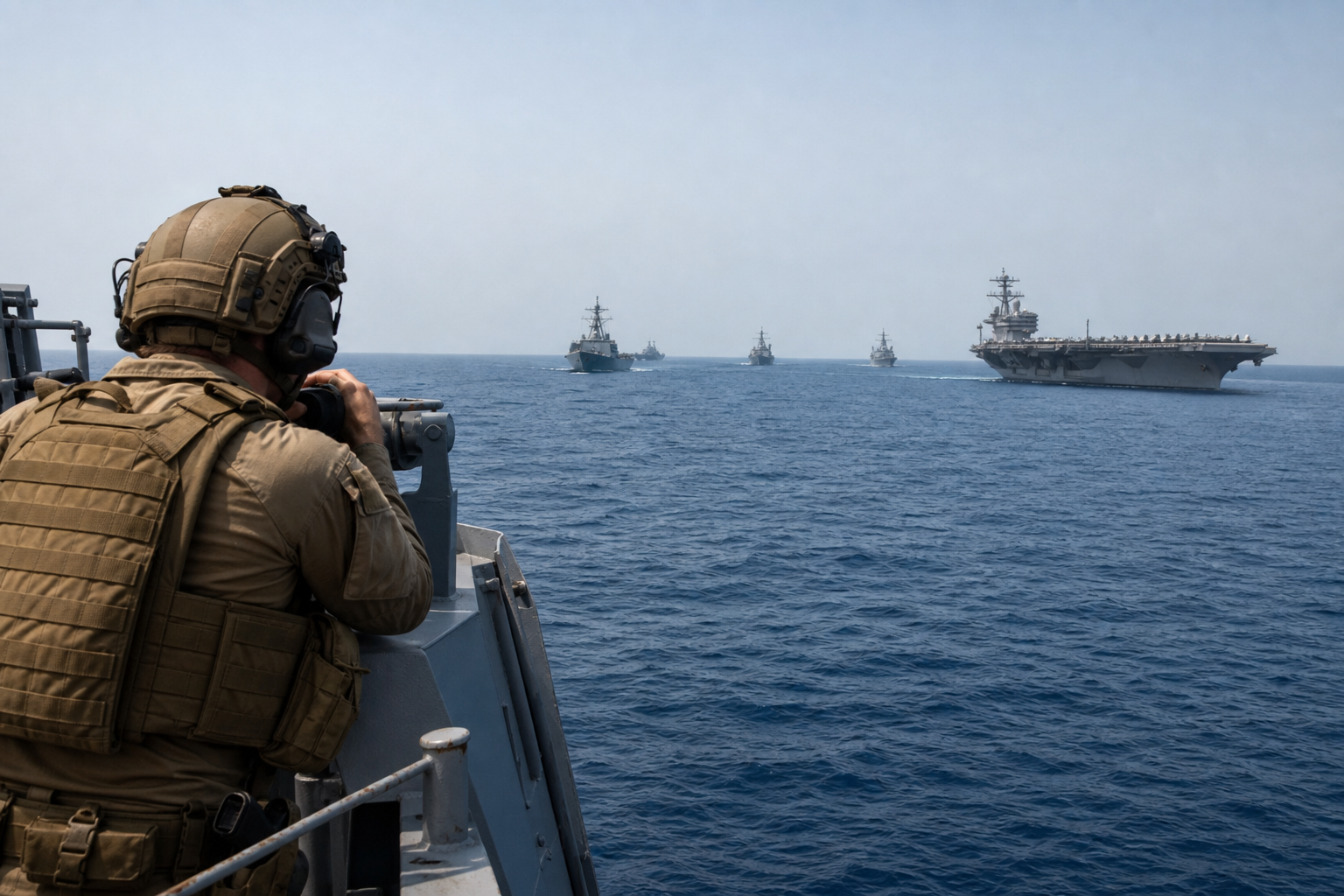
The Strait of Hormuz is not an abstract symbol. It is a narrow maritime chokepoint through which a large share of the world’s energy trade and commercial shipping moves. When Iranian forces announce that the Strait is closed, while Iran also attacks US allies in the region, attacks US bases in the region, and exchanges military strikes with the United States, the policy problem is concrete. A hostile state is signaling both intent and willingness to impose costs on global shipping. In that environment, the United States should use military force to ensure the Strait of Hormuz remains open to international shipping.
The key word is ensure. Not invade Iran. Not occupy the region indefinitely. Not launch a utopian war for regime change. Ensure. That means a bounded military objective: preserve freedom of navigation, protect commercial transit, deter mining, missile attacks, drone harassment, or interdiction, and impose costs high enough that closing the Strait becomes a losing proposition for Tehran.
The strongest objection is straightforward and serious. The United States itself says the Strait is open. Critics argue that using military force to open something that is still open risks turning a threatened crisis into an actual war. They warn, reasonably, that military action can escalate, that interventions often expand beyond their original rationale, and that a preventive use of force can create the very disaster it claims to avert.
That is not a frivolous concern. It is the best argument against the resolution, and anyone treating it lightly is not thinking clearly about costs. If the only facts were a rhetorical Iranian threat and no material attacks, restraint would deserve a longer runway. If shipping were flowing normally, insurance markets were calm, and no one were targeting allies or US forces, immediate military action would be hard to justify.
But those are not the facts we have. Iran did not just talk. It announced the Strait was closed, then launched attacks targeting US allies and US bases, and the United States and Iran exchanged military strikes. In other words, this is not a clean peace disturbed by speculative hawks. It is an active coercive campaign underway inside an existing confrontation. The fact that the Strait is still open is not evidence that the threat is imaginary. It is evidence that deterrence and defensive posture still matter, and may be barely sufficient.
This is where the anti-force case makes its biggest mistake. It treats “open today” as if it means “secure tomorrow.” It does not. In markets, everyone understands the difference between spot price and forward risk. The Strait’s current status is a spot condition. The relevant policy question is the forward curve: what happens next, given Iranian incentives, recent attacks, and the demonstrated willingness to escalate? If a ship can pass this morning but insurers, shippers, energy traders, and allied governments all must price in disruption tomorrow, then the waterway is already under partial attack. Risk itself raises costs.
A narrow shipping lane does not need to be physically blocked 100 percent of the time to damage the world economy. Mines, anti-ship missiles, drones, seizures, and harassment can reduce traffic, raise insurance premiums, reroute tankers, spike energy prices, and inject uncertainty into every downstream supply chain. The economic harm begins before total closure. That matters because the resolution is about ensuring openness, not waiting passively for the worst version of closure to occur.
The practical alternative offered by opponents is de-escalation first, force later if absolutely necessary. Fine in theory. Expensive in practice, if the adversary reads that as hesitation. Deterrence fails when threats are costless. Iran has every incentive to test how much pressure it can apply in the Strait of Hormuz before the US imposes meaningful consequences. If Washington signals that only a fully completed blockade will trigger decisive action, then Tehran gets a free option: ratchet pressure upward, harvest market panic, and dare everyone else to absorb the costs.
That is a terrible incentive structure. It rewards brinkmanship at one of the world’s most important chokepoints. And once the Strait is actually closed by mines, missile batteries, or sustained attacks on merchant shipping, reopening it becomes vastly more dangerous and expensive. You do not want to conduct clearance operations and convoy protection only after the enemy has had time to harden positions and after global markets have already convulsed. The cheapest war is the one you deter. The second-cheapest is the one you keep limited early.
None of this means writing a blank check for escalation. “Use military force” should be read narrowly and operationally. The United States should prioritize maritime patrols, convoy protection, suppression of immediate threats to shipping, destruction of assets directly used to close or attack the Strait, and clear communication of red lines. The goal is not national humiliation of Iran or maximal punishment. The goal is a stable shipping lane. Cost discipline matters. Mission creep is real. The United States should avoid broadening the campaign into an open-ended regional war unless Iran itself broadens it further.
That concession is important because the critics are right about one thing: there is no such thing as a free military action. There are real risks, real fiscal costs, and real possibilities of retaliation. But the relevant comparison is not force versus no cost. It is limited force now versus larger force later, plus a shipping crisis, plus a deterrence collapse, plus higher energy and transport costs imposed on allies and the global economy. On that comparison, limited force wins.
There is also a credibility issue that opponents underweight. Iran attacked US allies. Iran attacked US bases. The US and Iran exchanged strikes. If, after all that, Washington effectively communicates that even a declared closure of the Strait of Hormuz will not trigger a forceful effort to keep it open, then every ally, shipping company, and rival learns the same lesson: the United States protects freedom of navigation only rhetorically, and only after the costs have already exploded. That is not prudence. It is an invitation to repeated tests.
Some critics frame this as the US imposing its will on the region. That is too ideological for the facts at hand. The Strait of Hormuz is not a private quarrel. It is an international shipping artery. Ensuring access is not charity for oil companies, and it is not merely a favor to allies. It is enforcement of a basic rule of the trading system: countries do not get to choke global commerce by force whenever they want leverage.
The cleanest way to think about this is as an insurance problem. You do not buy fire insurance after the building is ash. You do not harden a network after the breach has already spread. And you do not wait for a vital sea lane to be fully shut before deciding whether to defend it. The United States should use military force to ensure the Strait of Hormuz remains open because the objective is limited, the stakes are high, and the likely cost curve gets worse with delay.
Restraint has its place. So does deterrence. In this case, restraint without credible force is not peace. It is outsourcing the timetable to Tehran. That is not strategy. It is just hoping the bill arrives later, with interest.