
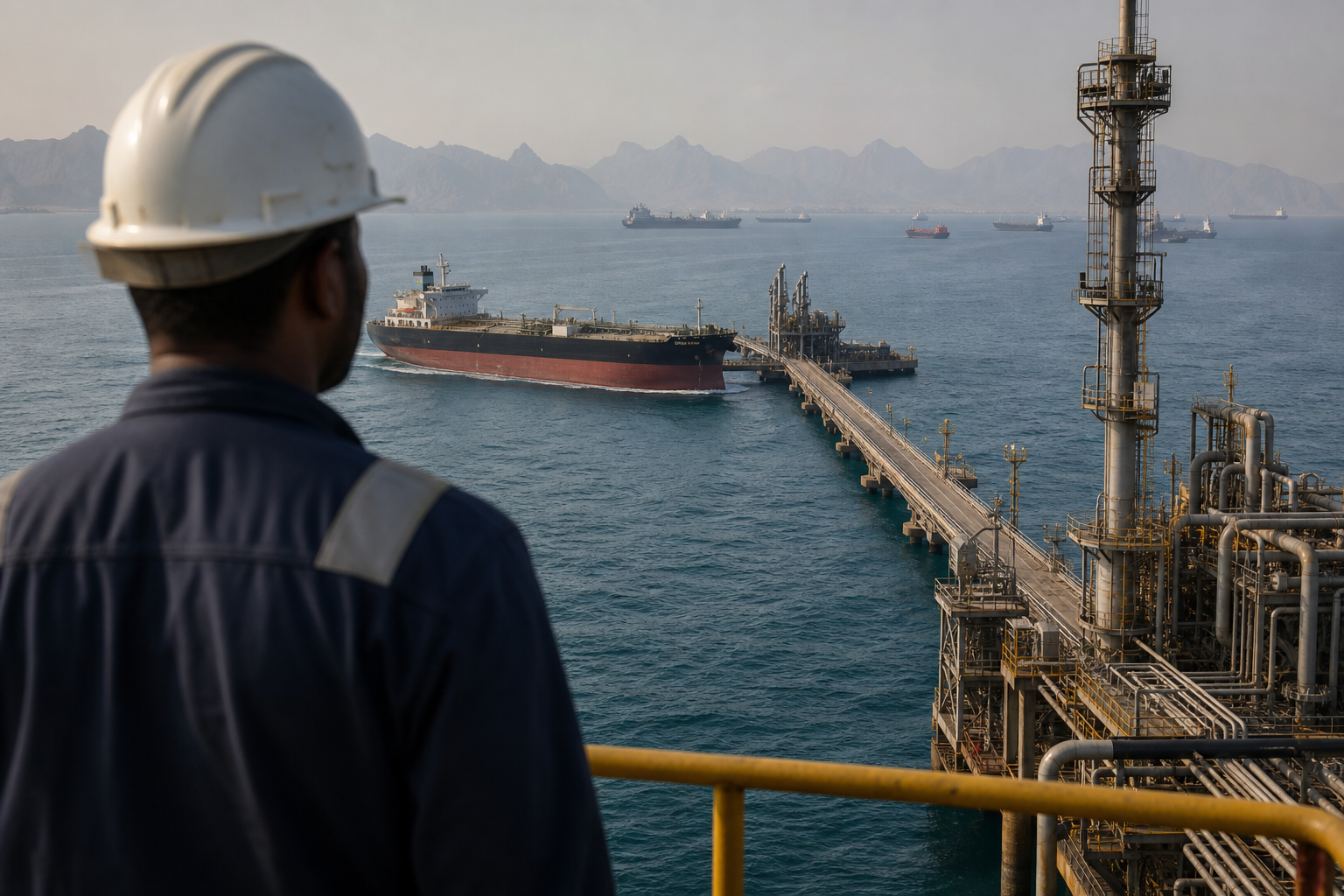
The policy question is not whether the Strait of Hormuz matters. It does. The question is whether the United States should wait for markets to solve that exposure on their own, or whether it should use economic measures now to lower the cost of the next disruption. On that question, the practical answer is yes, it should act.
The fact pattern is modest but sufficient. Iran has issued new demands related to the Strait of Hormuz. The strait remains subject to closure uncertainty. Market activity reflects those geopolitical developments, even if U.S. stock-index futures barely moved on Sunday. Investors are also waiting for inflation data later in the week. That combination matters. A chokepoint risk in a major oil transit lane does not need to trigger a stock panic to be economically significant. It only needs to raise the probability of a supply shock large enough to hit fuel prices, shipping costs, headline inflation, business planning, and consumer confidence.
The strongest objection is straightforward and serious: markets already price risk. If traders, refiners, shippers, and firms thought a sustained Strait of Hormuz closure was likely, prices would move more. Minimal futures movement suggests the market sees this as background noise, not a crisis. Government intervention, critics argue, would impose upfront costs for a low probability event, distort investment decisions, and create a new layer of subsidies, mandates, and political favoritism. That concern is not imaginary. Bad industrial policy is real. Rent-seeking is real. Washington is fully capable of spending a dollar to solve a 30 cent problem.
But that is not the end of the analysis. The relevant question is not whether markets can price next week’s risk. It is whether they can efficiently price and correct a chronic strategic vulnerability whose costs spill across the entire economy when it goes wrong. Those are different tasks.
A private firm can hedge some oil exposure. A shipping company can reroute some cargo. A refiner can diversify some supply. But no individual actor captures the full benefit of reducing the United States' aggregate dependence on the stability of one narrow waterway. If one company pays more today to build resilience, many of the gains from lower national inflation volatility and lower crisis exposure accrue to everyone else. That is a textbook underinvestment problem. You do not need to love central planning to recognize an externality.
This is why the pure market argument, while elegant, is incomplete. Decentralized adaptation is good at incremental optimization. It is weaker at paying now for protection against tail risk when the upside is broadly socialized and the downside can be deferred. Boards are rewarded quarter to quarter. Political coercion by a foreign chokepoint can accumulate for years before it shows up all at once in prices. By then, the expensive options are the only options left.
The best case for action is not maximalist. The United States does not need a giant command-and-control energy plan. It does not need to pretend it can abolish global oil interdependence. It should pursue targeted economic measures with high resilience payoff and tolerable distortion.
Start with diversification incentives that are technology-neutral where possible. If the objective is lower market dependence on Strait of Hormuz stability, then the metric is exposure reduction per federal dollar, not ideological loyalty to any one energy source. More domestic production can help at the margin. So can pipeline, storage, and refining flexibility. So can stronger incentives for non-oil transport, grid upgrades, and alternatives that reduce petroleum demand over time. The point is not to pick a utopian winner. The point is to widen the set of substitutes available during a supply shock.
Second, preserve and modernize strategic buffers. A strategic reserve is not proof against every disruption, and it can be misused for politics. Still, when designed as insurance rather than a campaign prop, buffer stock is cheaper than emergency improvisation during a live crisis. Insurance always looks wasteful right before you need it.
Third, de-risk supply chain adaptation rather than micromanaging it. Limited tax incentives, accelerated permitting for resilient infrastructure, and clearer investment rules can move private capital faster than broad mandates can. The government should shape incentives, not run tankers and refineries from Washington.
Fourth, price the trade-offs honestly. Some resilience measures will raise near-term costs. That is true. Redundancy is not free. But neither is dependence on a chokepoint repeatedly caught up in Iran-related threats. The real comparison is not intervention versus no cost. It is smaller predictable costs now versus larger chaotic costs later. If a modest package reduces the odds or severity of an oil price spike that would feed into CPI, transport, agriculture, and manufacturing, the macroeconomic payoff can be large relative to the budget line item.
The opposition also argues that intervention creates new dependencies and moral hazard. Correct, sometimes it does. A badly designed subsidy can lock in weak incumbents. A tariff can protect inefficiency. A politically allocated grant can become a permanent entitlement. That is why the resolution should be read carefully. It asks whether the United States should implement economic measures, not whether it should launch an indiscriminate industrial policy spree. The right answer is targeted, reversible, performance-based measures tied to a concrete strategic objective: lower sensitivity of U.S. markets to Strait of Hormuz instability.
Minimal stock-index futures movement does not refute that case. Equity futures on a Sunday are not a national resilience audit. Investors waiting on inflation data are actually a reminder of the transmission channel. Oil chokepoint risk matters because it can become inflation risk fast. It can tighten financial conditions without the Federal Reserve changing a word. It can tax households without Congress voting on anything. A narrow maritime passage thousands of miles away can still reach directly into trucking invoices, airline fares, fertilizer costs, and grocery receipts.
That is the practical stake. Dependence on Strait of Hormuz stability gives leverage to actors willing to manufacture uncertainty. Even if closure never fully materializes, recurring brinkmanship extracts a premium. The United States should want less of its economy priced off that premium.
The winning framework here is neither romantic faith in state planning nor religious faith in spontaneous market perfection. It is triage. Identify the concentrated vulnerability, estimate the spillover costs, and spend where the resilience return is highest. Some problems should be left to markets. This one should be partly pre-solved by policy because the downside is broad, the incentives to underprepare are strong, and the cost of late adaptation is usually far higher than the cost of early diversification.
So yes, the United States should implement economic measures to reduce market dependence on Strait of Hormuz stability. Not because every geopolitical threat demands intervention, and not because markets are stupid. Because in this case, a narrow, known chokepoint exposes the entire economy to an avoidable tax on stability, and buying down that exposure in advance is the cheaper play.