
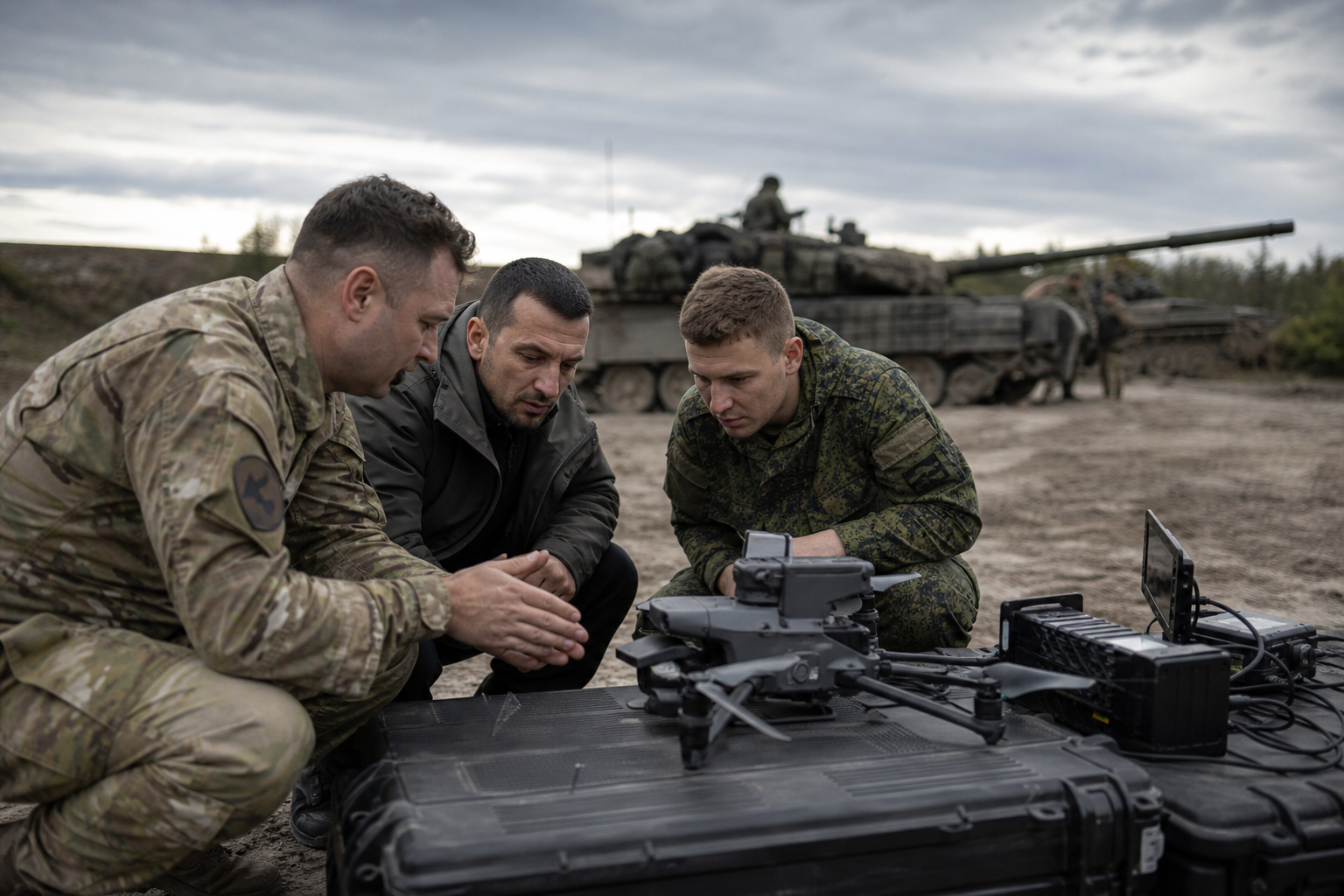
The argument over AI-enabled autonomous targeting technology is usually framed as an ethics seminar. In reality, it is a procurement and deterrence question with immediate battlefield consequences. A US company has signed a $100 million agreement to equip roughly 50,000 Ukrainian drones with AI target tracking. These are low-cost kamikaze-style unmanned aerial vehicles, and the software allows them to keep tracking targets without continuous human control. That is not a hypothetical future. It is a current operating model in a live war.
The resolution asks whether the United States should provide this kind of technology to allied nations engaged in active military conflicts. The practical answer is yes. Not because every autonomous function is inherently good, and not because markets are morally pure, but because denying allies a proven, scalable capability in the middle of a war is usually the more expensive, bloodier, and strategically dumber option.
Start with the arithmetic. A $100 million package for 50,000 drones works out to about $2,000 per drone in AI capability, if one simplistically spreads the contract value across the fleet. Even if the real cost structure is more complex, the broad point stands: this is cheap relative to the military value created. If autonomous target tracking raises mission completion, reduces jamming vulnerability, or cuts the need for scarce human pilots and data links, the return on investment is enormous. In modern war, low-cost attritable systems matter because they impose repeated costs on the enemy without consuming your own elite manpower or exquisite platforms.
That matters especially for allies like Ukraine, where volume, adaptation, and resilience count more than doctrinal purity. A drone that can continue tracking after communications degrade is not some futuristic luxury. It is an answer to electronic warfare and bandwidth limits. A low-cost loitering munition with onboard AI can compress the sensor-to-shooter timeline. It can keep pressure on armored vehicles, artillery, logistics routes, and field positions. It can make every truck movement, every radar emission, every exposed asset more expensive for the aggressor. If your ally is in an active conflict now, not in a tabletop exercise next year, those margins are not abstract.
The strongest objection is not that the capability lacks utility. Even critics concede that. The strongest objection is that autonomous targeting lowers the threshold for force, blurs accountability, and risks normalizing delegated lethal decision-making. That concern is real. Once software can track and prosecute targets with less continuous human supervision, errors scale faster. Proliferation risk is also real. So is the possibility that a company sees a warzone as a product demo.
But those objections do not actually get you to a workable policy of abstention. They get you to governance. The relevant comparison is not between a clean world without autonomous military AI and a contaminated one with it. That world is gone. The actual comparison is between American-aligned systems with constraints and auditability, versus a global market where allies buy whatever they can get, from whoever will sell it, under worse standards and less leverage. If the United States refuses to provide autonomous drone targeting technology, allies still face active threats. They will still seek drone AI, automated tracking, computer vision, and navigation aids. The only thing Washington controls by abstaining is whether it has any say over design standards, export terms, software updates, logs, geofencing, target classes, or post-strike review.
This is where some advocates overreach. The case for provision is strong, but the case for a laissez-faire free-for-all is not. The market is good at speed, iteration, and price discovery. It is not good at internalizing geopolitical externalities on its own. A pure company-to-country pipeline may be fast, but if you want sustained alliance advantage rather than opportunistic sales, the United States should set guardrails. The mistake made by anti-provision critics is assuming that because guardrails are necessary, provision should stop. The mistake made by some maximalist proponents is assuming that because speed matters, guardrails are dispensable.
The right framework is responsible acceleration, but with the emphasis on acceleration. Provide the technology, because delay imposes visible costs on allies in combat. Wrap provision in a narrow policy architecture that preserves operational tempo. Require defined target categories, clear human authorization at mission assignment, logging for after-action review, remote disable capability where feasible, and contractual limits on retransfer. Prioritize systems that improve target tracking, navigation resilience, and terminal guidance against lawful military objectives, rather than unconstrained target selection. In plain English, help allies hit the right military targets more reliably under jamming and battlefield friction; do not pretend every edge case can be solved by a conference in Geneva before the next artillery strike lands.
Another objection says this creates dependency on a US vendor and erodes allied sovereignty. Also fair, up to a point. Vendor lock-in is a real problem in defense tech. But dependency is not binary. In wartime, an ally often prefers high-performing dependency to low-performing autonomy. The solution is not to withhold capability. The solution is modularity, licensing terms, training pipelines, and diversified suppliers across the allied industrial base. If the United States is smart, it will use provision to build interoperability and local maintenance capacity, not permanent customer captivity.
There is also a broader strategic payoff. War is an information and adaptation contest. Real-world deployment teaches what works under electronic attack, camouflage, bad weather, and damaged infrastructure. That feedback loop matters for US readiness too. If American companies can harden autonomous drone targeting systems through allied use, the United States gains learning, industrial depth, and deterrent credibility. Critics call that cynical. It can be cynical if done carelessly. It can also be common sense. Better to learn with allies under shared security aims than to learn later, slower, and at higher cost when US forces face the same threat set.
The core issue is not whether autonomous targeting is morally uncomplicated. It is not. The core issue is whether the United States should help allies in active combat use a capability that is already here, already scaling, and already changing the economics of warfare. On that question, yes is the serious answer.
Refusing to provide AI-enabled autonomous targeting technology will not halt the spread of military AI. It will simply shift procurement to less trusted suppliers, reduce US influence over battlefield norms, and leave allies fighting with inferior tools against enemies who are not pausing for our discomfort. In strategy, the expensive mistake is often confusing unease with restraint and restraint with control.
The United States should provide the technology, quickly, selectively, and with enforceable conditions. That is not utopian and it is not reckless. It is what works.