
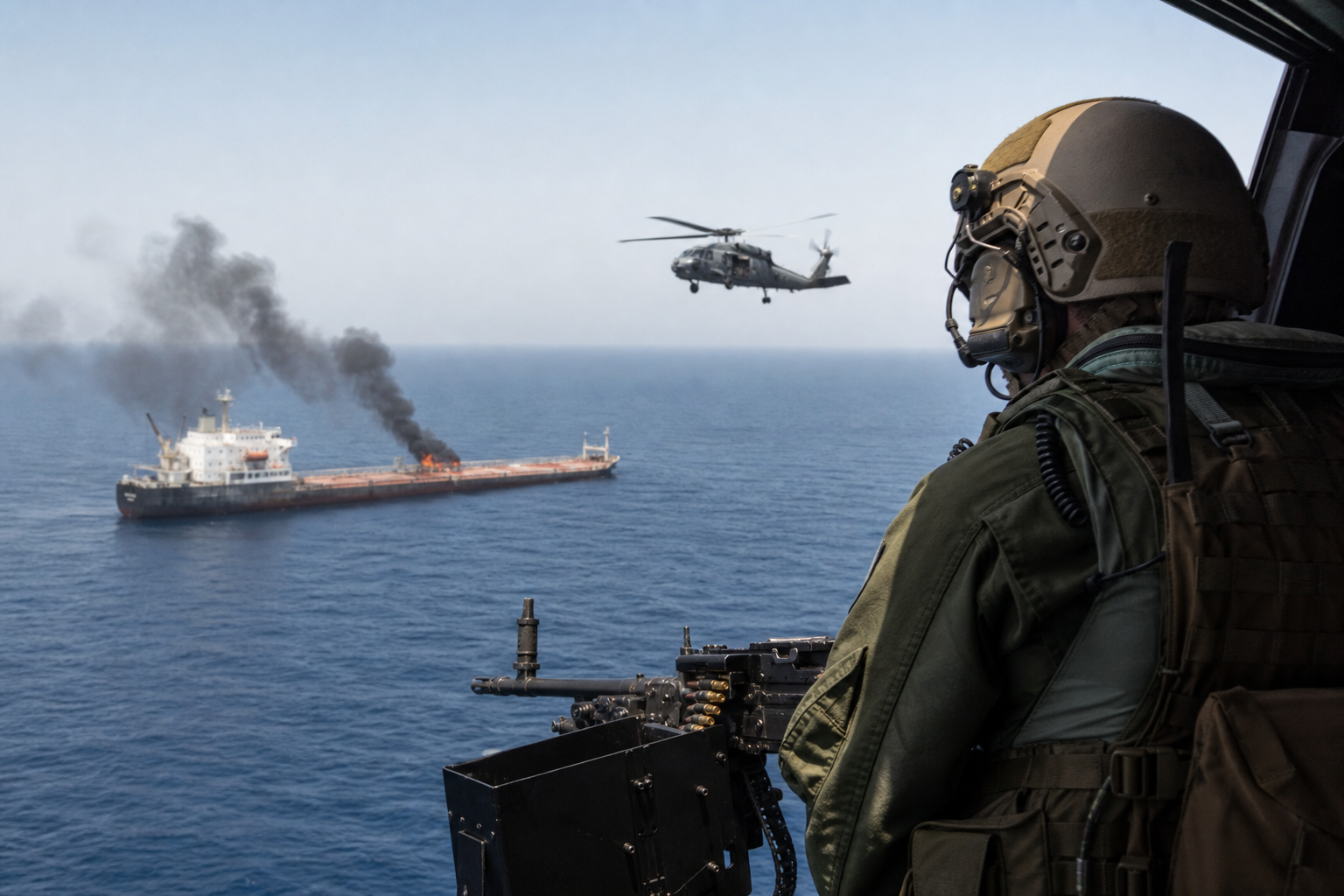
The United States should conduct military strikes against Iran in response to attacks on commercial vessels, not because military action is costless or cathartic, but because the security of major shipping lanes is a public good that only organized state power can provide. The fact pattern here is narrow but consequential. The United States launched military strikes on targets in Iran. Explosions were reported in southern Iran. President Trump said the strikes were a response to a bombing of ships and attributed that ship bombing to Iran. The bombing occurred one day before the US strikes. Iranian officials then announced intentions to retaliate.
Those last two facts are the ones critics seize on. They argue that because Iran has threatened retaliation, the strikes were self-evidently a mistake. They call this a spiral, a tit for tat, a predictable escalatory trap. That objection deserves serious treatment, because any state considering the use of force must account for second-order effects, not just immediate symbolism. But it does not follow that because retaliation is possible, or even likely, military strikes are unjustified or strategically unsound. If that were the standard, any state willing to threaten response would acquire a veto over enforcement at sea.
The central issue is not whether conflict carries risk. Of course it does. The central issue is whether attacks on commercial shipping can be allowed to stand without imposing larger, more diffuse, and more enduring costs on the international system. Commercial vessels are not incidental targets. They are part of the infrastructure of global commerce. When ships are bombed, the damage does not stop with a hull breach or an insurance claim. It spreads through shipping rates, war risk premiums, delivery delays, energy markets, commodity prices, and the basic credibility of maritime security. These are classic system-wide costs, distributed across actors who cannot individually solve the problem.
That is why the strongest case for strikes is institutional, not emotional. Individual shipping companies cannot deter a state or a state-backed actor. Flags of convenience cannot secure sea lanes. Ad hoc private precautions do not restore order when an attack is intended to test whether the commons still has a guardian. This is a domain in which fragmentation fails. Someone must set and enforce the rule that commercial vessels cannot be attacked with impunity. In practice, that means states, and in this case the United States.
The best opposing argument, articulated throughout the debate, is empirical and pragmatic. It says the United States already struck Iran, and Iran immediately announced retaliation. Therefore, the strategy has already failed. According to this view, additional military strikes would merely deepen instability, raise the risk of broader war, and make shipping less safe rather than more safe. This argument has surface force because it uses the available facts honestly. It does not deny the attacks on vessels. It questions whether force produces the deterrent its advocates promise.
But the conclusion is too quick. An announced intention to retaliate is not proof that deterrence has failed. It is proof that coercion has begun and that the target is signaling resolve. States routinely threaten response after being struck; this is a political necessity, not a strategic verdict. Deterrence is not measured one day later by the rhetoric of injured officials. It is measured over time by whether attacks continue, whether their scale changes, whether the aggressor bears real costs, and whether maritime behavior becomes more constrained. To infer from an immediate threat of retaliation that force can never work is to confuse the opening move with the end state.
There is also a conceptual weakness in the de-escalation camp. It often treats restraint by the United States as de-escalation in the system as a whole. That is not necessarily true. If one side attacks commercial vessels and the other side declines to impose meaningful costs, the result is not peace. It is a transfer of initiative. It tells the aggressor that disruption is affordable. It socializes the costs of insecurity across everyone else, ship owners, crews, insurers, importers, consumers, and allied states, while privatizing the tactical advantages for the attacker. That is not stability. It is permissive disorder.
None of this means every strike is wise, or that maximal escalation is desirable. A serious pro-strike position must concede what the critics get right. Attribution matters. Objectives matter. Proportionality matters. The United States should not confuse punishment with strategy. Military strikes are justified only insofar as they serve a defined public purpose: protecting commercial shipping, restoring deterrence, and reducing the expected frequency of future attacks. Symbolic violence without a broader enforcement architecture would be inadequate. So would a one-off attack that is not integrated with naval protection, diplomatic signaling, alliance coordination, and clear thresholds for further response.
Still, those implementation cautions strengthen rather than weaken the underlying case. If the problem is systemic, then the answer must be systemic. A bombing of ships is not merely an insult to be answered; it is a challenge to the governed order of trade. The correct response is not passivity disguised as prudence, but calibrated state action robust enough to change the aggressor's cost-benefit calculation. That is what critics of the strikes tend to omit. They are right that force has costs. They are wrong that the alternative has none. Tolerated attacks on commercial vessels create a standing invitation to repeat them.
There is a broader strategic principle here. The global economy depends on a layer of security that markets consume but do not generate. Open sea lanes, predictable transit, and credible protection for civilian shipping are public goods. They are underprovided unless a capable state is willing to organize, fund, and, when necessary, enforce them. In moments like this, the choice is not between a dangerous state and a peaceful vacuum. It is between a deliberate enforcement mechanism and unmanaged coercion by whoever is willing to use violence first.
The fact sheet does not tell us everything, and responsible commentary should not pretend otherwise. But it tells us enough to identify the governing logic. Commercial vessels were bombed. The United States attributed responsibility to Iran and struck targets in Iran. Iran threatened retaliation. That sequence does not eliminate the case for military action. It defines the seriousness of it. If attacks on shipping trigger no sustained consequence, the lesson learned across the region will be that maritime coercion works.
The United States should therefore conduct military strikes against Iran in response to attacks on commercial vessels, provided those strikes are disciplined by a clear objective and embedded in a broader security strategy. The purpose is not revenge. It is rule enforcement in one of the few arenas where failure to act predictably multiplies costs for everyone else. A state that cannot defend the arteries of commerce cannot plausibly claim to uphold order. And in the Persian Gulf, as in every contested maritime corridor, order will not emerge spontaneously from restraint alone.