
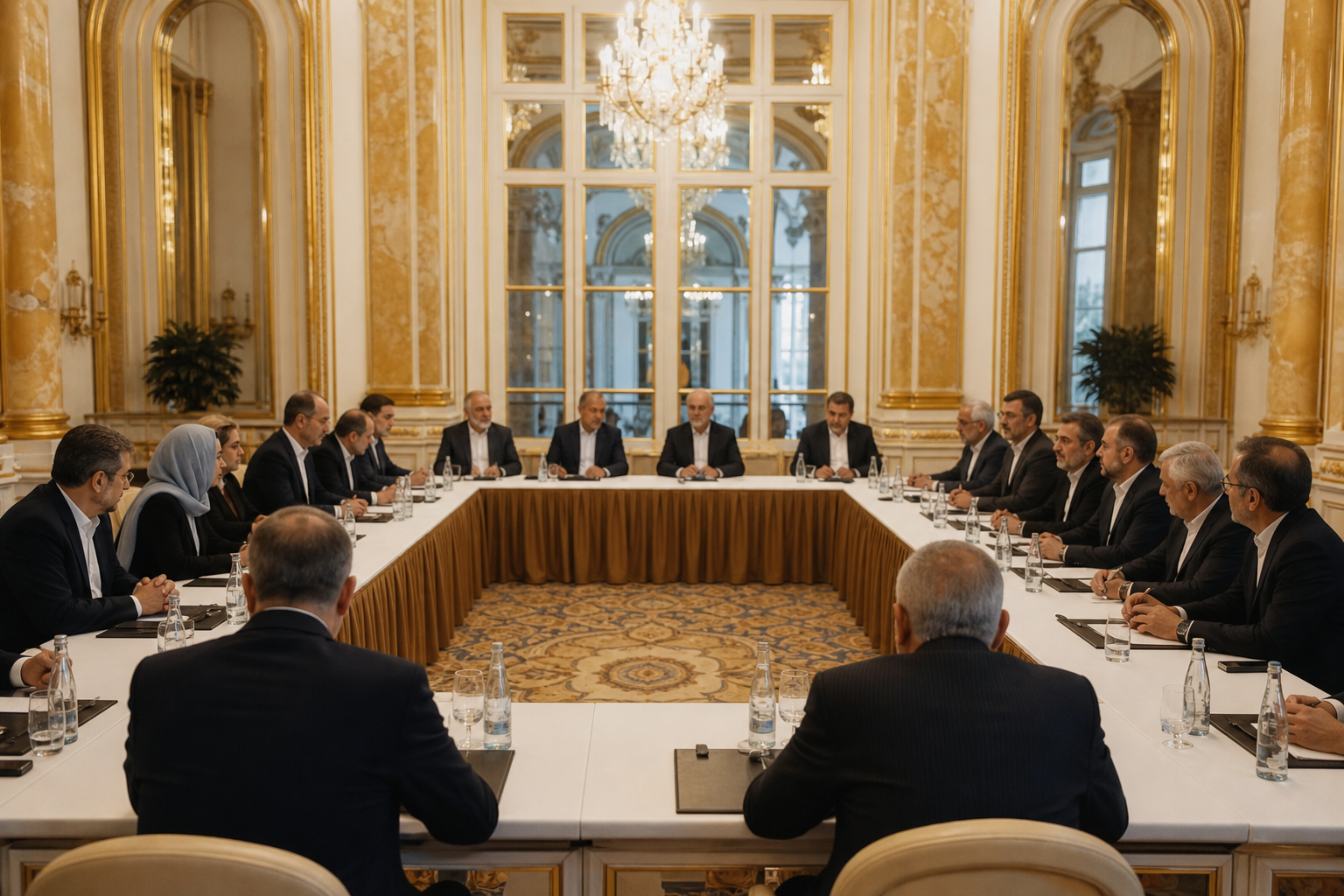
The United States should pursue a comprehensive diplomatic agreement with Iran within the proposed 60-day timeframe. Not because deadlines are magical. Not because any agreement is preferable to no agreement. And not because early progress in Switzerland guarantees success. The case is stronger, and more serious, than that. When the first round of US-Iran talks concludes with mediators describing progress, when the parties have already reached an agreement committing themselves to a final deal, and when the agreed window is 60 days, the responsible course for Washington is to organize the full capacity of the state around converting that opening into a durable diplomatic settlement.
The stakes are immediate and structural. A comprehensive diplomatic agreement with Iran is not a symbolic gesture. It is a mechanism for reducing uncertainty, constraining escalation, and replacing unmanaged confrontation with negotiated rules. In foreign policy, as in domestic governance, fragmentation is expensive. Drift creates room for miscalculation. Rival bureaucracies, regional spoilers, domestic posturing, and external opportunists all thrive when central direction is weak. A defined 60-day negotiating period is therefore not merely a clock. It is a coordination device. It compels decisions, concentrates expertise, and clarifies accountability.
That is the core divide in this debate. Some critics object to the pace. Others object to the premise. The pace critics warn that a compressed timeline could produce a shallow or defective bargain. The premise critics suggest the process is somehow illegitimate because there was already an agreement last week committing the parties to reach a final deal within 60 days. Both objections deserve a serious answer.
Start with the concern about speed. It is the strongest opposition argument because it identifies a real danger. A comprehensive agreement with Iran would necessarily involve technical complexity, verification questions, sequencing disputes, and political sensitivities. A 60-day framework can create incentives to settle language before substance is secure. History offers enough examples of rushed diplomacy to make caution rational. If all one knew were that talks began on Sunday, took place in Switzerland, and concluded with vague statements of progress, skepticism would be understandable.
But skepticism is not strategy. The relevant choice is not between a perfect process with unlimited time and an imperfect process with urgency. The actual choice is between pursuing a comprehensive diplomatic agreement within the agreed 60-day timeframe and allowing momentum to dissipate into a familiar landscape of delay, recrimination, and rising risk. In that real-world comparison, the case for disciplined pursuit is overwhelming.
A deadline does not require superficiality. It requires state capacity. This is the point too many deadline skeptics miss. If Washington treats the 60-day period as a public-relations countdown, the critics will be right. If it treats the period as a mandate for intensive, centralized execution, the deadline becomes an asset. Diplomatic negotiators, intelligence analysts, sanctions experts, regional specialists, legal teams, and verification professionals can be integrated around a single national objective. Complex agreements are not made safer by vagueness or drift. They are made safer by concentrated expertise, rigorous review, and coherent command.
The anti-deal critics make a different argument. They claim the existence of a prior agreement to reach a final deal suggests the outcome is pre-cooked, manipulated, or imposed by elites. This is a familiar populist suspicion of diplomacy itself: if negotiators are narrowing disputes behind closed doors, then the public must be getting swindled. But this objection mistakes structure for illegitimacy. Of course serious diplomacy involves frameworks, commitments, and pre-negotiated parameters. That is how states reduce transaction costs and avoid endless circular bargaining. No major agreement emerges from pure improvisation. The fact that there was an agreement last week before these talks is not evidence of fraud. It is evidence that the parties have moved from tentative contact to organized negotiation.
Indeed, the prior commitment to a final deal is precisely why the United States should proceed. Once a framework exists, refusing to pursue it does not restore some mythical condition of leverage or purity. It merely weakens Washington’s credibility, empowers hard-liners on every side, and signals that even modest diplomatic progress cannot survive domestic second-guessing. Governments do not build durable international outcomes by fetishizing indecision. They do so by translating preliminary commitments into enforceable arrangements.
There is also a narrower, more transactional critique: perhaps a deal in 60 days would be a bad deal, and perhaps extending the timeline or pursuing a phased approach would better protect US interests. This sounds prudent, but it hides a recurring policy failure. In practice, “more time” often means less discipline. “Phased” often means fragmented. And fragmentation in high-stakes diplomacy is rarely neutral. It lets each actor defer costs, free-ride on others’ restraint, and externalize the risks of non-resolution onto the broader international system.
A comprehensive diplomatic agreement matters precisely because piecemeal arrangements invite ambiguity. Ambiguity may feel tactically useful in the short run, but at scale it is destabilizing. It produces disputes over interpretation, encourages selective compliance, and weakens enforcement. The virtue of a comprehensive agreement is not aesthetic completeness. It is systemic coherence. A single integrated deal gives policymakers one framework for monitoring commitments, measuring compliance, and managing disputes. That is what states are for: building institutions that reduce the social cost of uncertainty.
This is where the pro-deal case must also differ from mere enthusiasm for acceleration. Speed is useful only when subordinated to durable design. The best argument for the 60-day timeframe is not that velocity itself creates truth. It is that an agreed and bounded timeline can mobilize the kind of whole-of-government seriousness that open-ended diplomacy rarely sustains. The first round of US-Iran talks in Switzerland, begun on Sunday and concluded with mediators citing progress, should therefore be read neither as a final triumph nor as a trap. It is a signal that the machinery of diplomacy is functioning. Washington should exploit that function while the window remains open.
Pursuit, moreover, is the standard in the resolution, and that matters. To say the United States should pursue a comprehensive diplomatic agreement with Iran within 60 days is not to guarantee that a final text will emerge on perfect terms. It is to say the United States should make the effort in earnest, at full institutional strength, with the expectation that structured diplomacy is superior to unmanaged confrontation. That is the correct standard. Foreign policy is not judged against fantasy scenarios. It is judged against the available alternatives.
Those alternatives are unappealing. Delay would not occur in a vacuum. It would invite speculation about bad faith. It would encourage domestic opponents in both countries to harden positions. It would erode whatever trust the initial talks generated. And it would return a major international dispute to the realm of improvisation, where signaling errors and political theater often do the work that negotiation failed to finish. That is not prudence. It is abdication.
The United States should therefore do what capable states do when an opening appears: centralize the objective, align the experts, and press forward. The 60-day timeframe is demanding, but demand is not a defect. In public affairs, deadlines often reveal whether governments intend to govern. Here, the obligation is clear. A prior agreement exists. Talks have begun. The first round has concluded. Mediators report progress. The United States should pursue a comprehensive diplomatic agreement with Iran within the proposed 60-day timeframe because the costs of fragmentation are real, the opportunity is present, and only coordinated statecraft can convert a narrow diplomatic opening into a stable outcome.