
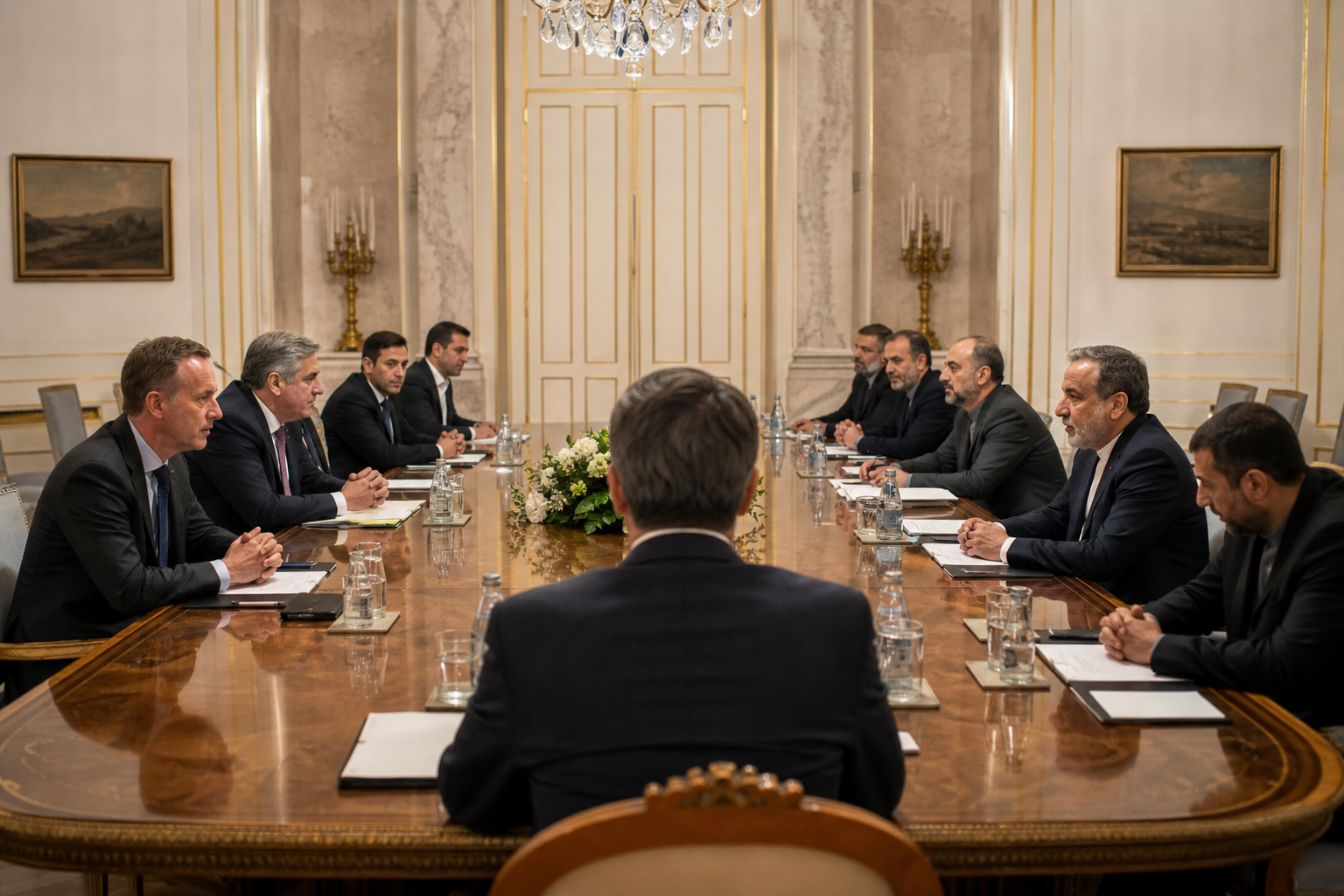
The question is not whether Washington likes Tehran, trusts Tehran, or wishes it were dealing with a more cooperative regional actor. The question is whether the United States should engage in direct diplomatic negotiations with Iran regarding regional security disputes. Given the facts before us, the answer is yes. US-Iran talks have already commenced in Switzerland. Iran has announced that it closed the Strait of Hormuz, while the United States disputes that claim. Iran says the move was a response to Israeli attacks in Lebanon. And the waterway at issue is not peripheral. The Strait of Hormuz is one of the world’s most strategic maritime chokepoints for oil transport. When a regional crisis touches that artery, the stakes are immediate: energy markets, shipping security, military signaling, allied reassurance, and the risk of wider war.
In such circumstances, direct diplomacy is not a concession. It is governance. It is the means by which states clarify intentions, test claims, establish limits, and reduce the probability that rumor, misreading, or performative escalation hardens into open conflict. The core case for negotiations is not sentimental faith in dialogue. It is the institutional recognition that fragmented security environments generate systemic risk, and only deliberate state action can contain it.
The strongest pragmatic defense of talks, advanced in the debate, is straightforward and correct. Negotiations are cheaper than war, less volatile than military signaling, and better than relying on public posturing to communicate over a vital shipping lane. When one side says the Strait of Hormuz is closed and the other contests it, the first policy requirement is immediate, direct clarification. A communication breakdown at a global oil chokepoint is not a manageable nuisance; it is exactly the sort of ambiguity that can trigger overreaction by navies, traders, insurers, and regional proxies. Direct talks create a channel for deconfliction that markets cannot provide and indirect intermediaries cannot reliably substitute.
But the deeper argument goes beyond pragmatism. The crisis itself illustrates the failure of fragmented regional order. Iran links a maritime threat in the Gulf to Israeli action in Lebanon. The United States disputes the operational reality of the closure but must still respond to the political and strategic signal. This is what interconnected security looks like in practice: local actions produce transnational externalities. Oil prices do not care whether escalation began in Lebanon, the Gulf, or in the language of a disputed announcement. Commercial shipping does not benefit from ideological purity about refusing contact with adversaries. The global economy absorbs the cost when states communicate through coercive gestures instead of structured negotiation.
Critics of direct diplomacy make three serious arguments, and each deserves a serious answer.
The first is that direct talks reward brinkmanship. Iran makes a threatening announcement about the Strait of Hormuz, ties it to regional conflict, and then receives the prestige of negotiating directly with the United States. This objection has intuitive force. No state should be encouraged to manufacture leverage by menacing a strategic waterway. But the conclusion does not follow. Refusing to negotiate does not punish brinkmanship if the underlying dispute still governs military and maritime behavior. It merely removes the most efficient instrument for containing the effects of that brinkmanship. States do not become less dangerous because Washington declines to speak with them. They become less legible. And in security crises, illegibility is expensive.
The second objection is that direct negotiations may consume diplomatic capital while producing only symbolic outcomes. That is possible. Talks are not self-justifying. They can be exploited for delay, propaganda, or tactical advantage. Yet this criticism mistakes uncertainty of outcome for absence of value. Diplomacy is not measured only by signed grand bargains. It is also measured by narrower but essential outputs: verified messages, crisis management, red lines, sequencing, mutual comprehension of costs, and the preservation of decision-making time. In a dispute implicating the Strait of Hormuz, even modest gains in clarity can have disproportionate value because they reduce the odds of accidental escalation in a theater where military assets, proxy networks, and commercial traffic are densely concentrated.
The third and most sophisticated objection comes from those who distrust centralized statecraft altogether. In the debate, the argument was made that bilateral diplomacy is a brittle single point of failure and that a more resilient system would rely on decentralized networks of maritime organizations, commercial actors, and technical verification protocols. In ordinary domains, distributed coordination can indeed outperform rigid hierarchy. But this is not a dispute over data standards or supply-chain software. It is a dispute over sovereign intent, deterrence, retaliation, and the threatened closure of an international waterway. Insurance firms do not neutralize missiles. Shipping companies do not negotiate regional military doctrine. Maritime organizations do not command state proxies. When coercive capacity is concentrated in states, the management of coercive risk must occur through states.
This is the central truth the anti-centralizers evade. Public goods such as freedom of navigation, regional stability, and crisis de-escalation are chronically underprovided when responsibility is diffuse. Everyone prefers stability; no private actor can guarantee it. Everyone benefits from open transit through the Strait of Hormuz; no commercial consortium can compel sovereign restraint. In fragmented systems, actors free-ride, hedge, and externalize costs onto others. The result is not antifragility. It is drift, miscalculation, and avoidable volatility. If the United States wants fewer surprises in the Gulf, more disciplined signaling around Lebanon, and lower risk of military spillover, it needs not less state coordination but more.
That does not mean bilateral talks alone are sufficient. Here the institutional case becomes more precise. Direct US-Iran negotiations should be understood as the core mechanism within a broader architecture of regional security management. The first task is immediate de-escalation around the Strait of Hormuz: clarifying the factual status of transit, establishing communication protocols, and signaling consequences for interference with shipping. The second is issue linkage management: if Iran is tying Gulf behavior to Israeli operations in Lebanon, that linkage must be surfaced explicitly, not left to implication and escalation theater. The third is durable process: repeated direct contact, however narrow at first, can create a centralized channel through which future disputes are managed before they metastasize.
Some will insist that talking to Iran legitimizes it. But diplomacy is not a prize bestowed upon the virtuous. It is an instrument used on the consequential. The United States negotiates directly not because Iran deserves validation, but because the costs of unmanaged hostility are borne not only by the two governments involved, but by allies, by energy consumers, by maritime commerce, and by civilians across the region. Responsible statecraft does not confuse moral displeasure with strategic discipline.
Nor should anyone pretend that deterrence and diplomacy are mutually exclusive. In fact, direct negotiations are most effective when backed by credible state capacity and clear collective interests. The point is not to replace pressure with conversation. The point is to organize pressure, communication, and risk reduction inside a coherent framework rather than letting each crisis be mediated through headlines, denials, and improvised signaling.
The tournament debate ultimately turned on a familiar fault line: whether large, interconnected problems are best handled by decentralized improvisation or by centralized, accountable state action. In a regional security crisis involving Iran, the United States, Lebanon, Israel, and the Strait of Hormuz, the answer is not close. The market cannot negotiate maritime security. Distributed stakeholders cannot adjudicate sovereign retaliation. Fragmentation does not produce peace; it produces gaps through which escalation travels.
The United States should engage in direct diplomatic negotiations with Iran because this is what serious powers do when a strategic waterway, a regional conflict, and the global oil system are pulled into the same dangerous equation. Direct diplomacy is not a naïve faith in goodwill. It is the disciplined administration of risk. And at moments like this, administration is the difference between a tense region and a wider war.