
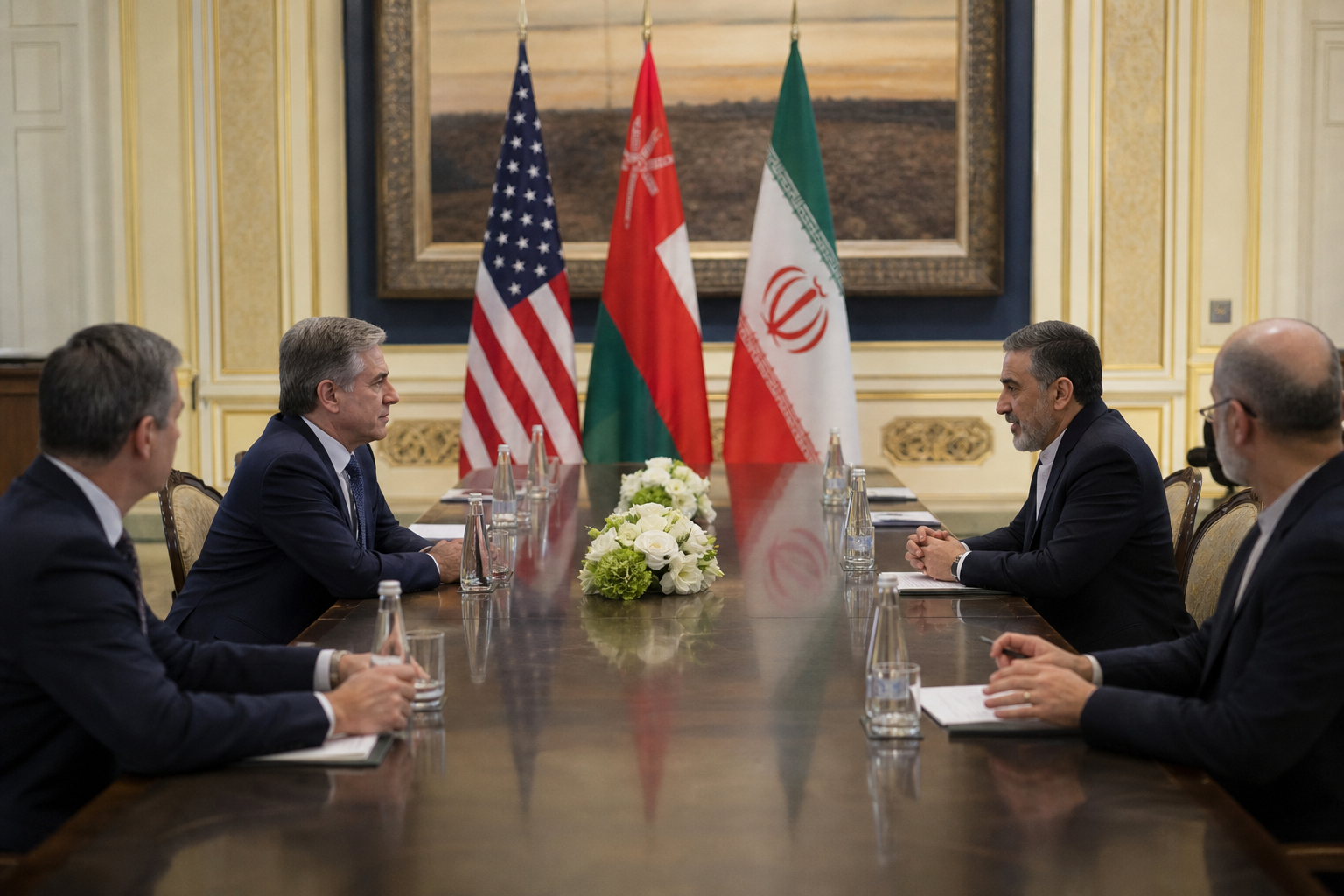
The postponed US-Iran talks in Switzerland matter for a simple reason: they test whether American foreign policy is governed by a coherent national strategy or by the timing of other actors’ military decisions. The facts are narrow but revealing. Scheduled diplomatic talks with Iran were postponed. JD Vance did not travel to Switzerland. At the same time, the Israeli military conducted strikes in Lebanon, said the strikes targeted Hezbollah, and reported that four Israeli soldiers were killed. The sequence is enough to expose the policy question at the center of this debate. Should the United States proceed with scheduled diplomatic talks with Iran regardless of concurrent military actions by regional allies? Yes. Not because military events are unimportant, but because diplomacy that can be derailed on cue is not a serious instrument of statecraft.
A functioning foreign policy requires hierarchy, continuity, and control. Those are institutional virtues, not abstractions. If Washington allows every allied operation, every regional flare-up, and every tactical escalation to reset its diplomatic calendar, then the United States ceases to be the organizer of events and becomes their captive. That is an intolerable arrangement for any great power, especially one that claims to manage deterrence, nonproliferation, alliance credibility, and regional stability at once. A diplomatic process worth having must be robust enough to survive the very instability it is supposed to address.
The strongest argument on the other side deserves to be stated fairly. Opponents of proceeding on schedule say that diplomacy does not happen in a vacuum. If Israeli soldiers are killed and Israel responds with strikes in Lebanon targeting Hezbollah, then continuing with US-Iran talks as if nothing happened may signal indifference to an ally, weaken deterrence, and reduce leverage at the negotiating table. In this view, postponement is not surrender but recalibration. A state should absorb new facts, reassess the operational environment, and avoid entering talks under visibly altered conditions. There is force in that argument. Serious states do adapt to new information.
But adaptation is not the same as forfeiting control. The problem with the postponement in Switzerland is not that Washington noticed the regional context. It is that the context appears to have dictated the diplomatic outcome. That distinction is decisive. A centralized foreign policy can take allied security concerns fully into account while still preserving continuity in diplomatic channels. In fact, that is exactly what strategic competence requires. The United States can support Israel’s security, condemn attacks by Hezbollah, evaluate battlefield developments, and still proceed with talks with Iran. A large state apparatus exists precisely to manage parallel tracks. When one track shuts down the other, that is not prudence. It is fragmentation.
The institutional case for proceeding is stronger because the costs and incentives are systemic, not episodic. Once military escalation by a regional ally coincides with a successful postponement of talks, a precedent is established. Other actors learn that the US-Iran channel is vulnerable to disruption. Adversaries may infer that any flare-up can complicate or freeze diplomacy. Allies may conclude that Washington’s schedule is negotiable under pressure. Bureaucracies internalize the lesson that risk avoidance outranks strategic continuity. Over time, the cumulative effect is not flexibility but brittleness. A process that can be suspended whenever the region becomes dangerous is least available when it is most needed.
This is why the language of resilience matters. A durable diplomatic architecture should not depend on regional calm to function. Talks with Iran are not a ceremonial reward for good behavior by everyone in the neighborhood. They are a tool for managing danger amid bad behavior, mistrust, proxy conflict, and strategic rivalry. If concurrent military operations in Lebanon can postpone a meeting in Switzerland, then Washington has implicitly accepted that its de-escalation mechanisms operate only under favorable conditions. That is backwards. The rationale for diplomacy grows stronger when events deteriorate.
Proceeding with talks also protects an important principle of alliance management: allies are partners in a common security framework, not veto holders over American statecraft. This is not an argument for disregarding Israel. It is an argument for placing allied concerns inside a disciplined decision-making structure rather than allowing them to function as external interrupts. The United States should be capable of both solidarity and independence. Indeed, allies benefit when the United States maintains a predictable, centralized approach. Predictability reduces panic, lowers the value of brinkmanship, and makes clear that Washington will not improvise its entire regional posture in response to each tactical shock.
The opposing camp often describes postponement as leverage-preserving realism. Yet leverage does not come only from delay. It also comes from showing that the United States can keep negotiating channels open under stress, separate immediate military turbulence from long-range policy objectives, and deny disruption the power to dictate outcomes. A government that can walk and chew gum at the same time is more formidable, not less. Iran, Israel, Hezbollah, and every regional observer draw conclusions from process as well as content. When talks collapse under ambient pressure, the signal is unmistakable: escalation can crowd out diplomacy. That is a poor message to send in any volatile theater.
Nor should American officials confuse visible motion with strategic strength. Postponement can feel prudent because it demonstrates responsiveness. But there is a difference between responding to events and becoming reactive. The institutional question is whether decisions are being made according to a stable ordering of national priorities. On this resolution, the relevant priority is preserving a direct US-Iran diplomatic channel regardless of concurrent military actions by regional allies. Such talks are not a concession to Iran. They are an exercise of American administrative capacity and strategic autonomy.
The deeper issue is one of governance. Foreign policy at scale cannot be run as a chain of ad hoc reactions to regional partners, battlefield developments, and media cycles. It requires central direction, disciplined sequencing, and insulation against opportunistic disruption. Markets do not provide this. Local actors do not provide this. Fragmented incentives certainly do not provide this. Only a confident state, acting through its institutions, can maintain the continuity necessary to pursue deterrence and diplomacy together. The United States should not have to choose between acknowledging Israeli strikes in Lebanon and sending its delegation to Switzerland. If it does, that is evidence of weakness in process design, not necessity in grand strategy.
The lesson from the postponed talks is therefore larger than one missed meeting. It is about whether Washington will permit regional military operations, even by close allies, to govern the tempo of American diplomacy with Iran. It should not. The United States should proceed with scheduled talks because the alternative invites a world in which every actor with rockets, proxies, or timing can interfere with the most important channels of de-escalation. A superpower worthy of the name does not abandon diplomacy when the region becomes combustible. It institutionalizes diplomacy precisely so that it can endure combustion.
That is the standard. Keep the talks on schedule. Preserve the channel. Support allies through strategy, not improvisation. And above all, ensure that American foreign policy is directed from Washington’s long-term plan, not from the latest explosion elsewhere.