
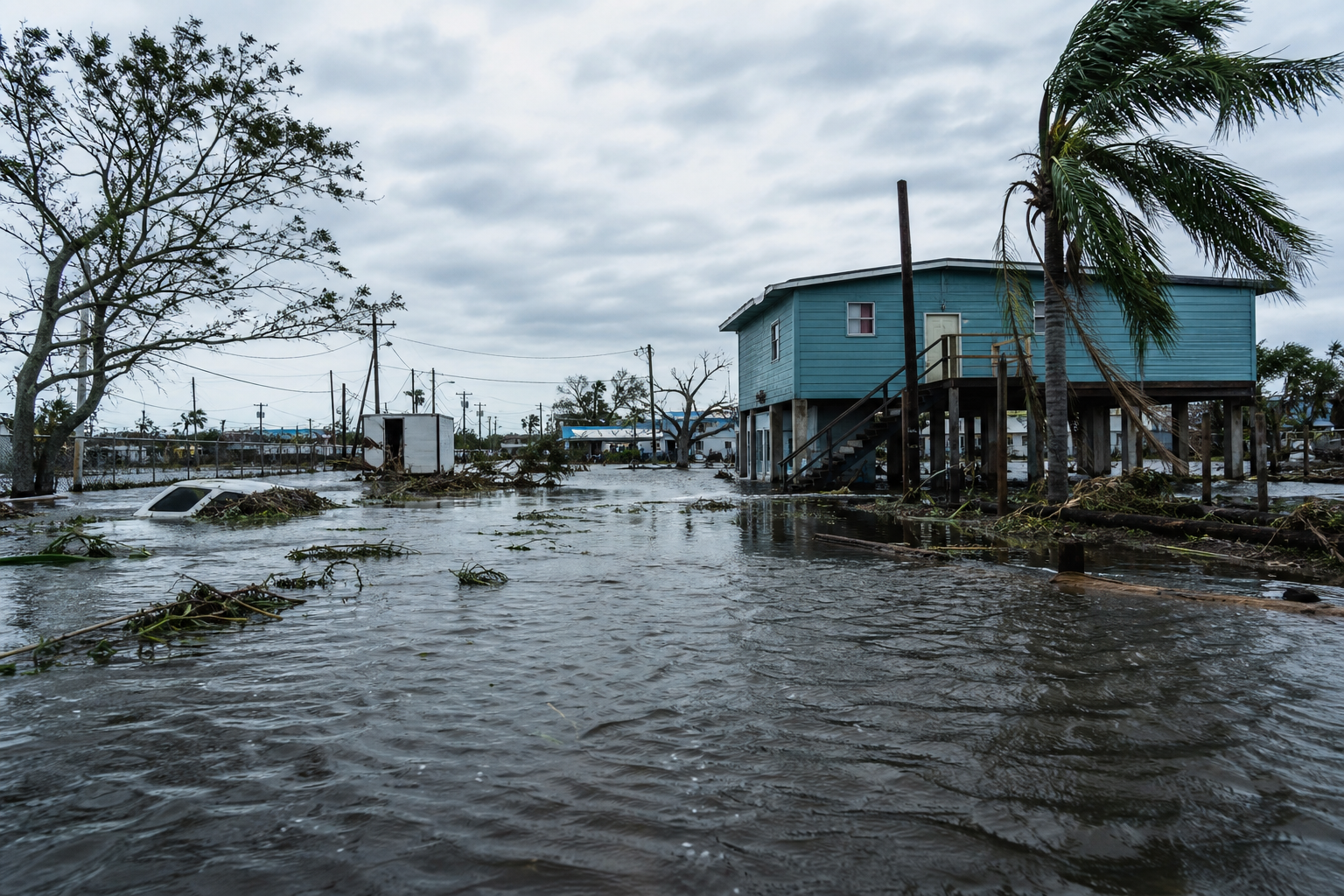
The Supreme Court cannot do everything at once. That banal fact is the whole case for prioritization, and it is why the October term matters. The docket includes disputes related to climate change. It also includes disputes related to immigration detention. Both are significant. But significance alone does not allocate scarce institutional bandwidth. Triage does.
If the Court is going to move one category to the front of the line, it should move climate change cases ahead of immigration detention cases. Not because detention is unimportant, and not because climate litigation is some magic wand. The reason is simpler and harder: delay in climate cases tends to impose broader, more irreversible, and more compounding costs, while a Supreme Court ruling in that area can provide legal clarity that affects investment, regulation, infrastructure, insurance, energy, and state and federal planning all at once.
That is the right lens for this choice. When capacity is fixed, the question is not which issue sounds more morally urgent in the abstract. The question is where the Court's time buys the most marginal value now.
The strongest argument for prioritizing immigration detention cases is serious, and it deserves more respect than climate maximalists often give it. Immigration detention disputes involve actual people being held by the state. Delays are not theoretical. Liberty deferred can mean weeks or months of confinement, family separation, procedural uncertainty, and, in some cases, unlawful detention that cannot be given back later. Courts exist in part to check state power. On that point, the critics are right. If you are sitting in detention, being told that your case is less urgent than a dispute over emissions rules sounds obscene.
Concede that much, because it is true. The harm in detention cases is immediate, visible, and personalized. It is often easier to describe and easier to sympathize with than the downstream effects of a delayed climate ruling.
But prioritization is not the same as moral ranking. It is a portfolio decision under scarcity. The Supreme Court is not being asked which issue matters in some cosmic sense. It is being asked what should go first in one term, on one docket, given a finite number of arguments and opinions.
On that question, climate change cases have the stronger claim.
Start with the shape of the harm. Immigration detention cases usually involve acute harms concentrated on identifiable parties. Climate change cases often involve legal disputes whose consequences spill across entire sectors. A single ruling can alter the expected path of permitting, federal regulatory authority, state compliance, utility investment, insurance pricing, industrial planning, and local government adaptation. That does not mean every climate case is automatically more important than every detention case. It means the category has a larger average blast radius.
Then look at timing. Delay in climate disputes is unusually expensive because the underlying problem compounds. Regulatory uncertainty slows capital formation. Developers wait. Utilities postpone. States hedge. Agencies either overreach and get sued, or underact and wait for clarity. Nobody likes to invest billions into assets that may be stranded by the next opinion. The result is not just legal confusion, but real economic drag. When the Court resolves a major climate question, it can unfreeze behavior far beyond the named parties.
This is the practical rebuttal to the claim that climate policy is mainly for Congress and the executive branch. Of course it is. Nobody serious thinks the Supreme Court should run environmental policy. But the Court does set the legal boundaries within which everyone else operates. In areas where those boundaries are contested, delay is not neutrality. Delay is a tax on coordination.
There is also an asymmetry in reversibility. If the Court takes a detention case later rather than sooner, the specific injustice may be severe, but the legal system has other partial pressure valves: lower courts, emergency motions, habeas procedures, administrative changes, narrower remedial pathways. None of those are perfect. Some are inadequate. But they exist. By contrast, when climate related legal uncertainty stalls infrastructure, permitting, grid modernization, adaptation spending, or emissions control, lost time is not easily recovered. Seasons pass. Projects die. Risk accumulates in the background. The economy then pays twice, once through delay and again through catch-up costs.
Opponents respond that this treats the Court as an economic manager and undervalues rights. Fair warning, yes, any purely spreadsheet version of this argument would be too crude. The Court is not a central bank for public anxieties. Its job is law. But law allocates power, and some legal questions have unusually high system effects. Recognizing that is not cynicism. It is competence.
The other objection is institutional. Climate change is sprawling, global, scientifically complex, and not solvable by judicial decree. True again. A Supreme Court opinion will not lower temperatures by itself. But that is not the relevant test. The relevant test is whether resolving climate disputes can reduce uncertainty at a key chokepoint. It can. The Court is not being asked to solve climate change. It is being asked to clarify legal authority in disputes that shape how quickly other actors can act.
That distinction matters. You do not need to believe in judicial heroics to prefer climate cases first. You only need to believe that when millions or billions of dollars of public and private decisions are waiting on legal answers, the highest court should answer them promptly.
Meanwhile, the argument that immigration detention cases are narrower is not an insult to their importance. It is a statement about transmission. Even when a detention ruling is landmark, its direct operational effects are usually more contained than the direct operational effects of a major climate decision. One protects against a specific form of state action. The other can reset expectations across energy markets, land use, transportation, insurance, and public finance. If the Court's scarce time can either correct a bounded set of injustices or reduce uncertainty across multiple sectors at once, the second option usually offers a higher social return per hour of judicial attention.
There is a final irony here. People who favor immigration detention cases first often argue from the Court's core duty to check government coercion. Fair enough. But climate cases are also, in large part, cases about the lawful scope of government power, who can regulate what, how far agencies may go, what states can require, and what private actors may rely on. They are not outside the Court's wheelhouse. They are central to it.
The practical rule should be this: prioritize the cases where delay creates compounding national costs, where the Court can deliver high-value legal clarity, and where the answer will guide many decision-makers beyond the litigants in the room. In this October term, that points to climate change cases over immigration detention cases.
That does not trivialize detention. It simply acknowledges triage. Every institution with finite capacity has to distinguish between painful problems and compounding ones, between immediate harms and cascading harms, between justice for some and clarity for many. The Supreme Court's docket is no exception.
Hear the immigration detention cases, absolutely. But hear the climate change cases first. The country can afford moral discomfort. It cannot afford expensive ambiguity on a problem that multiplies the cost of waiting.