
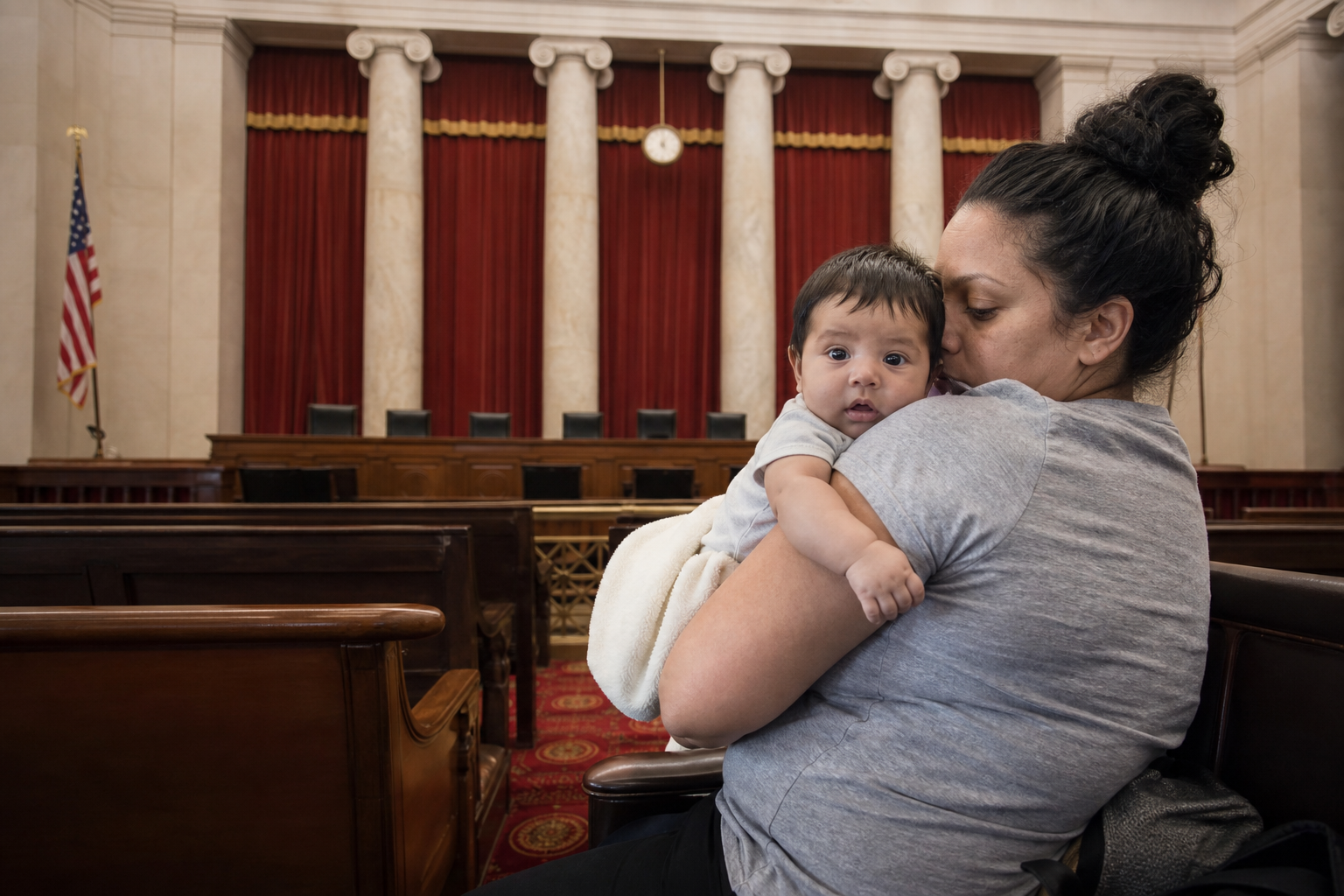
The Supreme Court's landmark decision on birthright citizenship was widely described as unfavorable to President Trump's position, and the immediate commentary split along familiar lines, constitutional principle versus immigration control. That framing is too lazy. The real question is not whether birthright citizenship feels noble or harsh. The real question is whether the United States should be forced to keep a citizenship rule that creates bad incentives, socializes costs, and strips policymakers of a useful lever for managing immigration and public capacity. On that question, the Court should have upheld restrictions on birthright citizenship.
Start with the operational stakes. Citizenship is not just a moral label. It is a legal asset with permanent value, access to voting rights, a claim on public institutions, and a pathway to family unification and long-run political membership. Any rule that automatically confers that asset at birth, regardless of parental legal status, changes incentives at the margin. You do not need to claim that most migration is driven by birthright citizenship to see the problem. Policy does not have to be the sole cause of behavior to be a meaningful pull factor. If a rule raises the payoff to illegal entry or visa overstay even modestly, then over millions of cases and over decades, the fiscal and administrative effects accumulate.
That is the practical case for restrictions. A narrower rule would not end illegal immigration, and supporters of the Court's ruling are right about that. But policy is not judged against fantasy. It is judged against available alternatives. If one rule tells the world that a child born here automatically receives full membership regardless of the parents' legal relationship to the country, and another rule ties citizenship more closely to lawful presence or citizenship status, the second rule is simply a tighter incentive structure. Tighter incentive structures usually produce less gaming and lower downstream cost.
The strongest argument on the other side is not sentimental. It is administrative. Defenders of the Supreme Court's decision argue that broad birthright citizenship provides a bright line. A baby is born in the United States, citizenship attaches, case closed. That clarity avoids a bureaucratic mess, prevents statelessness concerns, and reduces the risk of creating a permanent underclass of people born here but excluded from full membership. That is a serious point, and it should be conceded up front. Simple rules have value. Legal certainty has value. A country should not casually create millions of residents with ambiguous status.
But that objection proves too much. By that logic, any broad entitlement should be preserved if narrowing it requires more administration. That is not how competent states operate. Tax systems, visas, asylum, welfare eligibility, and employment law all impose line-drawing costs because boundaries matter. The mere existence of administrative complexity is not an argument against restrictions. The question is whether the complexity is worth the savings and deterrence effect. In many policy domains, it is.
Here, it likely would be. The current rule externalizes costs onto states, cities, school systems, hospitals, and welfare programs while concentrating benefits in a narrow set of immediate cases. It also weakens the credibility of immigration law. If unlawful presence can still produce an immediate citizen child, the system is effectively saying that legal status matters at the border but not at the point of generational incorporation. That disconnect is expensive. It creates political backlash, litigation, enforcement cynicism, and pressure on emergency services and local budgets. Even where the direct fiscal cost is debated, the governance cost is obvious. Rules that large portions of the public experience as loopholes do not remain stable. They generate recurring conflict.
The constitutional objection is stronger than the administrative one, but still not dispositive. Opponents of restrictions lean heavily on the Fourteenth Amendment and on long-standing precedent. Fair enough. Courts are supposed to respect text and precedent, and the case for a broad reading of citizenship at birth has deep roots. If the only question were what the Court was most likely to do under existing doctrine, the answer was always that President Trump's position faced long odds.
But this resolution is not about prediction. It is about what the Supreme Court should have done. On that question, precedent is a cost, not a trump card. The phrase "subject to the jurisdiction" has always done real work, and it is not irrational to read it as allowing a narrower citizenship rule than the one modern practice settled on. You do not need to pretend that the restrictive reading is obviously correct. You only need to recognize that it is plausible enough that the Court could have adopted it if it believed the current rule was producing substantial policy harm.
That matters because constitutional systems are not suicide pacts against incentive correction. If a broad interpretation of birthright citizenship degrades the state's capacity to control immigration and allocate membership on deliberate terms, then the Court is not virtuous for ignoring that reality. It is just shifting costs onto everyone else while calling the result principle.
Another strong opposing point is that restricting birthright citizenship could create a shadow population, people born in the United States but without citizenship, which in turn could worsen social fragmentation. Again, that risk is real. But it is often exaggerated by comparing a restricted system to a fully integrated one rather than to the actual status quo. America already has large numbers of non-citizens living under layered legal statuses. The state already tracks lawful permanent residents, temporary workers, visa overstays, asylum seekers, and undocumented migrants. A narrower rule would add classification work, but it would not invent legal stratification from scratch. More important, it could push policymakers toward a more honest immigration architecture, one in which citizenship follows from lawful admission and durable compliance, not geographic happenstance alone.
There is also an international realism point that critics of restrictions tend to wave away. Many developed countries do not grant unconditional jus soli citizenship. They use combinations of parental status, lawful residence, and time-based integration thresholds. The sky has not fallen. Those systems are not costless, but they reflect a basic truth, citizenship policy is part of migration policy whether lawyers like that or not. Pretending otherwise is a luxury position available mainly to people who do not have to balance school seats, emergency room budgets, housing demand, and enforcement capacity.
None of this means every proposed restriction would be wise. Some would be badly drafted, overbroad, or cruel in application. Some would invite expensive litigation. Some would save less money than advertised. Serious pragmatism requires those concessions. But the existence of bad versions does not refute the case for the general power to restrict. It strengthens it, because if restrictions are going to exist, they should be shaped by courts and lawmakers in a legally coherent way rather than treated as unthinkable until a crisis produces a sloppier response.
The Supreme Court's ruling may preserve doctrinal continuity. It does not preserve policy sanity. It leaves the United States with a citizenship rule that is unusually automatic, politically combustible, and poorly matched to an era of mass mobility and contested borders. Broad birthright citizenship is elegant on paper because it is simple. In practice, simplicity can be overpriced. When a simple rule creates lasting fiscal burdens and weakens deterrence, the right response is not to admire its elegance. It is to revise it.
The Court should have upheld restrictions on birthright citizenship because citizenship is too valuable, immigration incentives are too powerful, and public capacity is too finite to let territorial accident do all the work. A nation that cannot set tighter terms for permanent membership is not being generous. It is being careless with an asset it cannot cheaply replace.