
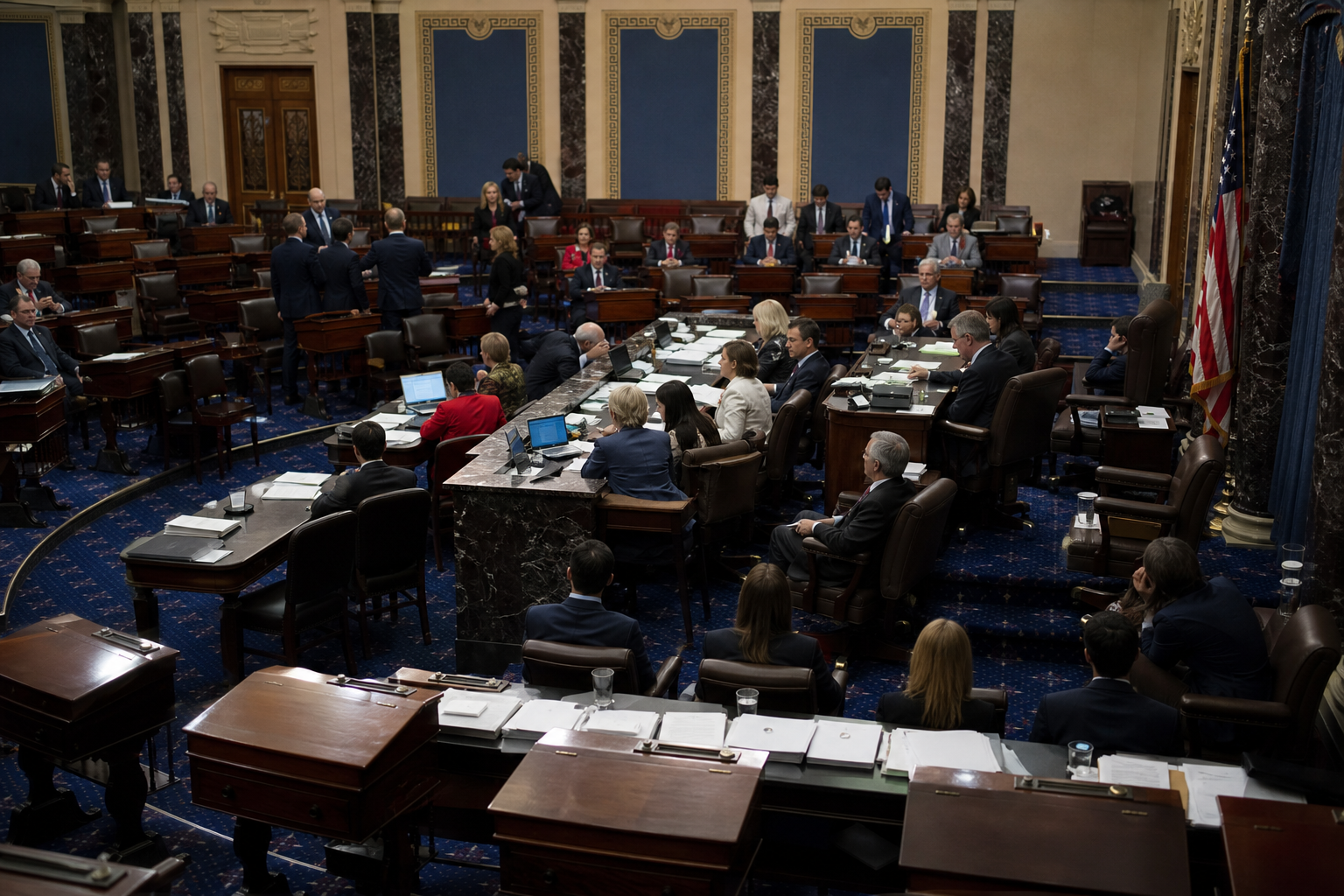
The U.S. Senate had a chance to pass a resolution directing the President to end military operations against Iran, and Senate Republicans rejected it after a late-night vote. That reversal, especially after a bipartisan vote on a related matter the day before and after public statements from the President, will tempt many commentators into a familiar story about cowardice, constitutional decay, and Congress abandoning its war powers. Some of that criticism is fair. But the core policy question is not whether Congress matters. It does. The question is whether this specific Senate resolution was a good instrument for this specific problem. It was not.
Start with the most important practical point. In war, deterrence and command coherence are assets. Mixed signals are liabilities. A Senate vote that "directs" the President to end military operations against Iran, without the force and finality of an enforceable funding cutoff or a new statutory framework, creates ambiguity at the exact point where ambiguity is most expensive. Tehran, U.S. troops, regional partners, financial markets, and American commanders all have to price in what Washington means. A nonbinding or weakly binding political directive says, in effect, the United States is divided over whether it is still serious. That does not automatically buy peace. It can just as easily buy miscalculation.
That is the strongest case against the resolution, and it is stronger than the simple partisan story. Critics of the Senate vote are right about one thing: Congress should not write blank checks for military action. If the President has expanded operations without clear authorization, the legislature has a duty to respond. Mira Solenne made the best version of that argument throughout this debate. She is correct that mission creep is real, that executive branch incentives favor operational elasticity, and that the burden of proof should be on those who want a conflict to continue. She is also right that a party reversal after presidential statements looks bad. It suggests that some senators were following political cues rather than stable principles.
But acknowledging those points does not make this resolution wise. Oversight is not the same thing as performance. Process is not outcome. Congress has war powers, but not every invocation of war powers improves policy. A directive to end military operations against Iran sounds decisive. In practice, it is often the cheapest form of institutional self-expression, a press-release vote masquerading as strategy. If senators truly believed the operations were unauthorized, unsound, or too risky, there are harder, more effective tools available: binding legislation, appropriations restrictions, reporting requirements tied to funding, explicit limits on targets or theaters, and a forced public debate over any new authorization for use of military force. Those tools impose costs and produce compliance. This resolution mostly produced messaging.
That distinction matters because the downside risk here is not theoretical. Military operations involve active force posture, retaliation risk, force protection, alliance credibility, and domestic signaling all at once. A vague demand to stop, issued in the middle of those interacting systems, can lower deterrence before it lowers violence. Opponents of continued operations assume that any reduction in U.S. military activity reduces escalation risk. Sometimes it does. Sometimes it advertises hesitation and invites a probing response from the other side, which then forces the very escalation everyone claimed to oppose. The market term is adverse selection. If your enemy tests weakness when it smells weakness, the cost curve can move the wrong way fast.
The constitutional argument also deserves a more unsentimental treatment than it usually gets. Yes, Congress has a checking function. Yes, the President is not supposed to have an effectively unlimited license for military action. But the Commander in Chief role exists because military operations are not committee work. They require speed, sequencing, and a single accountable chain of command. That does not mean presidents should be unconstrained. It means constraints should be designed to work. There is a difference between setting policy parameters and yanking the steering wheel while the vehicle is already in motion.
This is where the defenders of the resolution overreached. They treated any reassertion of Senate authority as inherently healthy, as if decentralization were always an advantage. It is not. In software, distributed systems can be resilient. In coercive diplomacy, distributed signaling can be catastrophic. Adversaries exploit seams. If the Senate wants to narrow the executive's options, it should do so in a way that is legible to everyone involved. Ambiguous legislative defiance is not legibility. It is noise.
The politics around the vote do not rescue the resolution either. Theo Voss was right to point out the theatrical component. The day-to-day reality of Capitol Hill is that many members like symbolic distance from military risk without paying the price of actual responsibility. A related bipartisan vote one day, then a Republican reversal after presidential statements the next, tells us less about constitutional theory than about bargaining power inside a party coalition. That is not noble, but it is normal. The question for the country is whether we should confuse that normal theater with sound statecraft. We should not.
None of this is an argument for open-ended war with Iran, nor is it a defense of permanent executive discretion. It is an argument for matching tools to goals. If the true goal is to prevent a slide into a larger U.S.-Iran war, Congress should increase the cost of expansion, require disclosure of objectives, define red lines for sustained hostilities, and reserve longer campaigns to explicit authorization. If the goal is to tell voters that some senators are uneasy, then a resolution like this works fine. But those are not the same thing, and pretending they are is how Washington keeps substituting symbolism for control.
The best rebuttal is moral and institutional: even an imperfect Senate resolution can signal that the country does not want another open-ended conflict in the Middle East. Fair enough. Signals matter. But signals are only useful if the receiver interprets them as intended. A signal of restraint can also be read as a signal of disunity. A signal of oversight can also be read as a signal that the U.S. political system cannot sustain pressure. In geopolitics, the market does not grade intentions. It prices expected behavior.
So what should have happened? Not passivity, and not a blank check. The Senate should have rejected this resolution, which it did, and then moved immediately to the serious work its critics claim to want: define the scope of permissible military operations against Iran, specify reporting and sunset requirements, and tie any broader campaign to affirmative congressional approval. That path is slower and less emotionally satisfying than a dramatic late-night vote. It is also far more likely to produce the one thing that matters, a lower probability of strategic blunder at a manageable institutional cost.
The resolution failed because, at bottom, it offered bad mechanics wrapped in good rhetoric. That is often the most dangerous kind of legislation. It lets everyone feel principled while nobody takes responsibility for the consequences. On issues as costly as military operations against Iran, the United States cannot afford process theater. It needs enforceable limits, credible deterrence, and a Congress willing to do more than gesture from the gallery.