
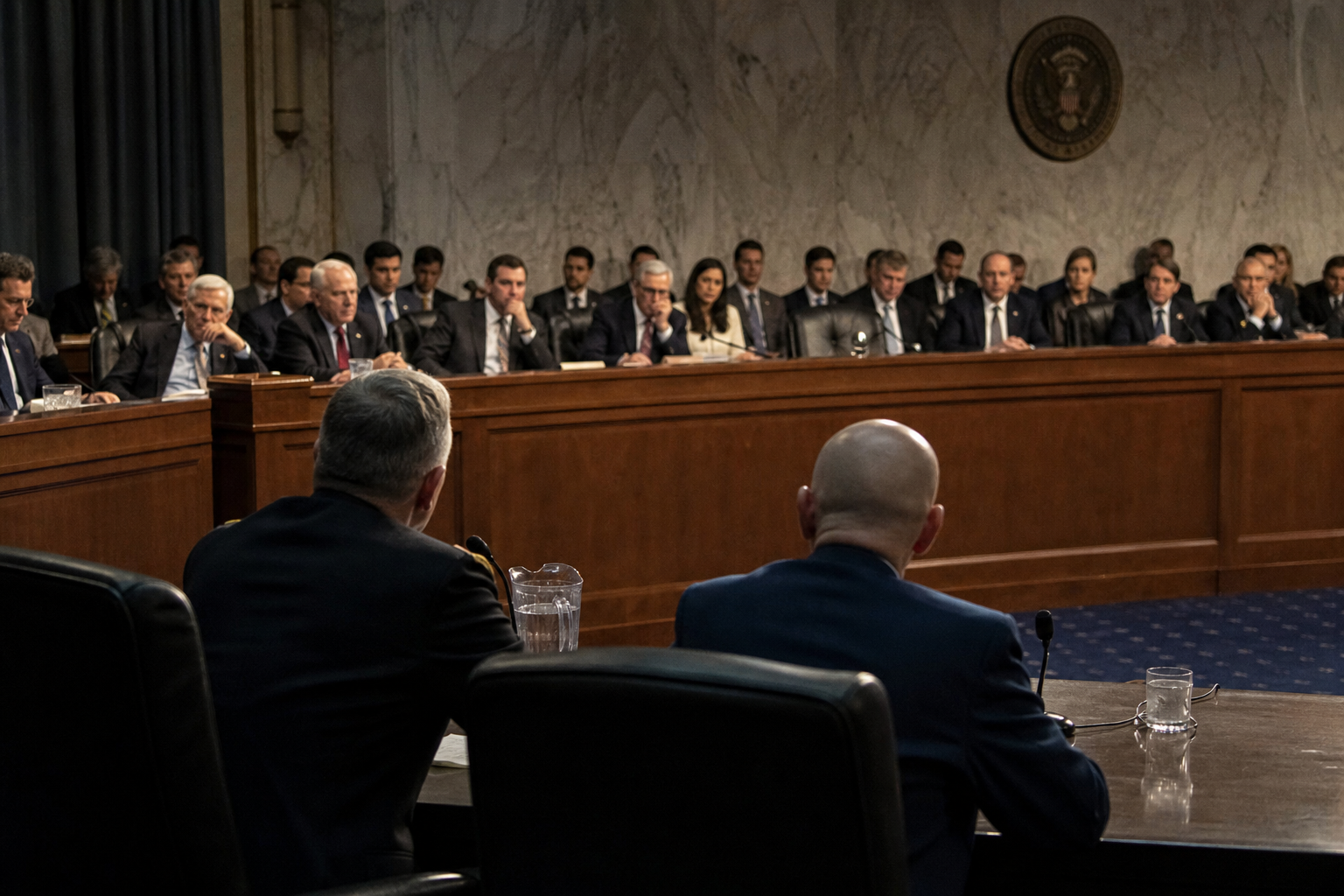
The question before the Senate is narrower than the shouting around it, and more important. Should a President be able to continue or begin military operations against Iran without congressional authorization, or should Congress reassert its constitutional role before the country slides from strike to campaign, from retaliation to war? On that question, the Senate is right to restrict presidential authority.
This is not a gesture against national defense. It is a defense of the constitutional architecture that was built precisely for decisions like this one. The fact sheet is plain. The Senate voted on a measure regarding presidential war powers related to Iran. The measure instructs the President to halt military operations against Iran or obtain congressional authorization. Some Republican senators joined Democrats. The vote represented a check on executive military authority. That is not procedural clutter. It is the system functioning, belatedly perhaps, but functioning.
The best argument on the other side is not unserious. It is the old and permanent case for executive speed. Iran does not schedule threats around Senate floor time. Military operations can require surprise, discretion, and immediate response. The President, as Commander-in-Chief, sees intelligence in real time, commands forces in the field, and may need to act before Congress can gather itself. A legislature is slow by design, porous by habit, and often eager to criticize action while avoiding responsibility for inaction. Anyone who denies this has not read much history either.
But history cuts harder the other way. The American record is full of limited actions that did not stay limited, of presidential initiative that outran legislative consent, of military commitments that acquired their own momentum while Congress discovered that troops once deployed are politically difficult to recall. The central lesson is not that every President is reckless. It is that the office itself, when left to define the scope and duration of hostilities, predictably expands. Institutions do not merely reflect virtue. They shape it, and they restrain its opposite.
That is why the framers split war powers. Congress was given the power to declare war, raise armies, fund them, and make rules for their governance. The President was made Commander-in-Chief, not sovereign over war itself. In practice, that arrangement has always involved tension. Presidents repel attacks, rescue personnel, and conduct discrete operations. Congress authorizes, funds, and, when it has the nerve, refuses. The tension is not a design flaw. It is the design. The founders did not trust a single magistrate with the power to carry the republic from peace to sustained conflict on his own judgment.
Notice what the Senate measure does and does not do. It does not abolish the President's capacity to react to immediate danger. It does not place tactical command in the hands of 100 senators. It says that military operations against Iran must halt unless Congress authorizes them. In other words, if the United States is moving beyond a momentary emergency into continued or future military action, the people's representatives must own the choice. That is exactly where the constitutional burden belongs.
Opponents call this dangerous friction. In truth, friction is one of the few reliable safeguards in the war power system. A republic should not be able to drift into armed conflict with a regional power because a sequence of executive decisions, each individually defensible, becomes collectively irreversible. Deliberation is not an enemy of sound strategy. It is often the condition for it. Congressional authorization forces the administration to state objectives, legal grounds, expected duration, costs, escalation risks, and exit conditions. If those questions cannot survive debate in the Senate and House, that is not evidence of legislative dysfunction. It is evidence that the case for war is not yet mature.
There is also a practical point that advocates of presidential freedom often understate. Congressional authorization can strengthen, not weaken, American credibility. Adversaries know the difference between a President acting on contested domestic ground and a nation acting with formal legislative backing. Allies know it too. Military action launched under ambiguous authority may be swift, but it is often strategically brittle. Action backed by Congress is more durable, more legitimate at home, and less vulnerable to the charge that it rests on one person's impulse or one news cycle's panic.
The bipartisan nature of the Senate vote matters here. When some Republican senators vote with Democrats to check executive military authority, the issue has escaped partisan convenience. This is not one party trying to hamstring a President of the other party while waiting to rediscover executive power later. At least in this instance, senators from both sides recognized a larger institutional truth. Congress has for decades tolerated the erosion of its own war powers, then complained about the consequences. The accumulation of precedents for unilateral action has not produced clarity. It has produced habit. And habit in constitutional life is powerful. If not interrupted, it becomes a substitute for law.
None of this means Congress is wise in every instance. Legislatures can be cowardly, grandstanding, ill informed, and late. They can leak, posture, and vote with one eye on cable television. The critics are correct about that. But the remedy for legislative weakness is not executive monopoly. It is legislative responsibility. If members of Congress fear the burden of authorizing force, that is an argument for making them carry it, not for excusing them from it.
There is another historical warning worth remembering. Republics rarely lose control of war decisions in one dramatic seizure. They lose it by accretion, by emergency, by exception, by the plausible claim that this case is too urgent for ordinary forms. Every age thinks its danger is unusually fast moving. Every executive believes its intelligence is uniquely compelling. Sometimes both claims are true. Yet the Constitution was written with full knowledge that emergencies would come. It did not place all consequential war making authority in the White House for the simple reason that urgent cases are the very ones most likely to need discipline.
Iran makes this especially salient. Conflict with Iran is not a border skirmish detached from larger consequences. It carries obvious risks of regional escalation, reprisals against U.S. personnel, pressure on allies, economic disruption, and a slide into prolonged hostilities that begin with precision and end in ambiguity. If such risks are worth taking, Congress should say so plainly. If they are not, the President should not be allowed to discover the answer alone through force of arms.
The Senate measure is therefore best understood not as an innovation but as a recovery operation. It recovers the distinction between command and authorization. It recovers Congress's duty to decide when hostilities against another state have become a national commitment rather than an executive initiative. And it recovers a truth that modern Washington often treats as antique, that the easiest wars to start are often the hardest to bound.
The United States does not need a weaker presidency in the abstract. It needs a presidency returned to its proper constitutional channel, especially where war with Iran is concerned. Restricting presidential military authority absent congressional authorization is not paralysis. It is the republic remembering that before the missiles fly, the legislature must speak.