
The question is not whether Congress and the Supreme Court may ever interact. They already do. The question is whether Supreme Court Justices should be required to testify before Congress regularly, on a schedule, as a normal feature of American government. They should not. What sounds like a modest transparency reform is, in constitutional practice, a substantial shift in the relationship between the legislative and judicial branches.
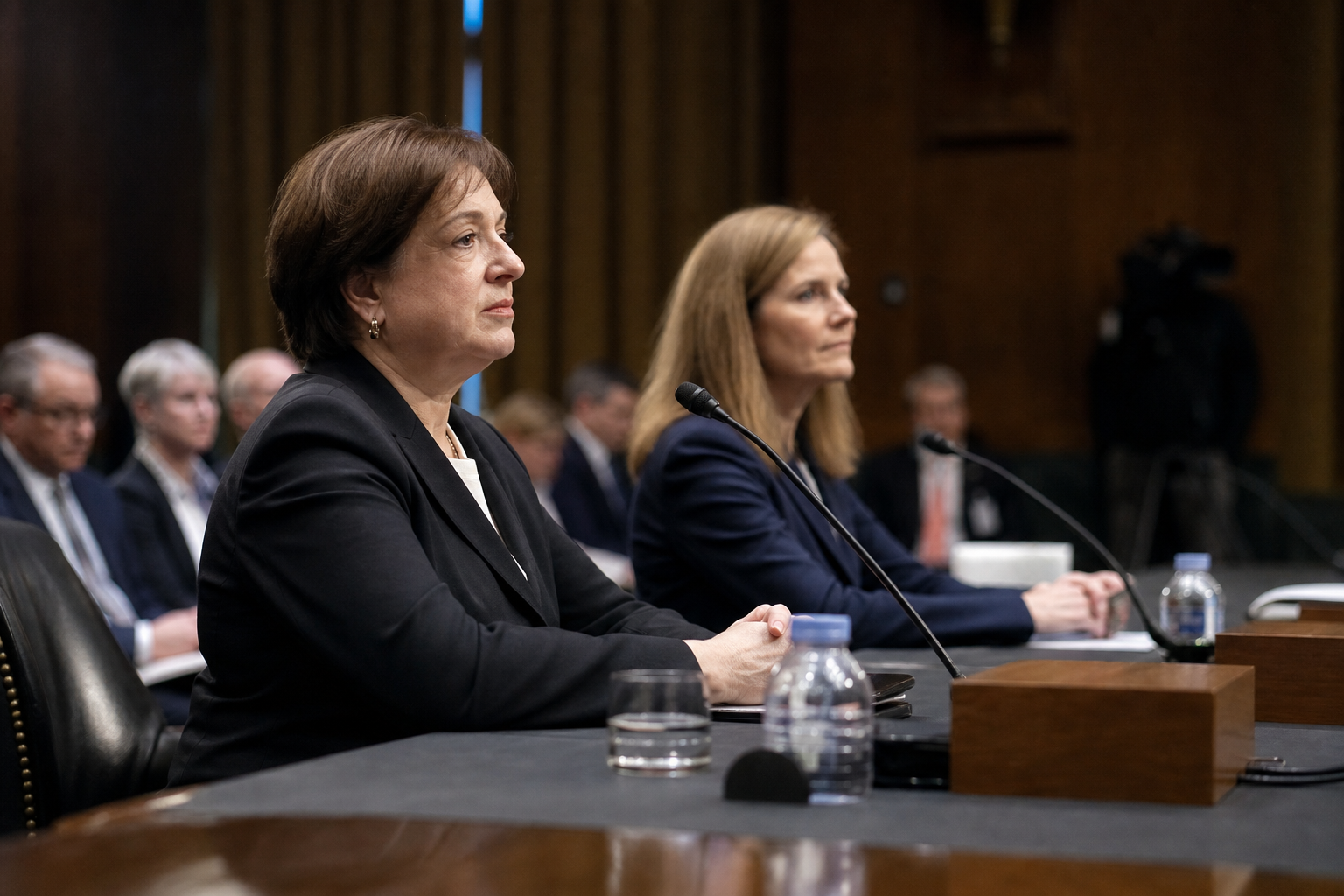
The recent appearances of Justice Elena Kagan and Justice Amy Coney Barrett have given this proposal a surface plausibility. Two sitting Supreme Court Justices testified before Congress. The sky did not fall. That matters, and opponents of regular testimony should concede it plainly. Occasional testimony is not unconstitutional by definition, nor is every conversation between branches a crisis. But from that narrow fact it does not follow that Congress should compel regular appearances from the members of the nation’s highest court.
In American constitutional history, rarity is often not an accident. It is often a boundary marker. Supreme Court Justices rarely testify before Congressional committees for the same broad reason that federal judges enjoy life tenure and salary protection: the judiciary is meant to decide cases under law without becoming a standing participant in day to day political combat. The separation of powers is not a slogan here. It is the architecture of restraint.
Advocates of regular testimony make the strongest case in the language of accountability. The Supreme Court is powerful, unelected, and insulated. Congress, they argue, needs structured opportunities to understand how the judiciary functions, what administrative pressures it faces, and how judicial decisions affect the broader legal system. In an age of distrust, routine public testimony could appear to offer transparency, a recurring civic ritual of explanation rather than mystery.
That argument deserves respect because it identifies a real problem. Public confidence in institutions is fragile. The Court’s decisions can reshape national life. Congress does have legitimate interests in judicial administration, appropriations, ethics legislation, the structure of lower federal courts, and the practical effects of statutes after judicial interpretation. It is also true that ad hoc appearances can look arbitrary. If Justices testify only when they choose, or only when political conditions align, the public may conclude that access is discretionary and accountability uneven.
But this is where history counsels skepticism. A recurring oversight hearing is not a neutral vessel. In Congress, regular testimony quickly becomes regular performance. Committees are designed for politics because Congress is designed for politics. That is not a criticism, it is a constitutional fact. Legislators posture for constituents, test arguments for cable clips, and press officials into yes or no answers on matters that are usually more complex than politics permits. Cabinet secretaries can be hauled into that arena because they are part of the political branches. Supreme Court Justices are not.
A standing requirement that Justices testify regularly would invite two unhealthy patterns at once. First, legislators would use hearings to signal approval or hostility toward recent decisions, pending controversies, or legal philosophies. Even if formal rules purported to bar questions about specific cases, everyone in the room would understand the subtext. A question about court administration would become a proxy fight over abortion, executive power, gun rights, affirmative action, or administrative law. Second, Justices would adapt. They would become more guarded, more strategic, more publicly political in self-presentation, because any regular witness before Congress learns to survive Congress.
That adaptation is itself a constitutional loss. The Court’s authority depends less on force than on the public belief that judges are applying law rather than managing constituencies. Americans already worry that confirmations resemble partisan campaigns. We should hesitate before adding another recurring ritual that trains the country to view Justices as legislators in robes, accountable not through opinions and legal reasoning, but through congressional spectacle.
The better reply from supporters is that testimony need not concern case merits at all. It could be confined to ethics rules, security, budget needs, court administration, and the workings of the federal judiciary. That is the most serious narrowing construction of the proposal, and it improves the idea. But even then, the case for requiring the Justices themselves remains weak.
Congress already has means to gather much of this information without establishing a regular summons power over the Supreme Court’s members. The judiciary can transmit reports. Administrative officials of the federal courts can testify. Written responses can be provided. Congress controls appropriations, jurisdiction in many respects, and, in extraordinary circumstances, impeachment. The point is not that existing mechanisms are perfect. It is that a new requirement aimed specifically at sitting Supreme Court Justices should clear a high bar, because the institutional costs are unusually high and the practical gains are narrower than reformers suggest.
There is also a deeper confusion in the modern appetite for visibility. Not every institution becomes more trustworthy by becoming more exposed to partisan theater. The long American experiment contains many examples of reforms sold as accountability that matured into pressure campaigns. The judiciary was insulated not because the Framers expected judges to be angels, but because they knew elected bodies would be tempted to treat adverse decisions as political defiance. Regular congressional testimony would normalize precisely that temptation.
The fact that Justices Kagan and Barrett have testified is therefore better understood as evidence that the present arrangement works tolerably well. When unusual circumstances justify interaction, interaction can occur. Voluntary or exceptional appearances preserve flexibility. They allow the branches to communicate without converting communication into subordination. A rare event can inform; a scheduled event becomes an institution. And institutions, once created, rarely remain as modest as their authors promise.
None of this means the Supreme Court should be beyond criticism, beyond reform, or beyond all contact with Congress. It means only that not every frustration with the Court should be answered by drawing it further into the habits of legislative oversight. Courts are accountable, but accountable differently. They must explain themselves in opinions, follow precedent or justify departures, operate within jurisdiction, submit to statutory revision where the Constitution allows, and ultimately depend on public confidence in their legal, not political, character.
The resolution asks whether Supreme Court Justices should be required to testify before Congress regularly. The strongest argument for yes is that routine testimony would increase transparency and reduce an accountability gap. The stronger argument for no is that it would change the Court more than it would enlighten Congress. Over time, the hearing room would not domesticate politics for the judiciary; it would import politics into the judiciary.
A republic that values separated powers should resist that trade. Rare testimony may be imperfect, but in this case imperfection is part of the safeguard. The line between interaction and intimidation is easier to cross than reformers admit, and much harder to redraw once crossed.