
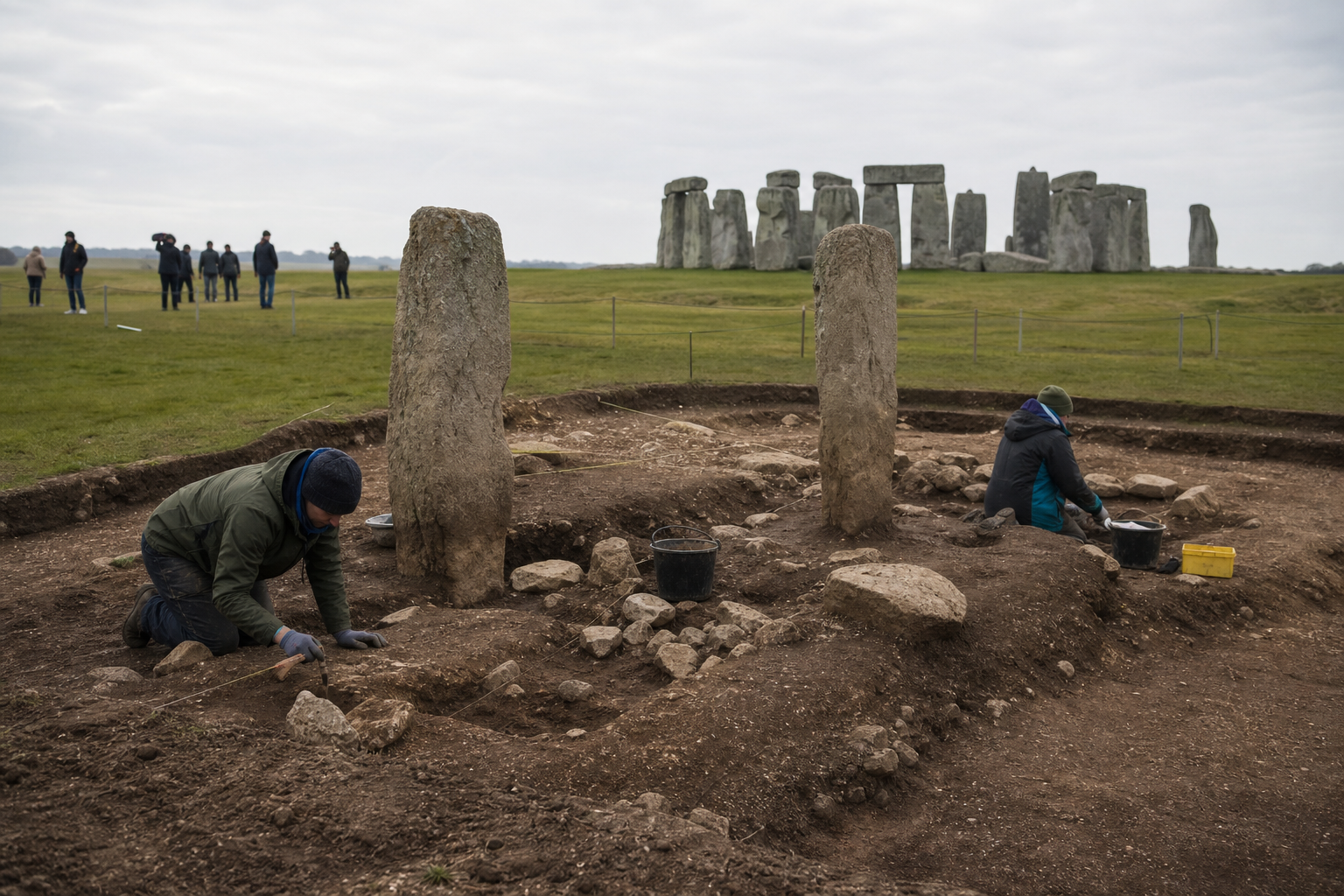
A structure consisting of two posts, discovered three miles from Stonehenge, would be easy to underestimate. It is simpler than the great stone circle. It is less dramatic in silhouette, less legible to tourists, less suited to postcards and heritage branding. Yet it is also older than Stonehenge, dates to approximately 5,000 years ago, and aligned with the solstices. Those facts make the policy question unavoidable: when archaeology uncovers a simpler structure near a major monument, should preservation and research funding treat it as an afterthought, or as a site of equivalent public importance within the wider historical system?
The right answer is yes: simpler structures near major monuments should receive equivalent preservation and research funding, not because every site is identical, and not because every trench should receive the same line-item budget, but because equivalent public commitment is necessary to preserve the integrity of the archaeological record. A state that funds only spectacle will inherit only spectacle. A state that funds context will understand civilization.
The strongest objection begins with scarcity. Stonehenge is a major monument. Two posts are two posts. Public money is finite. Why allocate equivalent preservation and research resources to a modest timber structure when a globally recognized prehistoric monument appears to promise more informational return, more visitors, and more immediate cultural value? This argument has intuitive force because it borrows the language of efficiency. It says archaeology should maximize insight per dollar and prioritize sites with the highest data density, broadest public appeal, or greatest architectural complexity.
But that framework fails precisely where public stewardship matters most. Archaeology is not a marketplace of isolated attractions. It is a cumulative knowledge system in which context determines meaning. The informational value of a site cannot be judged by grandeur alone. The two-post structure near Stonehenge matters because it is older, because it aligned with the solstices, and because it sits within the same cultural landscape. Those are not ornamental details. They are evidence that the practices later monumentalized at Stonehenge may have earlier, simpler antecedents. If we preserve the monument while underfunding the precursor, we do not save money. We impoverish interpretation.
This is the central failure of fragmented decision-making. Local preference, philanthropic whim, tourism economics, and prestige bias all predictably converge on famous monuments. Simpler structures then suffer from chronic underinvestment, not because experts have demonstrated they lack value, but because they lack visibility. That is a classic public-goods problem. The benefits of preserving contextual sites are diffuse, long-term, and collective. The incentives to neglect them are immediate and structural. Only coordinated public action can correct that imbalance.
Critics also warn that "equivalent funding" invites absurdity. If two posts receive the same treatment as Stonehenge, are we to preserve every ancient fence post as if it were a world wonder? Serious policy does not collapse under such caricature. Equivalent funding should be understood as equivalent category of commitment, not identical expenditure detached from need. The principle is that simpler structures in the orbit of major monuments should not be relegated to token salvage archaeology or treated as expendable because they are visually modest. They deserve preservation planning, rigorous research design, and durable financial protection commensurate with their role in explaining the monument itself.
This distinction matters. Equal spending and equivalent funding are not the same thing. No responsible national heritage strategy would insist on the same number of guards, barriers, or visitor facilities for every site. But a responsible strategy would insist that an older, solstice-aligned structure three miles from Stonehenge is not peripheral trivia. It is part of the same civilizational archive. Equivalent funding means the simpler site is brought under the same serious regime of investigation and protection as the major monument, rather than left vulnerable to development pressure, neglect, or cursory study.
Another objection comes from decentralization. Communities, private groups, and dispersed researchers, we are told, can create a more resilient and less biased system than central planning. There is a real concern embedded here: experts can be wrong, institutions can become insular, and official narratives can harden into orthodoxy. Archaeology should remain open to revision. But the conclusion does not follow. The answer to expert bias is better institutions, broader peer review, and stronger public accountability, not abandonment of coordinated funding.
Indeed, the history of underprotected heritage shows the opposite. When preservation depends on fragmented actors, simpler and less marketable sites lose. Local budgets are constrained. Private philanthropy chases prestige. Developers face incentives to minimize delay. Researchers pursue grants attached to famous names. The result is not democratic abundance. It is patterned neglect. A centralized preservation framework is not a threat to knowledge diversity; it is the mechanism that keeps unglamorous but essential evidence from disappearing before anyone can study it properly.
The Stonehenge case illustrates why monument-centered funding is too blunt an instrument. Major monuments are the peaks of a landscape, not the landscape itself. A two-post structure aligned with the solstices suggests continuity in ritual, calendrical observation, or spatial organization across time. Its simplicity may be the very reason it matters. Early forms are often more analytically revealing than later elaborations because they show the basic logic before it is obscured by scale, prestige, and accumulated modification. In archaeology, as in public policy, foundational systems are rarely the most photogenic parts of the whole.
There is also an equity question, though not in the shallow sense of flattening all distinctions. Public heritage policy should not privilege stone over timber, spectacle over subtlety, or tourism value over historical significance. Those hierarchies are not neutral. They reproduce the biases of preservation regimes built around what survives dramatically and what monetizes easily. Timber postholes, alignments, earthworks, and modest structures often require more proactive state intervention precisely because they are more fragile and less legible to non-specialists. If public investment is supposed to represent the inheritance of all, then it cannot merely ratify whatever captures mass attention.
What the debate ultimately exposed is a broader choice about how a society understands evidence. One model treats archaeology as a competition among sites for scarce admiration, with funding following fame, complexity, and immediate yield. The other treats archaeology as a national and human archive in which meaning emerges from relationships across a landscape. The first model is easy to administer and easy to market. It is also intellectually careless. The second requires planning, expertise, and sustained public expenditure. It is the only model capable of preserving not just isolated wonders but the developmental story they embody.
That is why the resolution is correct. Archaeological discoveries of simpler structures near major monuments should receive equivalent preservation and research funding. The two-post structure near Stonehenge is not a lesser inconvenience competing with a greater treasure. It is part of the same treasure. If it is older than Stonehenge, aligned with the solstices, and situated within that broader ritual geography, then underfunding it would amount to subsidizing ignorance. The public does not need a heritage policy organized around visual hierarchy. It needs one organized around historical coherence.
Civilization is not preserved by admiring its finished monuments alone. It is preserved by funding the full chain of evidence that explains how those monuments came to be. That requires a state confident enough to look past grandeur, disciplined enough to allocate resources systemically, and serious enough to protect the quiet structures without which the famous ones cannot truly be understood.