
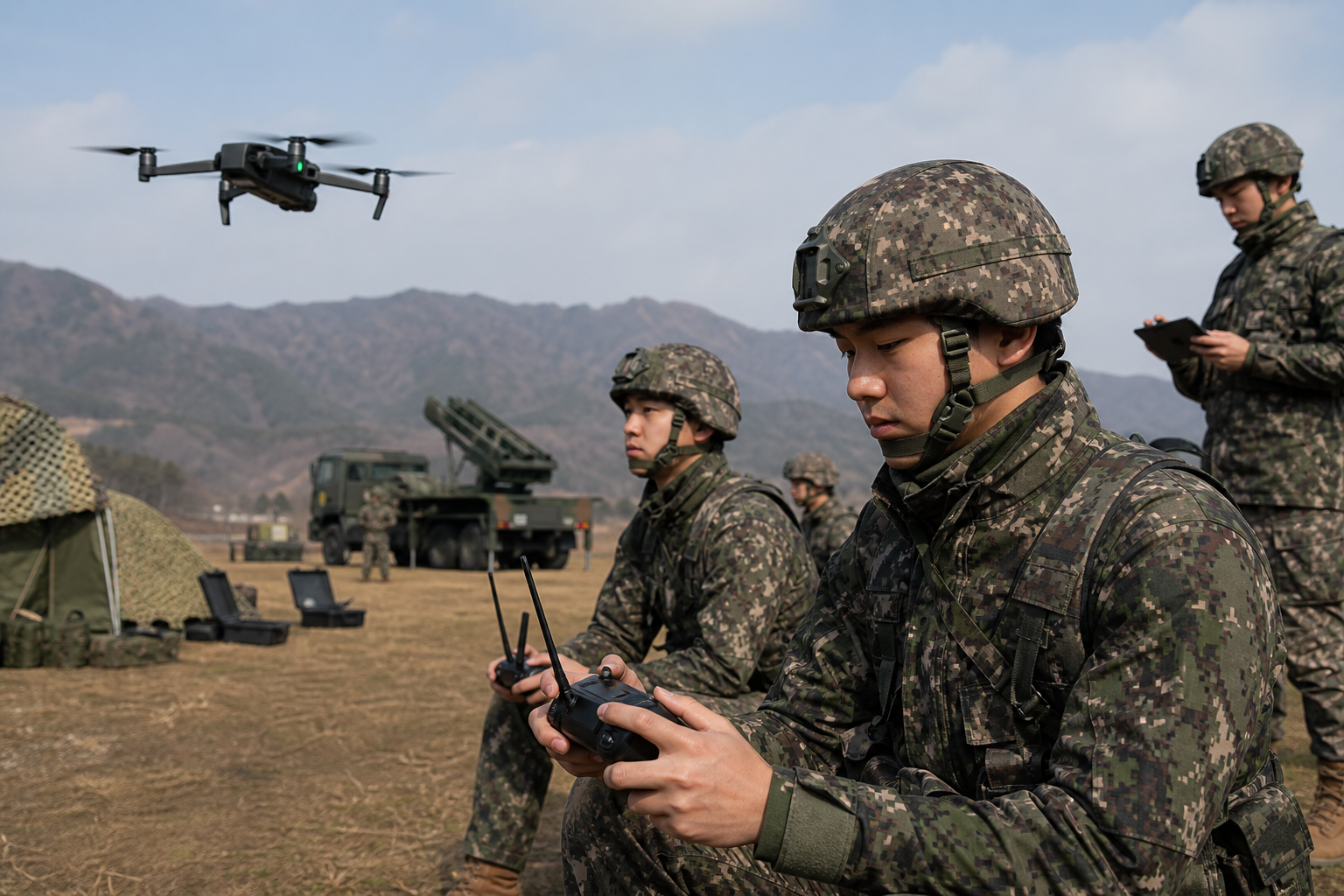
South Korea has announced plans to train its military personnel on drone operation, with the program intended to cover its roughly 500,000 active service members and to establish drones as a universal combat tool across all military units. That scope has triggered the predictable objection: surely not everyone needs this skill. Surely a modern military should rely on specialized drone units, selective certification, and mission-specific training rather than a force-wide mandate.
That objection sounds practical. It is also too narrow for the battlefield South Korea is preparing to face.
The real question is not whether every cook, mechanic, medic, submariner, or infantry soldier needs to become an elite drone pilot. They do not. The real question is whether a military that intends to make drones universal can afford a fragmented training model in which only some personnel understand how drones are operated, integrated, deconflicted, sustained, and used under pressure. It cannot.
The strongest critics of universal drone training raised serious concerns. Some argued that training 500,000 people is an inefficient allocation of time and money, particularly if many roles will rarely operate a small quadcopter or tactical unmanned system directly. Others warned that universal training could devolve into a lowest-common-denominator exercise, producing shallow familiarity rather than meaningful competence. Still others worried about bureaucratic bloat, contractor capture, or a superficial modernization campaign that looks advanced on paper while draining readiness elsewhere.
Those are not unserious points. Any program at this scale can become performative if the state confuses coverage with capability. A bad version of universal training would indeed waste resources. If South Korea tried to push identical drone proficiency standards onto every branch, specialty, and billet, critics would be right. Military modernization fails when uniformity is mistaken for sameness.
But that is not the only model of universalism, and it is not the best one.
A competent state does not respond to technological change by waiting for units to self-organize, improvise standards, and discover interoperability after the fact. That is not resilience. It is fragmentation with better branding. In military affairs, fragmentation imposes costs on everyone else. Units that underinvest in drone literacy force neighboring units to compensate. Commanders lose a common operating language. Logistics becomes harder. Safety deteriorates. Tactical opportunities are missed because the personnel on scene do not know what drones can do, what they cannot do, or how to plug into a drone-enabled operation.
This is why the resolution is correct. South Korea should implement universal drone training across its entire military force, not as universal specialization, but as universal baseline competence under a centrally designed framework.
That distinction matters. Universal drone training should mean that every service member receives a standardized foundation in drone operation, drone awareness, airspace discipline, basic tactical employment, counter-drone precautions, maintenance realities, and the command relationships surrounding unmanned systems. On top of that baseline, selected personnel and units should receive advanced, role-specific instruction. In other words, breadth first, depth second. The baseline must be universal; the mastery can and should be tiered.
This approach answers the efficiency objection better than critics do. The targeted alternative sounds lean, but in practice it tends to produce expensive islands of expertise in a sea of organizational ignorance. A smaller drone cadre may be highly capable, yet the rest of the force remains dependent, slow to integrate, and prone to misuse or nonuse. The result is hidden inefficiency, not savings. Specialized units become bottlenecks. Every request must flow through them. Every mission waits on scarce operators. Every branch develops different habits, vocabularies, and tolerances. That is exactly how a supposedly modern tool remains marginal.
By contrast, universal training creates a common military utility. It allows drones to be treated less like an exotic capability and more like radios, maps, or digital battle management systems, tools whose value depends on broad institutional familiarity. No serious military would argue that only a narrow specialist class should understand communications equipment because universal training is too expensive. Once a capability becomes central to operations, baseline literacy ceases to be optional.
The decentralization argument, presented in the debate as a case for distributed resilience and bottom-up innovation, identifies a real goal but proposes the wrong mechanism. Distributed capability is valuable. South Korea should want many units able to employ drones flexibly. But distributed capability does not emerge from permissionless acquisition and local experimentation alone. It emerges from central standardization that makes local adaptation possible. Shared protocols, common doctrine, interoperable systems, and baseline training are the architecture within which initiative becomes useful rather than chaotic.
The market analogy often implicit in anti-centralized arguments fails here for a reason. Military readiness is a public good inside the force. Individual units do not fully bear the cost of undertraining in drone integration; the institution does. One commander can decide that another skill is a higher local priority, but the resulting interoperability gap is paid for by the wider military when a joint operation stalls, miscommunicates, or leaves valuable unmanned capability unused. Central planning is not a luxury in that environment. It is the mechanism by which the institution prevents underprovision of a capability that benefits everyone but would otherwise be unevenly adopted.
There is also an equity argument that deserves more attention than it usually receives in defense debates. Universal drone training ensures that technological competence is not hoarded by prestige units, favored branches, or better-connected commands. If drones are to become a universal combat tool, then access to the knowledge required to use them should not depend on assignment luck. A force-wide standard prevents a two-tier military in which some personnel train for tomorrow's battlefield while others remain trapped in yesterday's structure.
The concern about ethics and safety is likewise best solved by universalism, not by delay or selectivity. The wider the expected use of drones, the stronger the case for common training in rules, limitations, accountability, and coordination. A military that deploys unmanned systems broadly but trains only a narrow operator class invites misuse by everyone else. Baseline knowledge across the force is a safeguard.
The most useful way to understand South Korea's decision is not as a bid to make 500,000 people identical drone operators. It is a bid to make drone integration nonoptional across the institution. That is strategically sound. South Korea faces a security environment in which readiness gaps are dangerous and coordination failures can be costly. In that context, the state should not hope that units converge on best practice by themselves. It should build that convergence deliberately.
A military of half a million active personnel cannot treat drones as a boutique specialty if its stated objective is to make them universal across all units. It needs doctrine, procurement discipline, safety rules, standardized curricula, tiered certification, and clear implementation metrics. Those are the instruments of serious public planning. Used well, they do not suppress effectiveness. They scale it.
The winning case for universal drone training is therefore not technological enthusiasm, and it is not bureaucratic maximalism. It is institutional realism. When a capability is central to modern operations, the state must ensure that it is understood everywhere, not merely mastered somewhere. South Korea is right to act accordingly.