
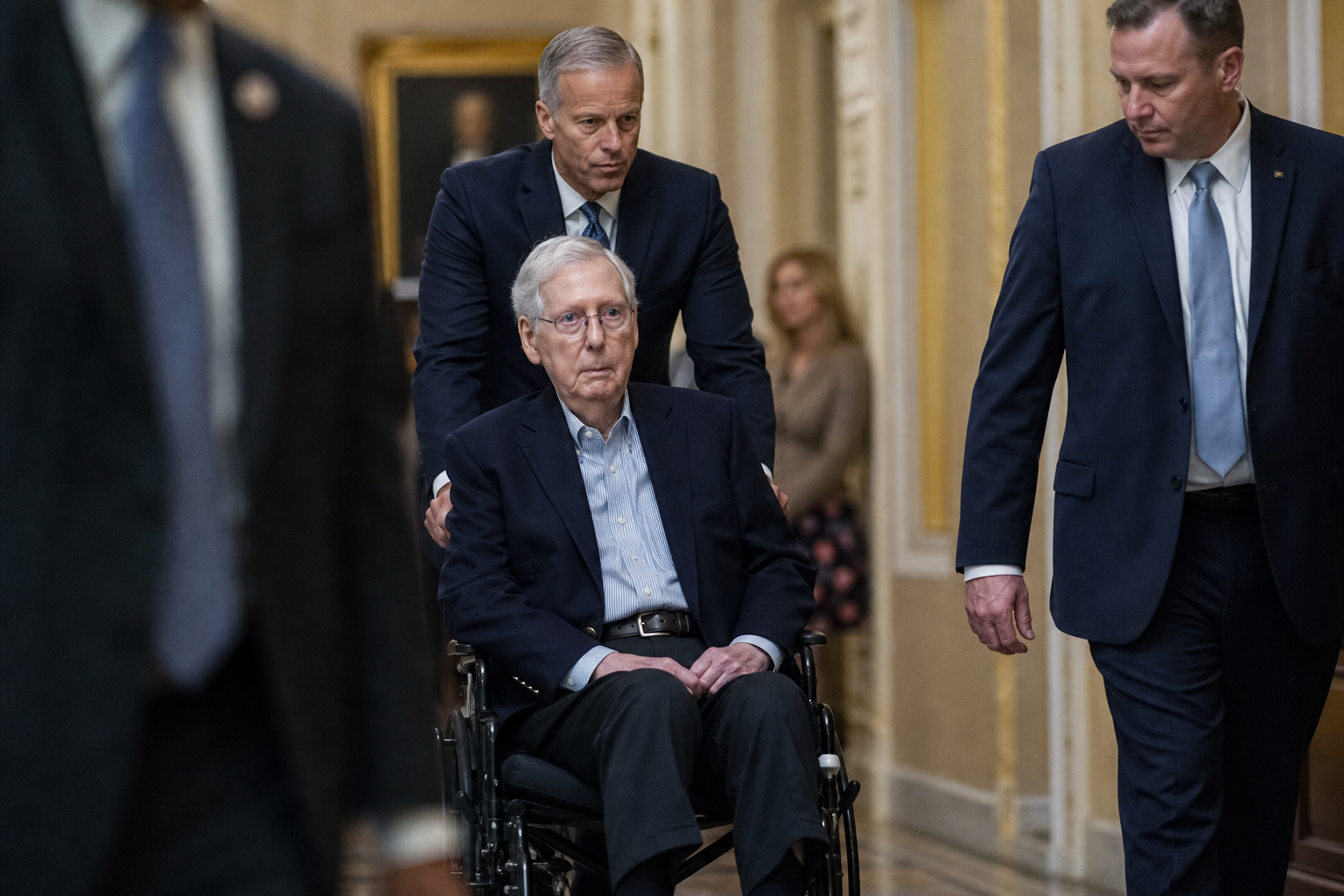
The case for regular fitness-for-duty medical evaluations for U.S. senators over 75 is not really about Mitch McConnell. It is about the Senate's duty to function even when individual officeholders cannot, or will not, offer timely clarity about their condition.
The immediate facts are modest but revealing. McConnell made a public statement after weeks without public comment. He said he is recovering from a fall. He denied suffering a heart attack. He was discharged from a hospital and transferred to a physical rehabilitation center. No date was given for his return to the U.S. Capitol. None of this proves incapacity. That is precisely the point. In the absence of a regular, credible process, the public is left to speculate, colleagues are left to improvise, and a constitutional institution is left to run on rumor.
A serious republic should not govern this way.
The resolution before us is narrow. It does not call for age caps. It does not force retirement. It does not empower party leaders to expel a rival. It asks whether senators over 75 should be required to pass regular medical evaluations establishing fitness for duty. The answer should be yes, because the Senate is not a private club and a senator's health is not solely a private matter once it affects representation, committee work, floor votes, negotiations, and leadership continuity.
The strongest objection is constitutional. Critics argue that the Constitution lists the qualifications for serving in the Senate, age, citizenship, and residency, and that adding a medical test amounts to inventing a new qualification for office. This concern deserves respect. A medical standard cannot become a disguised mechanism for nullifying elections. But that objection overstates what a fitness evaluation must be.
Government already distinguishes between qualifications for office and conditions for performing official duties. Financial disclosures, ethics rules, security procedures, and attendance expectations do not rewrite the Constitution. They operationalize the public's right to a functioning institution. A narrowly tailored fitness-for-duty framework would do the same. It need not say that illness makes one ineligible to hold office in perpetuity. It can say that because senators exercise immense public power, there must be a regular, independent process for determining whether they can presently discharge core duties, with transparent consequences for temporary incapacity and clear procedures for review.
That is not constitutional vandalism. It is basic administrative competence.
Another objection is that voters should decide. In a broad democratic sense, they do. Elections remain the ultimate source of authority. But elections are episodic, blunt, and poorly suited to real-time incapacity. Voters cannot cast an informed ballot on conditions they cannot see, especially when health information is partial, delayed, or strategically managed. McConnell's recent case illustrates this information gap. After a fall, hospitalization, and transfer to rehabilitation, the country still had no specific return date to the Capitol. The electorate cannot meaningfully police capacity when the facts arrive late and in fragments.
The costs of this fragmentation are not theoretical. Every prolonged uncertainty surrounding a senator's health affects staffing, committee scheduling, whip counts, constituent services, and leadership planning. In a closely divided chamber, one absent senator can alter confirmations, appropriations, and national security votes. The harm is not merely partisan. It is institutional. The Senate's work depends on predictable participation, and the public has an interest in continuity that cannot be outsourced to private doctors, family spokespeople, or partisan communications teams.
The age threshold of 75 also invites charges of arbitrariness or age discrimination. Here the critics have a point worth acknowledging. Age is an imperfect proxy. Some senators under 75 are less fit than some senators over 80. But policymaking often uses administrable thresholds when risks increase materially with age and individualized monitoring is impractical. We accept enhanced screening rules in many settings not because every person in the category is impaired, but because the aggregate risk profile changes and the cost of failure is high.
The Senate is one of those settings. A senator is not merely another worker. A senator can stall legislation, shape wars and budgets, influence judicial appointments, and represent millions of people. When the office is this consequential, the public standard should be higher than trust us.
The final serious objection is political weaponization. Who picks the doctors? Who defines fitness? Could a majority use medicine as a pretext to marginalize inconvenient elders? This is the most practical challenge, and it is exactly why the answer must be a standardized federal framework rather than the current ad hoc mess. Fragmentation invites abuse because it leaves disclosure to campaigns, parties, and personal entourages. A centralized system can build guardrails.
Those guardrails are not mysterious. Evaluations should be conducted by an independent bipartisan medical board with staggered appointments and fixed criteria. The assessments should focus on capacities essential to senatorial duty, cognitive functioning, mobility sufficient for attendance, and the ability to communicate decisions, not on irrelevant diagnoses. The results disclosed publicly should be limited to a pass-fail determination plus any temporary work restrictions, protecting legitimate privacy while providing meaningful accountability. There should be an appeals process, periodic reevaluation, and no automatic removal from office absent existing constitutional procedures. In short, the policy can be designed to reduce both opacity and opportunism.
What opponents ultimately defend is not liberty, but drift. They prefer a system in which incapacitation is handled informally, disclosures are selective, and the nation learns the status of senior lawmakers through leaks, press huddles, and conspicuous absences. That model is not respectful of voters. It is contemptuous of them. It assumes the public deserves theater instead of standards.
Experience and seniority matter. Institutional memory matters. This argument is not a brief against older senators. Many serve with distinction well past 75. But experience is an asset only when it remains usable in office. A legislature that cannot distinguish between honoring service and verifying capacity has confused sentiment with stewardship.
McConnell's statement may reassure some Americans, and his recovery may proceed smoothly. One hopes it does. Yet public policy cannot be built on optimistic case-by-case assumptions, especially for offices that carry national consequence. The proper lesson from this episode is not that one senator looked frail, nor that age itself is disqualifying. The lesson is that the Senate lacks a durable process for handling foreseeable human limitations in a system that requires continuous public trust.
That is what regular fitness-for-duty medical evaluations for senators over 75 would supply: not humiliation, not age panic, not a partisan purge, but a minimum standard of institutional seriousness. When power is public, capacity cannot remain purely private. A mature state plans for weakness before it becomes crisis. The Senate should do the same.