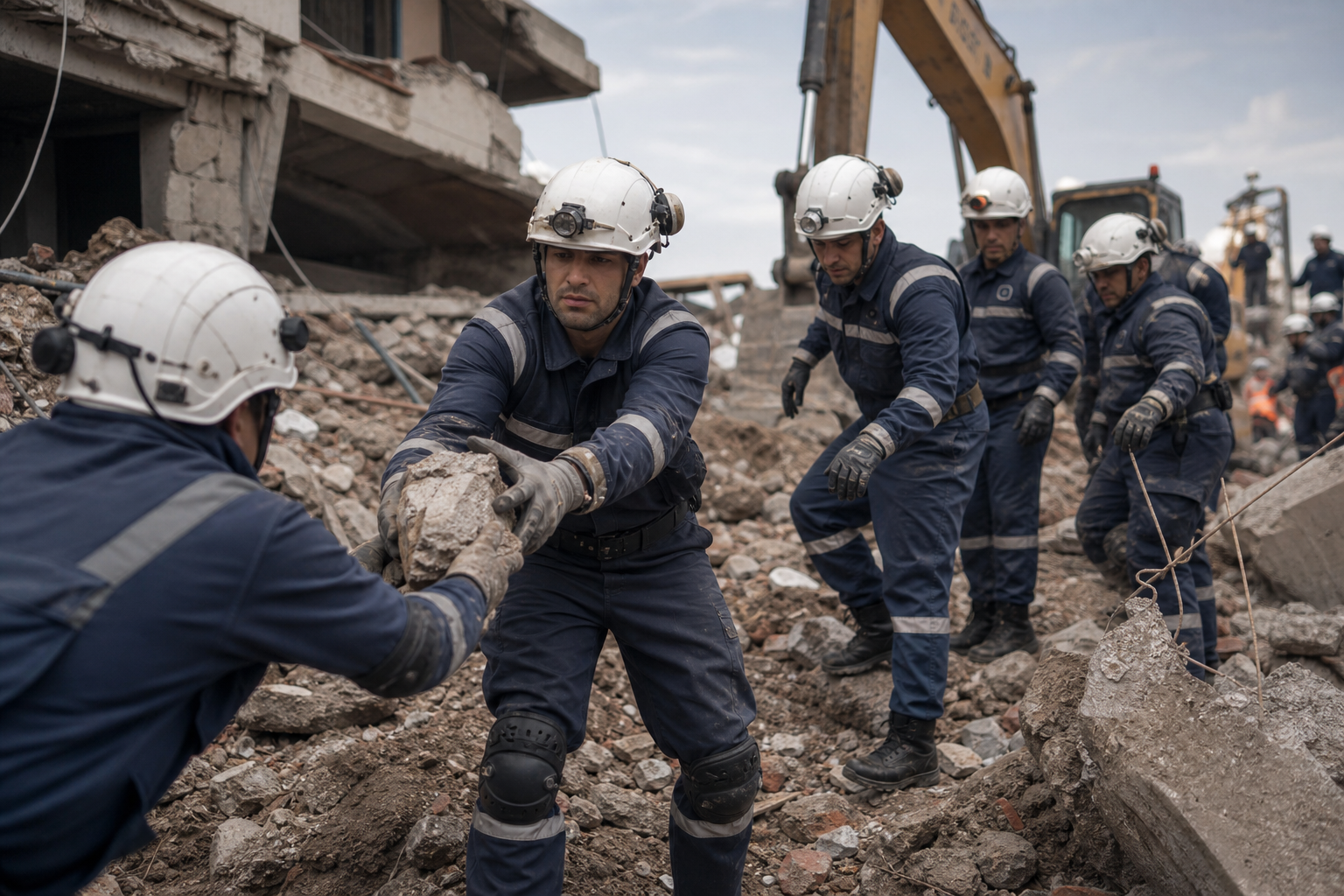
The case for deploying international rescue teams to natural disaster zones in countries with strained diplomatic relations is not sentimental, and it does not require pretending diplomacy, sovereignty, or operational risk do not matter. It is a straightforward judgment about comparative costs under severe time pressure. In Venezuela, earthquakes have killed 920 people, hundreds remain unaccounted for beneath collapsed structures, international rescue teams have arrived, and families are still searching for information about missing relatives. That is the entire decision environment. The question is not whether cross-border disaster response is tidy. It is whether refusing or delaying it produces better results. It does not.
In earthquake search and rescue, time is the scarce asset. Specialized urban search and rescue teams bring trained personnel, listening devices, search dogs, structural engineers, medical capacity, and extraction equipment that local responders may not have enough of, especially when a country is already under strain. The survival curve for people trapped under rubble is brutal. Every additional hour turns a rescue mission into a recovery mission. If outside teams can raise the probability of finding even a fraction of those still missing, the expected benefit is enormous and immediate.
That is why the resolution should be answered yes. International rescue teams should be deployed to disaster zones even when relations between governments are bad. Not because politics disappears in a crisis, but because the cost of letting politics dominate the first phase of disaster response is too high.
The strongest objection is not cynical geopolitics, though that exists. It is the argument about safeguards. Critics are right to point out that strained diplomatic relations can mean poor communication, uncertain legal status, limited access, security risks for rescuers, and opportunities for governments to manipulate aid. A rescue team cannot do much if it cannot clear customs, move fuel, enter affected areas, or coordinate with local incident command. In the worst cases, foreign responders can become a burden rather than a force multiplier.
That is a serious point, and a useful one, because it improves the policy. It does not defeat it.
The practical choice is not between perfect deployment and no deployment. In real disasters, the menu is uglier: imperfect deployment now, or cleaner process later when the life-saving window has closed. If your benchmark is ideal consent, ideal coordination, and ideal accountability before any boots move, you are pricing rescue out of the market. The people under concrete do not benefit from procedural purity.
A competent policy therefore treats diplomatic strain as an operating cost to be managed, not a veto point. That means deploy with conditions that reduce friction: use pre-cleared humanitarian channels where they exist; limit the mission narrowly to search, rescue, emergency medicine, and victim identification; work through internationally recognized disaster protocols; publish manifests and mission scopes; embed liaison officers with local authorities; and set clear exit timelines. In short, de-risk the intervention instead of abandoning it.
This is also where some opponents overstate the sovereignty problem. Sovereignty matters. A country is not an open field for foreign actors to enter at will, and unilateral intervention can backfire. But the resolution says rescue teams should be deployed to disaster zones in countries with strained diplomatic relations, not that they should invade without consent. Those are different claims. In the Venezuela case, international rescue teams have arrived. That fact matters. It means even amid diplomatic strain, some degree of permission, toleration, or practical accommodation was available. The relevant policy lesson is not that diplomacy makes rescue impossible. It is that crisis pressure often creates enough overlap of interest to allow life-saving operations to proceed.
And the interests really do align more often than the rhetoric suggests. The host government wants fewer deaths, fewer images of untreated devastation, and less domestic panic. Foreign governments and rescue organizations want lives saved and reputational credit for effective aid. Families want information and bodies recovered if survivors cannot be found. None of these incentives requires friendship. They require a transaction. Disasters create one.
There is also a broader reason to normalize rescue cooperation across hostile political lines. If every earthquake response becomes contingent on diplomatic warmth, then people in the worst-governed or most isolated countries pay the highest mortality penalty. That is a terrible allocation rule. Natural disasters already hit unevenly. We should not add a geopolitical surcharge to survival. The principle should be simple: the more acute the life-saving window, the lower the tolerance for political delay.
Some critics warn that humanitarian deployment can be exploited for intelligence gathering, propaganda, or leverage. Fair enough. States pursue mixed motives all the time. But mixed motives do not erase real benefits. If a foreign search team pulls survivors from a collapsed apartment block, the rescue is not fraudulent because a government also held a press conference. The correct response to the risk of politicization is transparency and mission discipline, not paralysis. Keep the scope narrow, monitor conduct, and get the teams where they need to go.
Others argue that reliance on international rescue undermines long-term domestic capacity. There is a kernel of truth there too. Countries need stronger local emergency management, better building standards, and more resilient infrastructure. But that is a reconstruction and preparedness argument, not a reason to decline help during the golden period after an earthquake. You do not refuse a fire brigade because you should have installed sprinklers. You save what can still be saved, then fix the system.
The debate ultimately comes down to decision quality under constraint. When 920 people are dead, hundreds are still missing under collapsed structures, and families are desperate for information, the burden of proof should fall on those who want to slow or block international rescue teams. They need to show that the diplomatic and operational downsides exceed the expected lives saved. In most earthquake scenarios, that is a losing case.
The pragmatic framework prevails here because it respects both urgency and reality. It concedes the obvious, strained relations increase friction, operational safeguards matter, sovereignty is not imaginary. Then it asks the only question that matters in the first 72 hours: what course of action gives trapped people the best chance at survival and families the best chance at answers? The answer is not diplomatic waiting. It is controlled, rapid, narrowly scoped international deployment.
Earthquakes do not check foreign ministries before they hit. Rescue policy should not act as if they do.