
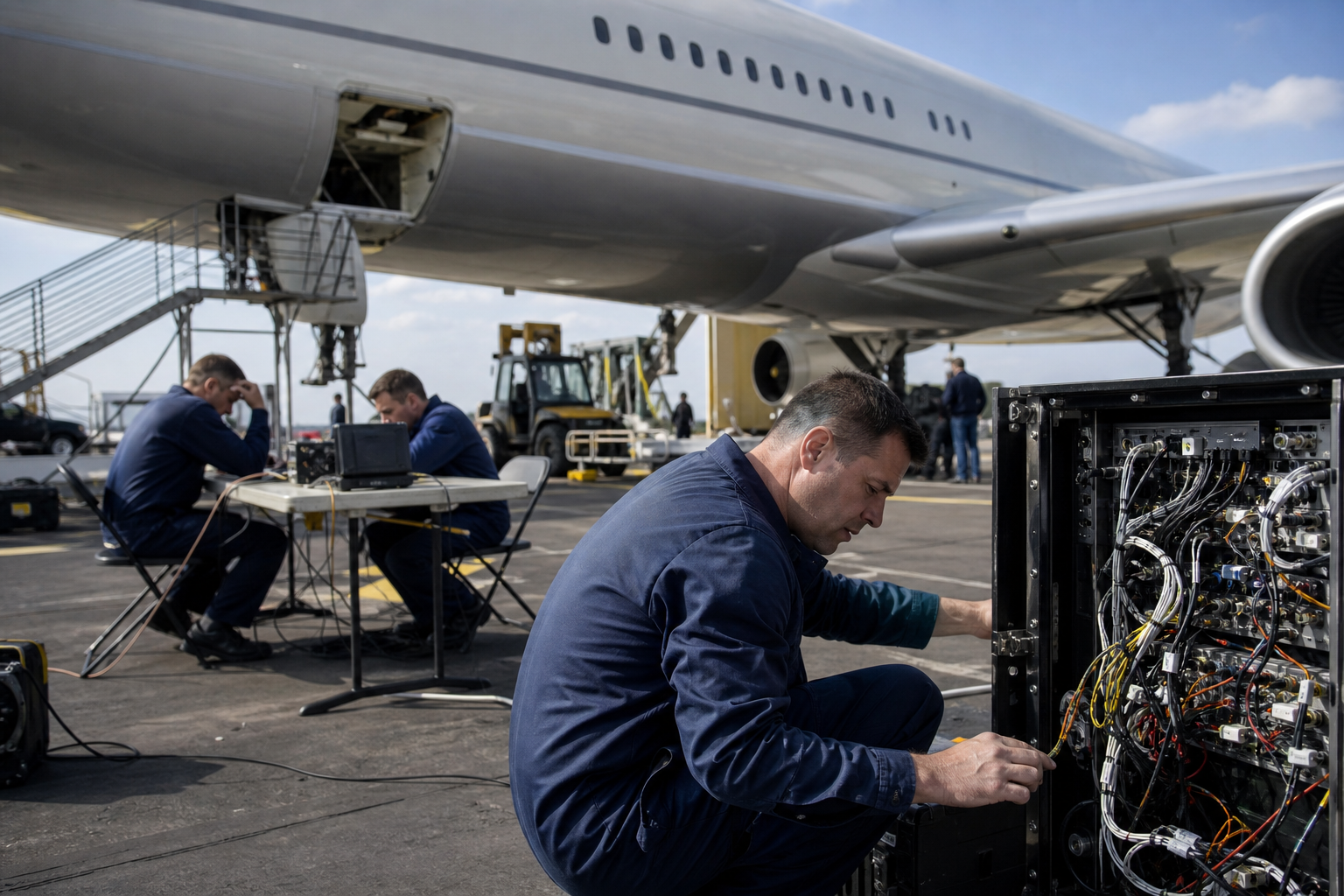
The policy question is not complicated, even if the politics around it are. A Qatari-donated aircraft has been discussed for presidential use. Donald Trump has said the new Air Force One will be taken out of service. The plane will undergo modifications described as being "maxed out." And public scrutiny has centered on whether the aircraft's defensive capabilities are sufficient to protect a U.S. president and other passengers onboard.
Those facts are enough to reach a sober conclusion. The United States should remove the aircraft from presidential service for enhanced security modifications.
That is not alarmism. It is basic state capacity. A presidential aircraft is not a normal government plane, and it is certainly not a luxury jet with a patriotic paint job. It is a flying command platform, a continuity-of-government asset, a communications node, and a target. Its standard is not "good enough to fly." Its standard is whether it can reliably protect the presidency under worst-case conditions, including threats the public will never fully see. When there are open questions about defensive capabilities, the burden is not on skeptics to tolerate risk. The burden is on the state to eliminate uncertainty.
Some of the objections raised in this debate deserve serious engagement, because they reflect real concerns about cost, delay, symbolism, and the difference between routine upgrades and full withdrawal from service. The strongest opposing case says, in effect, that presidential aircraft are always being updated. Scrutiny is normal. Modifications are continuous. Therefore, taking the plane out of service sounds more dramatic than necessary, perhaps even performative. Why not improve the aircraft in place, phase in changes, and avoid disruption?
Under ordinary circumstances, that would be a respectable managerial instinct. Complex systems are often modernized incrementally. Fleets are upgraded over time. Not every technical deficiency justifies a shutdown.
But this case is not defined by ordinary fleet maintenance. It is defined by the combination of three facts: the aircraft was donated by a foreign government, its defensive capabilities are under scrutiny, and the planned modifications are being described as "maxed out." That language matters. It suggests not a software patch or a cabin retrofit, but a fundamental security buildout intended to push the aircraft to the outer edge of what presidential protection requires. If the modifications are that extensive, removing the plane from service is not theatrical. It is operationally rational.
There is also a deeper point about how public institutions should handle high-consequence assets. Routine upgrades can be scheduled around service needs. Comprehensive security remanufacture cannot. A platform carrying the president must be tested, hardened, integrated, inspected, and recertified under controlled conditions. You do not improvise that process in the margins. You do not leave an aircraft in the symbolic orbit of presidential service while admitting, at the same time, that its defenses need to be maxed out. The contradiction is too plain.
A second objection is more subtle. It argues that too much emphasis is being placed on the aircraft's Qatari origin. After all, an airframe's source does not alone determine its final security profile. The United States can inspect, modify, and domesticate the platform. In that view, the important issue is not where the plane came from, but whether American technicians can bring it up to standard.
That argument is partly right, and acknowledging that makes the case for removal stronger, not weaker. The problem is not that a Qatari donation is inherently disqualifying. The problem is that once a donated aircraft enters consideration for presidential transport, the United States assumes a heightened duty to revalidate every critical system according to its own standards. A foreign gift cannot be allowed to create ambiguity around sovereign control, supply chain assurance, defensive architecture, or public confidence. The answer is not paranoia about Qatar. The answer is disciplined federal oversight.
That is why removal from service matters. It marks the point at which the U.S. government stops treating the plane as a ready symbol and starts treating it as what it is, a strategic asset that must be rebuilt to American specifications before it can be trusted. The state should not be embarrassed by that. It should insist on it.
There is, to be fair, a narrow concern about precedent. If every security question leads to taking an aircraft out of service, governments can drift into overcorrection, delay, and spiraling expense. That would be a legitimate warning in a lower-stakes context. Bureaucracies do sometimes mistake visible action for effective action.
But presidential security is the wrong place to economize on institutional seriousness. The President of the United States is not merely another passenger. An attack on a presidential aircraft would not just endanger lives onboard. It would test military response, crisis communications, market stability, alliance confidence, and continuity of constitutional authority, all at once. The state exists, in part, to plan for exactly these concentrated risks that no private actor and no ad hoc arrangement can responsibly absorb.
This is where the broader philosophy of governance comes into view. Fragmented decision-making is often defended as flexible, adaptive, and efficient. Yet when the asset in question is Air Force One, fragmentation is simply another word for tolerated inconsistency. Presidential transport cannot depend on overlapping judgments, informal assurances, or optimism that upgrades will eventually close the gap. It requires a single accountable standard, enforced centrally, with no ambiguity about who is responsible if that standard is not met. That is what removal for enhanced security modifications accomplishes.
The most persuasive version of the opposition says that the state should focus on outcomes, not symbolic withdrawal. Agreed. But the outcome here is inseparable from the withdrawal. If the aircraft's defensive capabilities are under question, and if the required modifications are extensive enough to be called maxed out, then taking it out of presidential service is the mechanism by which the serious outcome is delivered. In this case, withdrawal is not symbolism. It is the administrative form of caution.
And caution is not weakness. It is one of the few virtues available to governments entrusted with irreplaceable responsibilities. The United States has many aircraft. It has one presidency. The central obligation is to ensure that any plane used for presidential travel can protect the office under the harshest conditions imaginable, not merely under peacetime assumptions or political convenience.
That is the standard the public should demand. Not gratitude for a donation, not confidence games about optics, not a vague promise that upgrades are always happening. If the plane is not yet secure enough, it should not be in presidential service. Remove it, rebuild it, test it, certify it, and only then let it carry the president and other passengers.
On matters this consequential, the mature state does not muddle through. It verifies, hardens, and decides.