
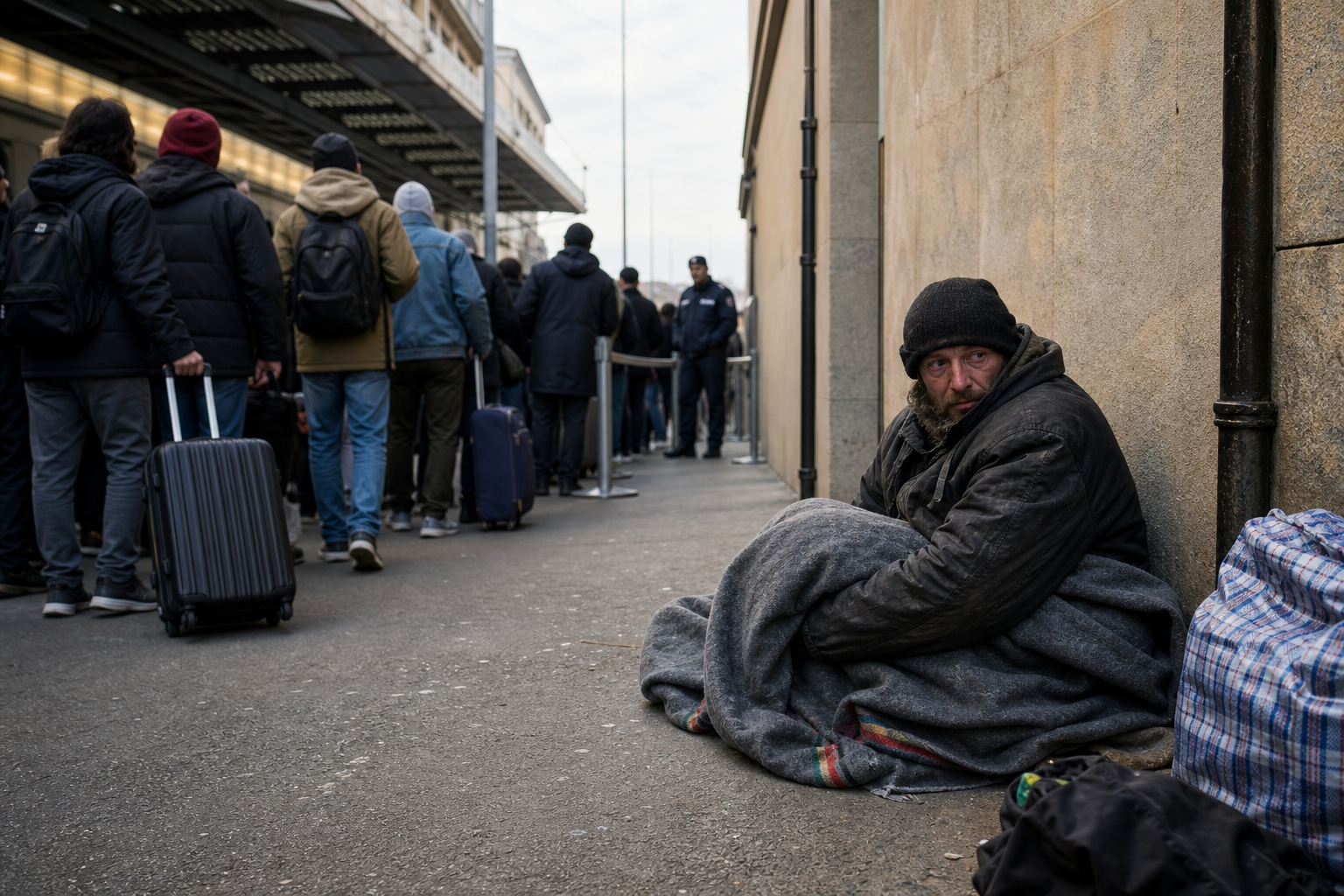
The argument sounds brutally simple. If a place has fewer newcomers, especially in a tight housing market, there may be less competition for rent, shelter beds, and social services. Therefore, reducing migration levels could reduce homelessness. A Reason Magazine article titled Fewer Migrants, Fewer Homeless puts that intuition into a memorable phrase.
But public policy cannot be built on intuition alone, especially when the proposed lever is restricting human movement and shifting burdens onto a politically vulnerable population. The stakes are not abstract. Homelessness means sleeping in cars, shelters, encampments, hospitals, and jail cells. Migration policy determines whether people fleeing danger, poverty, or instability can lawfully enter and remain. When these two issues are fused carelessly, governments invite a familiar abuse: treating outsiders as the adjustable variable for failures they created at home.
The strongest case for the resolution deserves to be taken seriously. Housing is finite in the short run. In many cities and regions, supply is inelastic, construction is slow, vacancy is low, and public benefits are strained. Under those conditions, any rapid population increase, whether from migration, domestic in-migration, or natural growth, can intensify competition at the bottom of the market. The poorest renters are the first to be displaced. If that is all one means by calling migration reduction an effective policy tool, then there is a narrow, practical point here: in an undersupplied housing system, lowering demand pressures can produce short term relief.
That concession matters, because serious analysis should not pretend arithmetic does not exist. More people chasing too few homes can worsen housing insecurity. If a local government has failed to build housing, expand vouchers, fund shelters, or provide mental health and addiction treatment, then population growth can expose and accelerate the harm. In that limited sense, migration levels can interact with homelessness numbers.
But the resolution is broader than that narrow point, and the available evidence is far weaker than the policy claim being made. We do not have a dataset, a timeframe, a city, a state, or even a clear definition of who counts as homeless in the cited article excerpt. We have a headline. A headline can suggest correlation. It cannot establish causation, rule out confounding variables, or prove effectiveness.
That missing rigor is not a technicality. It goes to duty of care. Before a government uses migration restriction as a tool for reducing homelessness, it should have to show at least four things. First, that homelessness actually fell in a measurable and meaningful way. Second, that the decline was not better explained by other factors, such as more housing supply, lower rents, changed counting methods, an improving labor market, colder weather dispersing encampments, or stricter enforcement moving people out of sight. Third, that any effect was durable rather than a brief fluctuation. Fourth, that the harms imposed by migration cuts were proportionate to the benefit.
That burden of proof has not been met here.
This is where the precautionary principle matters. Restricting migration is not a harmless pilot program. It can separate families, trap people in danger, reduce labor supply in sectors that build and maintain housing, and intensify stigma toward migrants and unhoused people alike. It can also create perverse incentives for officials to underinvest in the real solution. If leaders can claim that homelessness is mainly a function of who arrives, they can avoid accountability for zoning bottlenecks, inadequate public housing, weak tenant protections, frozen vouchers, and fragmented mental health care.
The opposing side in this debate pressed a fair challenge: must we wait for perfect evidence while people remain homeless? No. Governments often must act amid uncertainty. But acting amid uncertainty is not the same as privileging the most punitive, rights-restricting option on the basis of the thinnest evidence. A city can expand rental assistance without proving every downstream effect with laboratory precision. A state can streamline housing approvals, acquire hotels for shelter conversion, or fund supportive housing because these measures address the housing problem directly. They are at least targeted to the mechanism of harm.
Migration restriction is different. It is a blunt instrument aimed at people rather than the housing system. It treats scarcity as fixed and asks who should be excluded from it. That is politically tempting because it can produce visible numerical changes faster than building apartments or reforming service delivery. But speed is not the same as effectiveness. If a policy reduces the queue by denying entry to some applicants, while leaving the broken institution intact, it may improve a metric without solving the underlying problem.
There is also a deeper fairness issue. Homelessness policy should be evaluated by whether it reduces unsheltered living and housing instability without arbitrary burden shifting. A government that has underbuilt housing for decades does not earn moral or analytical credit by saying, in effect, we failed to prepare, so fewer outsiders must come. That response reverses responsibility. The state has the primary duty to plan for population change, regulate land use, fund emergency shelter, and protect vulnerable residents from foreseeable displacement. Migration may affect the scale of the challenge, but it does not erase that duty.
The better synthesis of this debate is therefore neither denial nor scapegoating. Yes, population growth can stress a housing market. Yes, migration levels may matter at the margin in places with severe shortages. But no, that does not make reducing migration an effective homelessness policy in the sense that should guide responsible governance. At best, it is a contingent and temporary pressure valve. At worst, it is a misleading shortcut that converts a housing failure into a border argument.
If policymakers want to claim otherwise, they should bring evidence stronger than an evocative magazine headline. Show the data. Show the place. Show the timeframe. Show what happened to rents at the low end, shelter occupancy, eviction filings, and unsheltered counts. Show that the effect persists. Show that it outweighs the costs imposed on migrants, workers, families, and the broader economy. Without that, the slogan Fewer Migrants, Fewer Homeless is not a demonstrated solution. It is a hypothesis carrying serious human consequences.
The most responsible conclusion is plain. Reducing migration levels may sometimes reduce immediate demand pressure in a constrained housing market, but that does not make it a sound or proven tool for decreasing homelessness. The durable answer to homelessness remains what it has always been: more housing, better prevention, stronger income support, coordinated treatment, and competent public administration. When governments substitute exclusion for capacity, they do not solve homelessness. They merely reveal which vulnerable group they are least willing to defend.