
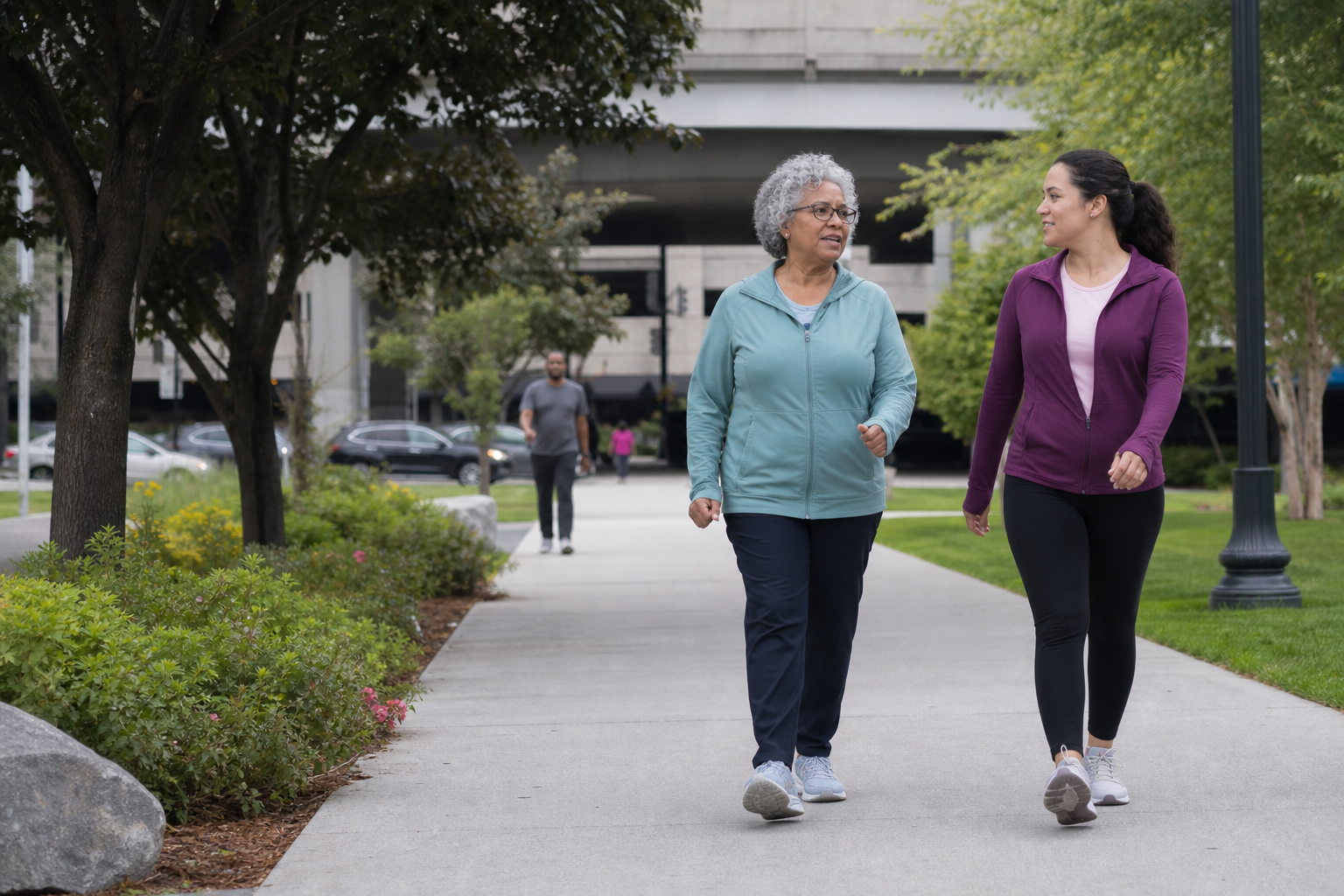
Public health campaigns should prioritize promoting daily 30-minute walking routines, but only if they do so honestly, safely, and with clear attention to unequal conditions on the ground. That is the right conclusion not because walking is fashionable, cheap, or easy to sloganize, but because it is one of the rare interventions that is broadly beneficial, low cost, habit-friendly, and adaptable to ordinary life. The case for prioritizing walking becomes strongest when paired with the duty of care that public health owes the people least well served by one size fits all messaging.
The stakes are straightforward. A public health campaign is not casual lifestyle content. It is an official signal about what matters, where scarce attention goes, and what kinds of behavior government and institutions are prepared to encourage. To prioritize a daily 30-minute walking routine is to tell the public that regular movement belongs at the center of preventive health. The fact sheet points to practical ways people already fold walking into daily routines, walking dogs before breakfast, getting off public transportation one stop early, building a repeatable habit rather than pursuing a punishing fitness plan. That matters because habit formation, not momentary inspiration, is what changes population health.
The best argument for prioritizing walking is not that it solves everything. It plainly does not. Walking will not fix unsafe streets, poor nutrition, untreated depression, or the time poverty of low wage work. Critics are right to warn against the familiar public health mistake of substituting individual behavior advice for structural reform. Telling a parent working two jobs to walk 30 minutes a day can become a form of institutional self-excuse if the same institutions tolerate neighborhoods without sidewalks, bus systems that waste hours, and public spaces that feel dangerous after dark. A serious walking campaign cannot become a moral lecture aimed at people navigating conditions they did not create.
That criticism deserves to be taken seriously because it identifies a foreseeable harm. If public health presents a daily walking target as universally simple, it risks excluding people with disabilities, chronic pain, mobility limits, caregiving burdens, or unsafe environments. It may also reinforce the idea that people who do not meet the target have simply failed to make good choices. Public health has a duty to avoid that trap. Safety and accessibility are not afterthoughts. They are part of the campaign itself.
But acknowledging those limits does not defeat the resolution. It sharpens it. The answer to an imperfect environment is not silence about beneficial habits. The answer is responsible guidance. A walking campaign can say, clearly, that 30 minutes is a target, not a test; that shorter bouts count; that people can adapt the routine to their body, schedule, and surroundings; that alternatives may be appropriate; that communities need safe routes, lighting, benches, sidewalks, and traffic calming if this advice is to be realistic. In other words, public health can promote walking without pretending everyone starts from the same place.
Some opponents argued that public health should avoid a single prescriptive routine and instead let communities generate their own solutions. There is truth in that instinct. The fact sheet itself reflects reader contributed suggestions, not a central planner dictating every step. Public health messaging works better when people can recognize their own lives in it. Walking the dog before breakfast, taking the stairs, stepping off the bus one stop earlier, these are context specific adaptations, and campaigns should welcome them.
Still, decentralization is not enough. Public health needs a clear, legible baseline. Without a simple target, campaigns become vague encouragements that are harder to remember, harder to evaluate, and easier to ignore. A 30-minute walking routine is useful precisely because it translates a broad health principle into an actionable habit. The goal supplies direction; the examples supply flexibility. That is not authoritarian. It is competent communication.
The strongest challenge came from the resource allocation side. Why prioritize walking over nutrition, sleep, mental health, or anti-smoking efforts? It is a fair question because prioritization always carries opportunity costs. Public health agencies have finite budgets, finite message bandwidth, and finite trust. They should not elevate a campaign merely because it is benign.
But this objection asks for a level of comparative precision that public health often cannot and need not have before acting on obvious, low risk measures. A daily walking campaign does not require expensive equipment, specialist staff, or complex compliance systems. The behavioral asks are modest. The suggested methods are already embedded in daily life. And unlike more intensive interventions, walking does not depend on subscriptions, transportation to facilities, or substantial out of pocket spending. In a crowded field of health messaging, that matters. Prioritizing walking is not the same as declaring every other intervention less important. It means recognizing a practical baseline intervention with unusually broad reach.
There is also a difference between a campaign that merely advertises walking and one that uses walking as an anchor for broader public health accountability. The second model is better. If officials encourage people to exit public transportation one stop earlier, they must also ask whether the route is safe to walk. If they recommend a before breakfast dog walk, they should consider whether people have access to secure green space, adequate lighting, and clean sidewalks. If they talk about daily movement and habit formation, they should ensure the message does not erase people who cannot walk 30 minutes continuously. A good campaign invites adaptation and exposes infrastructure gaps. A bad one hides behind personal responsibility.
This is why the precautionary principle does not argue against prioritizing walking. Properly understood, it argues against doing so carelessly. The foreseeable harms here are not produced by walking itself for most people, but by sloppy universalism, exclusionary messaging, and official indifference to unsafe conditions. Those risks can be mitigated. The foreseeable harms of saying nothing about regular movement, meanwhile, are substantial and ongoing. Sedentary routines become normal. Preventive health remains abstract. Another cycle of chronic illness is treated as regrettable but inevitable.
Public health should not wait for perfect comparative data before endorsing a simple, low barrier routine that many people can begin today. But it also cannot hide behind simplicity. The burden of proof lies with institutions that want the reputational benefit of a walking campaign without the harder work of making walking safer and more realistic for the public they serve.
So yes, prioritize promoting a daily 30-minute walking routine. Do it because habit formation matters, because people need concrete guidance, and because walking can fit into ordinary life, whether through a dog walk before breakfast or getting off the bus early. But do it with caveats that respect disability, with language that avoids blame, and with policy follow-through that treats sidewalks, street safety, and accessible public space as part of the health intervention rather than somebody else’s department.
A public health campaign is a promise as much as a message. If we tell people to walk, we incur an obligation to care where, how, and whether they can. That is not a reason to retreat from prioritizing walking. It is the reason to do it responsibly.