
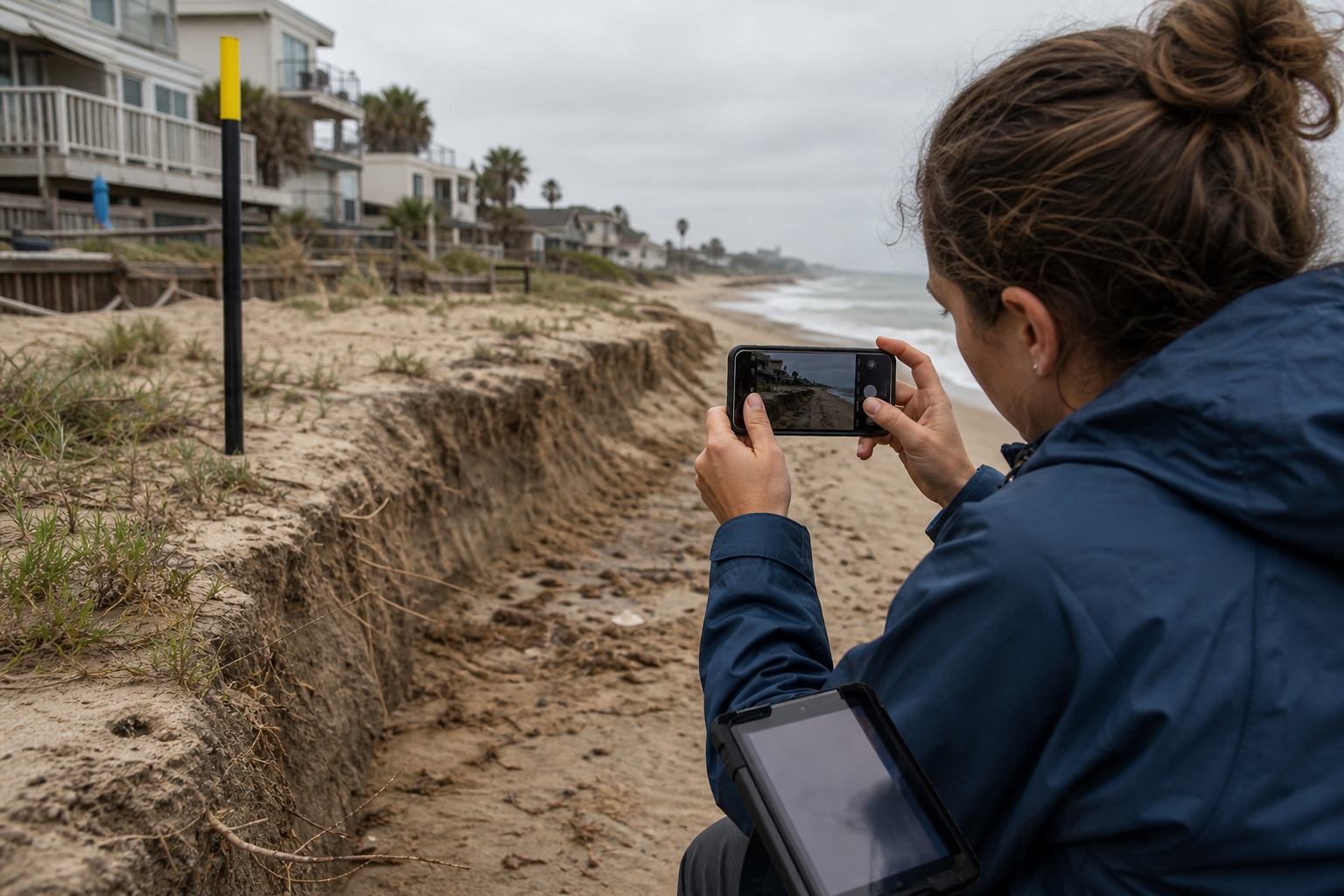
The resolution is straightforward: scientific institutions should actively solicit and utilize public photographs for climate change research. On the facts here, scientists are already collecting photographs taken by beachgoers, using them for research in coastal areas, with the goal of gathering data about climate change impacts on coastlines. The real question is not whether this is imaginable. It is whether institutions should lean in and build it out.
They should.
Not because crowdsourcing is fashionable, and not because public participation is inherently virtuous, but because coastlines are changing faster than many research budgets, field teams, and monitoring systems can keep up. Every month of under-observation is a month of lost evidence about erosion, flooding, dune loss, shoreline retreat, storm damage, and habitat change. If millions of people are already taking photographs at beaches, piers, promenades, and bluffs, then refusing to convert that ambient record into climate data is not prudence. It is waste.
The strongest case against soliciting public photographs comes in three forms. First, privacy and consent. Second, data quality. Third, institutional extraction, the fear that scientific organizations get free labor and messy liabilities while citizens get little control. These are not frivolous objections. They are the right objections to test any serious citizen science project.
Start with privacy. A beach photograph can capture faces, children, license plates, homes, routines, and metadata. Any institution that actively solicits public images has to confront that reality directly. This means opt in participation, clear terms of use, limited retention, strong anonymization practices where appropriate, and strict rules against repurposing imagery beyond research. The answer to privacy risk is governance, not paralysis. Scientific institutions already handle sensitive information in medicine, ecology, and geospatial research. They can build a system that asks for relevant coastal photographs while minimizing personal exposure.
The key point is that the existence of privacy risk does not defeat the project. It disciplines the project. If the standard were zero possibility of misuse, vast swaths of modern science would stop. The practical standard is whether the institution can obtain informed submissions, narrow the use case, and reduce foreseeable harms to acceptable levels. For public coastal photo collection, that is entirely achievable.
Now the harder objection, data quality. Public photographs are noisy. Camera angles vary. Dates can be wrong. Locations can be imprecise. People photograph scenic beaches, not necessarily representative ones. A stormy coastline and a tourist beach do not show up in equal proportions. Opponents are right that a giant pile of unstructured imagery does not automatically become good science.
But this objection confuses “imperfect” with “not useful.” Climate change research on coastlines does not require every image to function like a calibrated satellite sensor. It requires enough images, enough metadata, enough repeated vantage points, and enough computational filtering to extract patterns that would otherwise remain invisible or under-measured. The choice is not between perfect institutional data and flawed public data. The actual choice is between a sparse monitoring system and a denser one.
That matters because coastlines are dynamic. They change after storms, king tides, seasonal shifts, and long-term sea level rise. Traditional field campaigns are expensive, episodic, and geographically limited. A scientific team cannot stand on every beach every week. The public already can, accidentally. Soliciting public photographs turns passive recreation into distributed observation. That is not a gimmick. It is scale.
Critics often treat validation as an intolerable burden, as if processing public images will consume more resources than they save. That is too static a view of the problem. The entire modern advantage of digital science is that compute scales. Image sorting, geolocation checks, duplicate detection, quality ranking, shoreline extraction, and pattern recognition are exactly the kinds of tasks that software and machine learning increasingly help with. Human review is still needed, especially for edge cases and training sets, but the marginal cost of processing one more photo is falling. The marginal cost of dispatching one more field crew is not.
This is where the accelerationist case becomes concrete rather than rhetorical. A large public photo archive of coastal areas compounds in value over time. A single beach image is a snapshot. Ten years of beachgoer photographs from the same boardwalk, cliff path, or dune access point become a time series. That time series can reveal shoreline retreat, vegetation shifts, storm impacts, and infrastructure exposure. The more institutions solicit standardized submissions, the more useful future submissions become. Participation today lowers research costs tomorrow.
That compounding effect also answers the concern about unpaid public labor. Yes, institutions should avoid exploitative framing. They should be honest that they are asking citizens to contribute data. They should make participation voluntary, lightweight, and transparent. They should also give something back, including public dashboards, local findings, educational feedback, and open summaries showing what the photographs revealed about a given coastline. But let us not romanticize the alternative. The real alternative is not a perfectly compensated corps of community observers at every shoreline on earth. In most cases, it is no observation at all.
And no observation has a cost. It means slower detection of erosion hotspots. It means weaker coastal climate models. It means local governments and communities planning with less evidence. It means adaptation money allocated later or with less confidence. Delay is not neutral in climate research. Delay is information poverty, and information poverty shows up downstream as avoidable physical damage.
There is also a democratic upside here, if institutions handle it well. Public photography projects can make climate change visible in a way abstract models often do not. A resident who submits photos of the same stretch of beach over five years is not just donating data. They are seeing change accumulate in a familiar place. That can strengthen public trust in research because the evidence is not remote. It is legible in the coastline people know.
None of this means public photographs should replace traditional science. They should not. Beachgoer images are a supplement, not a substitute, for professional surveys, tide gauges, satellite imagery, lidar, and ecological sampling. The winning model is hybrid. Use rigorous instruments where rigor is indispensable, and use crowdsourced coastal photographs where scale, frequency, and historical depth are indispensable. The institutions that understand this will build better climate intelligence than the ones that cling to old bottlenecks.
So yes, scientific institutions should actively solicit and utilize public photographs for climate change research. They should do it with consent rules, privacy protections, and clear scientific protocols. They should do it knowing the data will be messy. They should do it anyway because the world is messy, coastlines are changing, and the cost of waiting for cleaner inputs is steeper than the cost of learning to use abundant ones.
The deeper principle is simple. When society already generates a massive stream of potentially useful information about a fast-moving public problem, serious institutions should not ignore it out of habit. They should organize it, improve it, and put it to work. Climate change is rewriting the edge between land and sea. Scientific institutions need every credible lens they can get, including the one already in the public's hand.