
The argument over whether private space companies should prioritize Mars mission development over Earth orbit infrastructure is, at bottom, an argument about sequencing, public goods, and institutional competence. It asks whether firms should direct scarce capital and engineering talent toward the most distant and glamorous objective, or toward the orbital systems around Earth that make every other objective cheaper, safer, and more durable. In this news cycle, the contrast is unusually vivid: Blue Origin has begun reconstruction work at a launch pad facility, a reminder that terrestrial and orbital capacity still requires painstaking investment; Relativity Space has announced targeting missions to Mars, a reminder that ambition remains abundant; and a French launch startup has even had to discontinue use of its rocket’s name because of a trademark issue, a small but telling example of how fragmented private competition can consume attention that broader planning would better discipline.
The resolution says private space companies should prioritize Mars over Earth orbit infrastructure. They should not. Not because Mars is unimportant, and certainly not because ambition is undesirable, but because Earth orbit infrastructure is the indispensable platform on which any serious Mars program rests. Launch facilities, orbital logistics, communications architecture, navigation, servicing capability, refueling systems, debris management, and standards for interoperability are not side quests. They are the system. A Mars mission without robust Earth orbit infrastructure is not evidence of strategic clarity. It is evidence of developmental imbalance.
The strongest case for prioritizing Mars deserves to be stated fairly. Its advocates argue that large goals force innovation. A company targeting Mars can pull investment, compress timelines, and create demand for better rockets, advanced manufacturing, life-support systems, and cheaper access to space. On this view, Mars is not a distraction from infrastructure but the catalyst for it. The bold objective disciplines engineering, inspires talent, and prevents the sector from becoming trapped in incrementalism. If Earth orbit becomes the destination rather than the staging ground, the industry risks endless optimization of low Earth orbit while postponing the civilizational leap that deep-space settlement represents.
This argument has emotional force and some practical truth. Ambitious programs do, at times, create technological spillovers. Clear missions can focus minds. Relativity Space’s Mars target is therefore not irrational. It is understandable as a strategy for differentiation in a crowded launch market, and as a means of attracting capital to long-horizon technology development.
But as a governing priority for the private sector as a whole, it fails. It mistakes aspiration for architecture. A mission target can motivate innovation, but it does not substitute for the underlying systems that make innovation broadly usable and economically efficient. In sector after sector, fragmented private actors underinvest in shared infrastructure because they cannot capture all of its returns. That is the textbook problem of public goods, and space is full of them. Reliable launch access, orbital traffic coordination, standardized interfaces, collision avoidance, environmental monitoring, and cislunar and Earth-orbit logistics create value well beyond the balance sheet of any single company. The benefits diffuse; the costs concentrate. Private firms therefore tend to free-ride, duplicate efforts, or build proprietary silos that maximize internal advantage while minimizing systemic resilience.
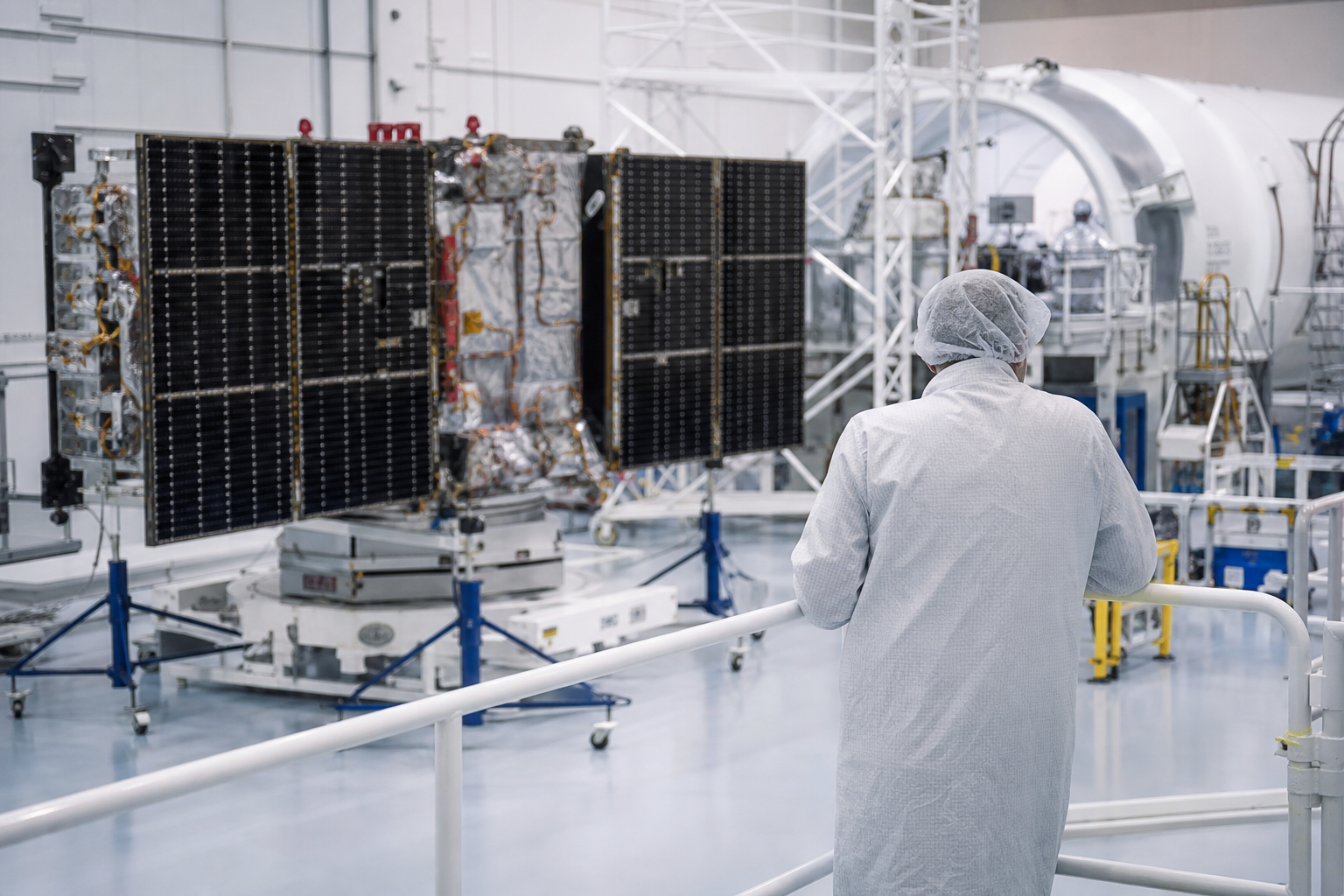
This is why Blue Origin’s launch pad reconstruction matters more than it first appears. A launch pad is not romantic. It does not carry the rhetorical electricity of a Mars manifesto. But reconstruction work at a launch facility reflects something more important than spectacle: patient capacity building. It strengthens the launch base that supports commercial satellites, science payloads, national security missions, in-space servicing, and, eventually, deep-space expeditions. It is exactly the kind of foundational investment that a healthy space ecosystem needs more of, not less.
Likewise, the minor story of a French launch startup changing a rocket name because of a trademark issue is not merely trivia. It illustrates the frictional costs of a fragmented landscape organized around narrow corporate claims. Trademark disputes are ordinary in markets, but in strategic sectors they are also symptomatic. They reveal how easily attention and resources are diverted into proprietary boundary-policing rather than integrated capability-building. No one should overstate the significance of a naming conflict, but neither should anyone ignore what it symbolizes: without coordination, firms optimize for their own lane, not for the network.
The market-oriented rebuttal is familiar. Competition, we are told, is not waste but discovery. Multiple firms trying different approaches produce innovation; central direction risks bureaucracy and stagnation. If Mars is commercially or strategically compelling, capital will flow there. If Earth orbit infrastructure offers better returns, firms will build that instead. Let the market decide.
This account is too elegant by half. The space economy is not a frictionless market, and it never has been. It is capital-intensive, safety-critical, deeply path-dependent, and saturated with externalities. Orbital congestion, debris risk, spectrum coordination, launch safety, and standards for servicing and docking are not matters that can be efficiently sorted by isolated private preference. Nor is this only about safety. It is about aggregate productivity. A sector built around interoperable orbital infrastructure lowers costs for everyone, expands participation, and enables multiple downstream missions, including lunar operations and Mars development. A sector built around prestige projects without shared systems produces islands of capability separated by bottlenecks.
The historical analogy is simple: societies that built ports, railways, power grids, and air traffic systems before overextending into speculative frontier schemes generated broader and more durable prosperity. They did so because infrastructure multiplies the returns of later ambition. Space is no different. The proper sequence is not anti-Mars; it is pro-capacity. Build the common layer first so that missions beyond Earth become repeatable rather than theatrical.
There is also an equity dimension that deserves more attention than it usually gets in these debates. Earth orbit infrastructure is not only a technical foundation for private companies. It supports communications, climate monitoring, disaster response, navigation, and scientific access that affect entire populations. The social returns of stronger orbital architecture are diffuse, global, and immediate. The private returns of a company branding itself around Mars may be substantial, but the public returns are delayed, uncertain, and contingent on the very infrastructure that has been deprioritized. When resources are finite, an orderly system should prefer investments whose benefits are widely distributed and whose enabling effects are cumulative.
None of this means abandoning Mars. On the contrary, a serious Mars agenda requires rejecting the fantasy that inspiration alone can carry an interplanetary program. Mars should be the long-range objective of a coordinated space strategy, not the near-term priority over Earth orbit infrastructure for private firms operating under fragmented incentives. If companies wish to develop Mars technologies, they should do so within a broader framework that first expands orbital lift capacity, servicing, logistics, standards, and reliability. That is how one converts a headline into a supply chain.
The debate’s most seductive mistake is to frame caution and ambition as opposites. They are not. The real opposition is between system-building and spectacle. Mars-first rhetoric flatters the imagination, but Earth orbit infrastructure sustains the enterprise. A reconstructed launch pad is not a retreat from the future. It is the future in usable form. A targeted Mars mission is not meaningless, but without the common architecture around Earth, it remains a narrow bet with broad dependencies.
Private space companies should therefore prioritize Earth orbit infrastructure over Mars mission development, and public institutions should reinforce that priority with standards, investment, and strategic coordination. The measure of seriousness in space policy is not how quickly one announces a destination. It is whether one has built the shared machinery that makes arrival possible.