
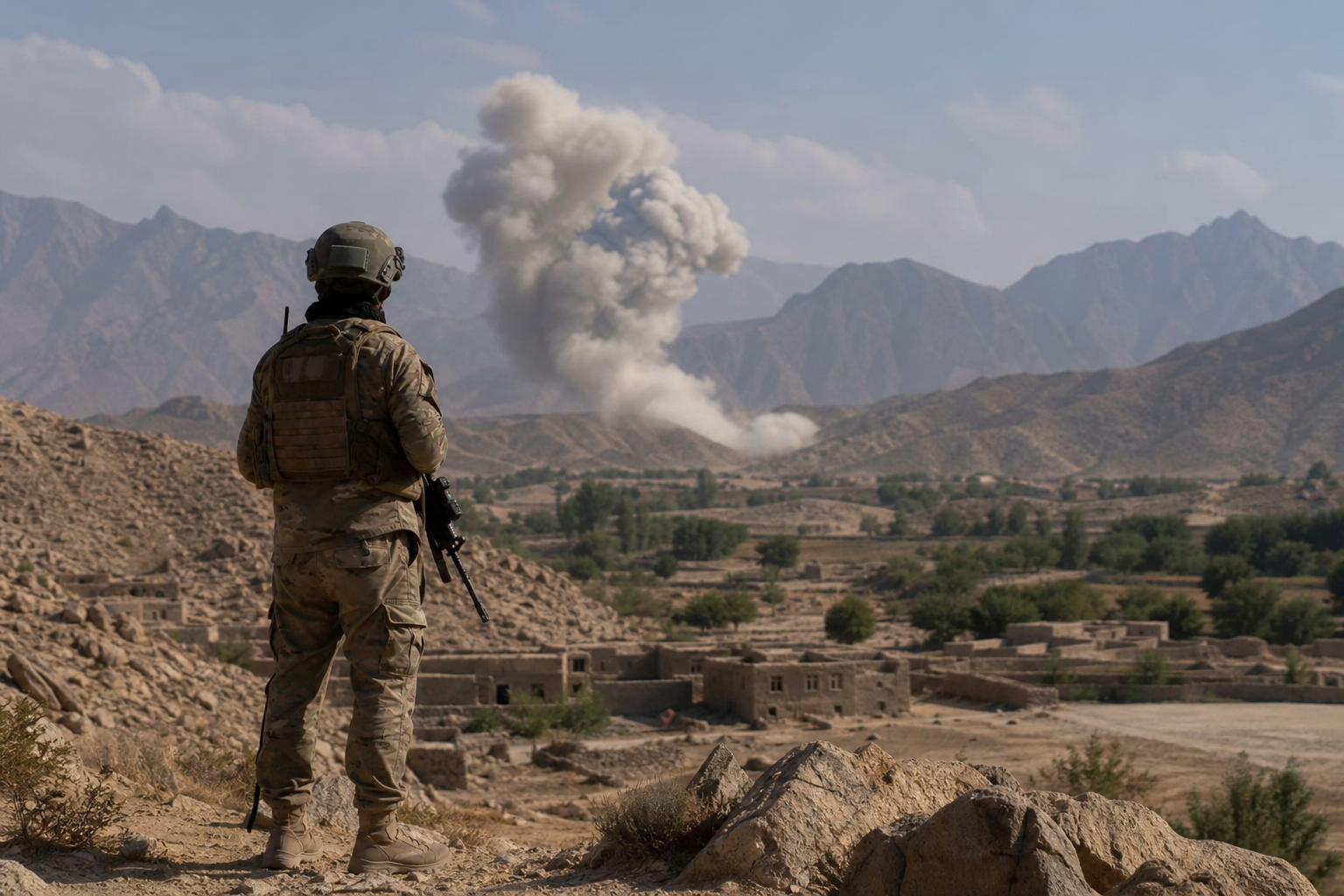
The argument over Pakistan's military strikes on Afghan territory turns on a hard question that states cannot evade for long: what is a government supposed to do when militants operate across the border, the neighboring authority does not neutralize them, and waiting carries its own body count?
That is the actual policy conflict here. Pakistan says it struck militants in Afghanistan. The Taliban government says the strikes killed dozens of civilians. The two governments dispute the nature of the casualties. Those facts are narrow, but the stakes are large. This is not just a quarrel about one incident. It is a test of whether a state facing cross-border militant threats must absorb repeated danger until perfect proof is available, or whether it retains a right to act in self-defense even under uncertainty.
My answer is yes, Pakistan is justified in conducting military strikes on Afghan territory to target militant groups, if the predicate is real and the operation is genuinely aimed at degrading an active threat. Not automatically, not infinitely, not without limits. But justified, yes.
The strongest argument against that conclusion deserves to be taken seriously. Critics are right to say that civilian protection is not a decorative concern. If dozens of civilians were killed, that is not a public relations problem. It is a grave moral and strategic event. They are also right that states lie, or shade, or selectively frame. "We targeted militants" is not a magic phrase that dissolves accountability. Cross-border airstrikes can generate blowback, deepen hatred, and create the next generation of fighters. A bad strike can be worse than no strike.
That critique matters because it identifies the central risk in this kind of operation: the gap between tactical action and strategic effect. If a strike kills innocents, it can fuel recruitment for militant groups, inflame Pakistan-Afghanistan tensions, and make the border even more unstable. Any honest defense of Pakistan's action has to concede that possibility up front.
But the cautionary case still fails as a governing standard. Why? Because it quietly converts uncertainty into paralysis. It treats disputed casualties, imperfect visibility, and the absence of independent real-time verification as reasons to suspend a state's operational right to defend itself from threats emanating from across a border. That standard sounds humane, but in practice it rewards exactly the actors most willing to exploit sovereign seams, civilian cover, and political hesitation.
Militant groups do not wait for legal clarity. They use sanctuary, mobility, and ambiguity as weapons. If Afghanistan's rulers are unwilling or unable to stop those groups, the cost of delay is not abstract. It compounds. Networks recruit. Bomb-makers relocate. Plotters learn. Border insecurity hardens into a permanent condition. A state is not required to accept an indefinitely accumulating threat merely because the geography of the threat lies a few miles beyond a recognized frontier.
This is where the debate often goes wrong. Critics frame the choice as action versus restraint, as though restraint were costless. It is not. Inaction has victims too. A government that knows armed groups are operating from neighboring territory and does nothing is not preserving peace. It is outsourcing risk to its own civilians and gambling that the next attack will be survivable. That is not prudence. It is passivity dressed up as principle.
The better test is not whether military strikes are immaculate. War never is. The better test is whether the strikes are the least bad available tool for reducing a continuing threat, and whether they are executed with enough discrimination that they diminish violence over time rather than expand it. On that standard, the existence of disputed casualty claims does not erase justification. It creates a burden of discipline.
That distinction is critical. Pakistan can be justified in striking militants inside Afghanistan and still be obligated to prove, as much as possible, that it selected legitimate targets, used proportionate force, and took precautions against civilian harm. Justification is not impunity. If anything, a justified right of self-defense imposes a higher requirement for competence, because strategic legitimacy depends on operational precision.
This is where some defenders of cross-border force become lazy. They invoke sovereignty, self-defense, and precedent, then stop thinking. That is not enough. If Pakistan wants the justification to hold politically, legally, and strategically, it must show that these strikes are part of a coherent counter-militancy strategy rather than episodic punishment. Are they degrading actual militant capacity? Are they based on credible intelligence? Are they selective enough to avoid turning local populations into enemies? Are they paired with diplomatic pressure and border security measures? Those questions matter because the point of force is not catharsis. It is security.
And yet the existence of those questions does not negate the core right. A border is not a suicide pact. A neighboring government does not get a de facto veto over a victim state's self-defense simply because the threat source sits on its side of the line. If militants enjoy sanctuary in Afghanistan and launch or prepare attacks against Pakistan, Islamabad does not have to wait for a cleaner world before acting. It has to act better than its enemies, not wait until risk disappears.
The most persuasive criticism from the opposing side is strategic, not moralistic: what if the strikes breed more militants than they kill? That is the right question. But it cuts both ways. What if failing to strike allows those militants to grow stronger, deadlier, and more entrenched? What if visible impunity is itself the recruitment tool? What if every successful sanctuary model becomes an advertisement to other armed groups that borders can be weaponized against slower states? In a region already strained by militancy and weak cross-border trust, the price of demonstrating helplessness can be very high.
So the real issue is not whether speed is reckless or caution is wise in the abstract. The real issue is which error is more dangerous in this setting. Given the facts we have, the more dangerous error is to deny Pakistan any justified room for cross-border action while militants operate from Afghan territory. That would create a standing incentive for armed groups to exploit sanctuary and for host authorities to do too little, too late.
A serious doctrine should be clear. Pakistan is justified in military strikes on Afghan territory when there is a credible militant threat, when Afghan authorities fail to suppress it, and when the operation is designed to be targeted rather than indiscriminate. Civilian casualty allegations must be investigated, because strategy without accountability curdles into self-defeat. But disputed claims do not by themselves void the underlying right of self-defense.
States survive by choosing among bad options before they become catastrophic ones. In border conflicts shaped by militant mobility, the most expensive mistake is often delay. The aim is not endless escalation. The aim is to deny sanctuary, compress the threat timeline, and restore deterrence before violence compounds further. If Pakistan struck militants in Afghanistan for that purpose, it was justified. The burden now is to ensure that justified force is also effective force, because the only thing worse than acting late is acting clumsily and having to pay for the same war twice.