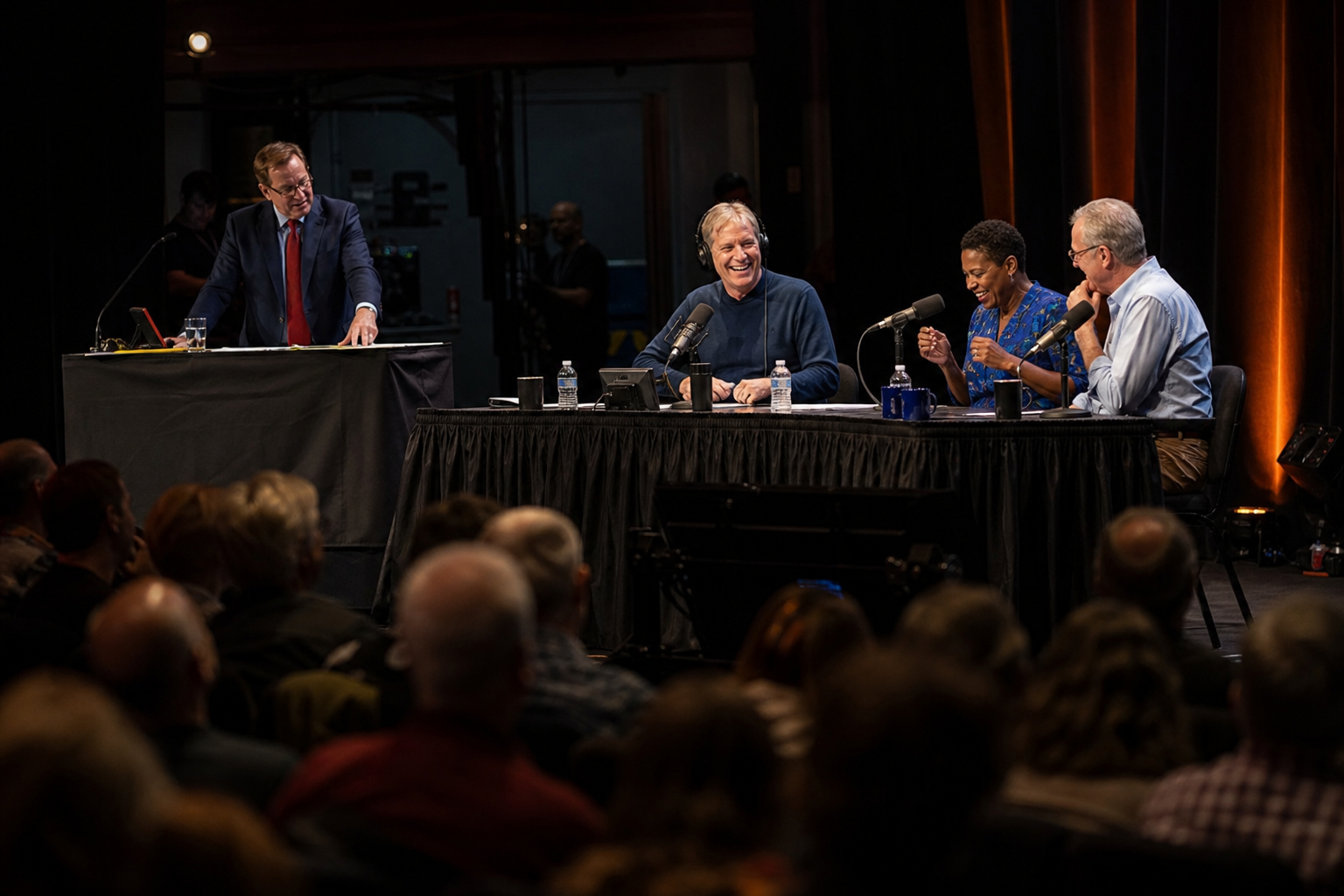
The case for expanding NPR live recordings of comedy news quiz shows beyond Chicago is not complicated, but it does require discipline. On July 18, 2026, Wait Wait Don't Tell Me aired a live episode recorded in Chicago, with Tom Papa as guest host, Vicki Peterson as the Not My Job guest, and Alonzo Bodden, Helen Hong, and Dulcé Sloan on the panel. That matters less as a glamorous one-off than as a useful operating signal. NPR has already shown it can put this format on the road, fill a room, produce the show, and preserve the product listeners expect.
The resolution is whether NPR should expand live recordings to more cities beyond Chicago. The right answer is yes, but not as a blanket cultural crusade and not as a touring vanity project. It should do it the way competent operators scale anything uncertain, start with markets where the math is favorable, preserve quality control, and stop pretending every city needs the same thing.
That middle position won the debate because it is the only one that respects both upside and friction. The strongest argument for expansion is straightforward. A live comedy news quiz recording is not just a broadcast. It is a second product layered on top of the first. It can create ticket revenue, deepen local station relationships, generate sponsorship opportunities, and strengthen audience loyalty in a way a studio-only show cannot. If one trip produces a solid show and a paying room, NPR is no longer guessing whether remote production is possible. It is deciding where repetition is worth the marginal cost.
The strongest argument against expansion is also real. One successful event in Chicago does not prove a national rollout pencil outs. Travel, venue rental, crew time, union rules, lodging, local promotion, contingency planning, and talent scheduling all add cost. Chemistry can suffer on the road. A show built on timing and familiarity can become looser, slower, or gimmicky if every episode starts to feel like an event operation instead of a radio program. And because NPR is not an arena-pop promoter, there is a legitimate concern that chasing live dates could drain resources from the core broadcast product.
Those objections deserve more respect than boosterism usually gives them. Chicago is not Boise, Birmingham, Phoenix, or Seattle. A single live Wait Wait Don't Tell Me episode, even with a strong lineup like Tom Papa, Vicki Peterson, Alonzo Bodden, Helen Hong, and Dulcé Sloan, is still one data point. The anti-expansion camp is right about that. Scale can kill unit economics. Plenty of media experiments look smart in one prestige market and mediocre everywhere else.
But that is exactly why the no-expansion position overreaches. The choice is not between one Chicago show and an instant fifty-city roadshow. It is between using a tested capability selectively, or leaving value idle because one does not have certainty in advance. In practice, institutions get better by running controlled expansions, not by demanding perfect proof before the next step.
The more ideological pro-expansion case also misses the mark. NPR does not need to justify this as a sacred project of national civic uplift or equitable cultural distribution. That framing invites bad decisions, because once expansion becomes a moral mandate, management starts booking weak markets to satisfy a theory instead of a budget. If the goal becomes symbolic access rather than operational performance, the result is exactly what skeptics fear, a patchwork of expensive dates, inconsistent attendance, and a diluted show.
Public service media still face arithmetic. If a live recording in another city costs substantially more than it returns in cash, audience growth, donor conversion, or affiliate value, it should not happen. Sentiment is not a business model. Neither is prestige touring.
So what should NPR actually do? Expand, but only under a hard filter.
First, prioritize cities with dense member station bases, proven public radio listenership, and venues appropriately sized for strong sell-through rather than headline bragging rights. A full room at 1,200 seats is better than a half-full room at 2,800. Second, lock in local underwriting or venue partnerships before final confirmation, so travel and production risk are partially pre-funded. Third, treat each live recording as a measurable acquisition and retention exercise, not just a stage event. NPR should want data on ticket buyers, member conversions, local audience growth, digital listening bumps, and post-event donations. Fourth, keep the production calendar limited enough that the regular show does not become operationally exhausted.
This is where the pragmatist framework beats both the nostalgists and the romantics. The nostalgists argue that centralized production is safer because the old model works. Fair enough, until the environment changes. Audio competition is brutal, loyalty is fragmented, and every media brand is fighting for direct audience connection. A high-quality live recording is one of the few ways a radio show can become tangible in a local market. Not every opportunity has to be seized, but refusing to test expansion because the current model is familiar is how institutions quietly age into irrelevance.
The romantics, meanwhile, want to make every city a symbolic node in a national cultural network. Nice rhetoric, bad procurement strategy. If NPR expands because every community deserves equal access to a touring comedy news quiz, it will either waste money in thin markets or pressure itself into subsidy-heavy programming with weak returns. Audiences do not benefit when resources are spread thinly in pursuit of geographic virtue.
The practical path is narrower and better. Use Chicago as proof of competence, not proof of universal demand. Build a tiered list of cities. Start with places where local stations are strong, venue economics are manageable, and the likely audience for a live Wait Wait recording is obvious. Run a handful per year. Measure aggressively. If some markets outperform, revisit frequency. If some disappoint, stop. No shame, no manifesto, just feedback.
There is also a qualitative upside that matters because it can be monetized without cheapening the show. Comedy news quiz programs work on intimacy and immediacy. A roomful of listeners changes pacing, lifts panel energy, and gives local audiences a reason to feel that public radio came to them rather than merely broadcasting at them. That can strengthen the bond between NPR and its affiliates in a way that generic fundraising appeals cannot. The trick is to capture that upside without letting the road schedule define the product.
Chicago, in this sense, is not the destination. It is a pilot. The July 18, 2026 episode proved that a live Wait Wait Don't Tell Me recording outside the default setting can be produced and aired with recognizable talent and a coherent broadcast result. That should move the conversation from abstract fear to disciplined expansion planning.
NPR should expand live recordings of comedy news quiz shows to more cities beyond Chicago because the opportunity cost of doing nothing is now real and the operational risk is manageable if it is kept selective. Not every city, not every week, and not for performative reasons. Just more cities where the numbers, the audience, and the show itself all say yes.
That is how institutions grow without getting stupid.