
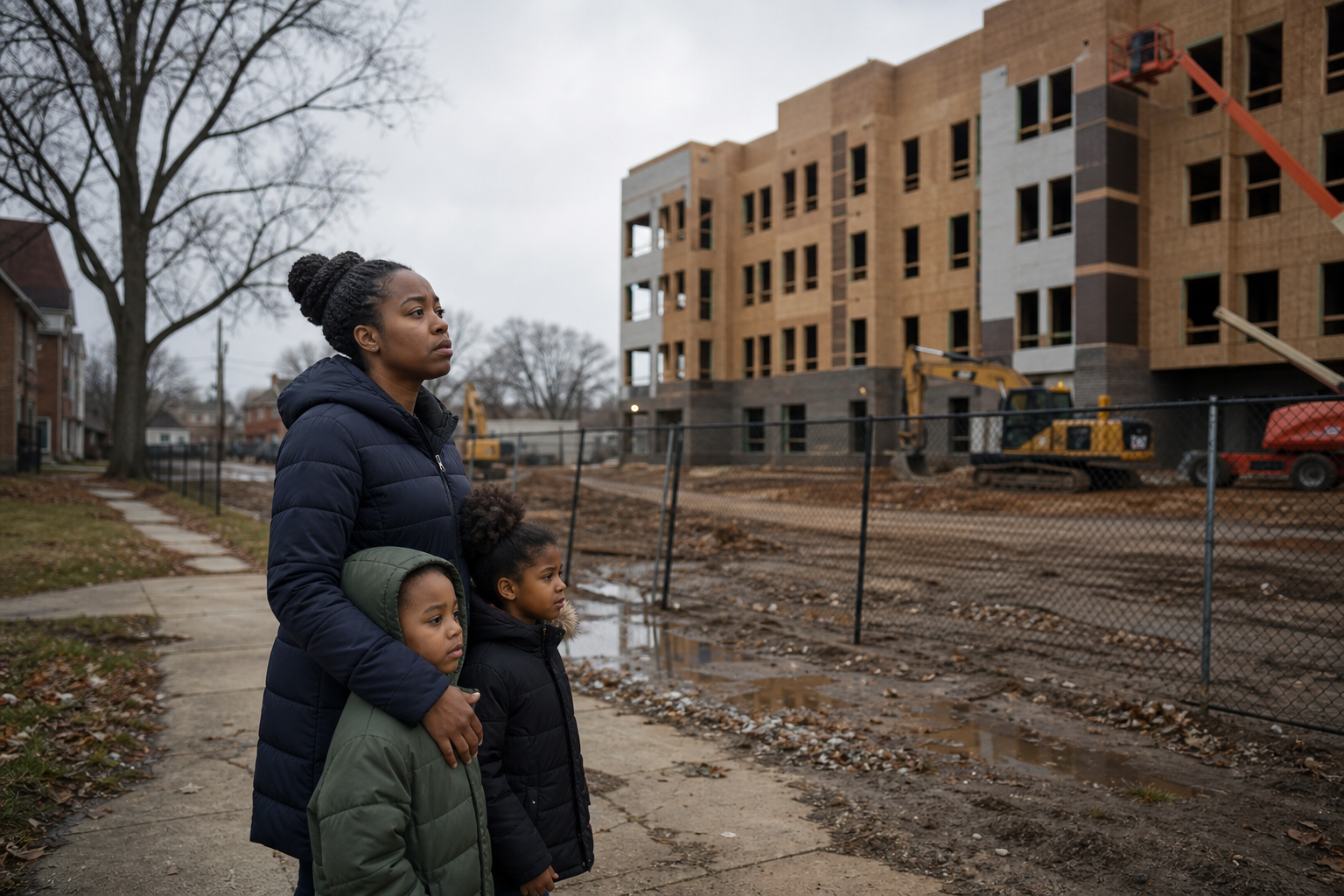
Michigan should adopt the affordable housing policies being advocated by state Democrats, not because every state housing plan is automatically wise, and not because local governments have no role, but because housing affordability is one of the clearest cases where fragmented authority has produced predictable, measurable failure. When workers cannot afford rent near jobs, when older residents cannot downsize within their communities, when young families cannot buy or lease stable homes, the effects do not stop at the city line. They spread across labor markets, school systems, transportation networks, public health, and household balance sheets. That is precisely when state government must act.
The core dispute in this debate was not whether housing affordability matters. On that point there is broad agreement. The real question was whether Michigan should rely on local discretion and market adaptation, or whether the state should adopt a coordinated framework backed by public authority. The strongest objections deserve serious attention. Critics warned that state action can become one-size-fits-all policy, that bureaucracies can move slowly, that politically connected developers can capture subsidies, and that local communities often understand their own housing needs better than Lansing does. These are not frivolous concerns. They are the routine pathologies of public policy, and any serious housing agenda has to guard against them.
But those objections do not justify continued fragmentation. In housing, decentralization has not produced responsiveness equal to the scale of the problem. It has produced veto points, exclusion, spillover costs, and chronic underproduction. Individual municipalities have strong incentives to limit change, preserve incumbent preferences, and push affordability pressures onto neighboring jurisdictions. That behavior may be rational from the standpoint of a single suburb, town, or neighborhood. It is disastrous from the standpoint of a state economy.
This is the central fact opponents never overcome. Housing is governed locally, but its consequences are regional and statewide. A community that blocks new apartments does not eliminate demand. It displaces it. Workers drive farther. Prices rise elsewhere. Employers struggle to hire. Families double up, delay moves, or leave the state. School enrollment patterns become less stable. Public infrastructure carries the burden of longer commutes and more dispersed development. In policy terms, local control here routinely externalizes costs. Michigan Democrats are right to treat housing affordability as a state problem because that is what it is.
Some critics framed state action as an assault on self-determination. That language is emotionally effective and analytically thin. The relevant freedom in a housing market is not only the freedom of existing residents to resist change. It is also the freedom of renters to remain in their communities, the freedom of workers to live near opportunity, and the freedom of young adults to form households without being priced out. A system that protects the preferences of incumbents while foreclosing entry for everyone else is not neutral. It is a publicly enforced scarcity regime. The state has both the authority and the obligation to correct that imbalance.
Other skeptics argued that the market, if simply left with fewer burdens, would allocate housing more efficiently than a centralized plan. There is a limited truth here. If state Democrats are advancing permitting reform, zoning modernization, or incentives that expand housing supply, those are valuable tools and should be used aggressively. But the market alone does not reliably produce affordability for low and moderate income residents, because profitability does not map neatly onto social need. Private actors build where returns are highest, not necessarily where the shortage is most damaging or where households are most rent-burdened. They cannot be expected to internalize the educational, health, and labor-market benefits of stable affordable housing. Public policy exists precisely because those benefits are real and markets underprovide them.
This is why the best case for Michigan Democrats' affordable housing policies is not a simplistic call for subsidies, nor a romantic belief in pure planning. It is a case for state coordination across several failures at once. The state can set consistent rules where local obstruction has choked supply. It can align funding with measurable affordability goals where the private market will not reach. It can standardize expectations across jurisdictions so that no municipality can free-ride on the willingness of others to permit homes. And it can do what no city can do alone, connect housing policy to transportation, workforce development, infrastructure, and fiscal planning.
The debate also surfaced an important internal tension on the pro side, speed versus equity. One argument emphasized urgency, scale, and volume. Another emphasized equitable distribution, long-term stability, and strategic deployment. In practice, Michigan should reject the false choice. A serious state housing agenda must build more housing faster and target affordability intentionally. Quantity matters because scarcity drives prices. Equity matters because unstructured growth does not guarantee access for the households under the greatest pressure. The state is uniquely positioned to insist on both.
That combination is exactly why state action is superior to a patchwork. Local governments often do one of two things badly. They either block housing outright, or they permit growth without adequate concern for who benefits. A statewide framework can move beyond both errors. It can accelerate approvals, reduce needless barriers, and support new construction, while also directing public investment toward affordability outcomes that the market will not produce on its own. It can demand accountability in exchange for funding. It can require performance metrics, such as units created, affordability preserved, and geographic distribution, instead of accepting symbolic politics from every level of government.
The anti-state case also leaned heavily on cautionary abstraction. We were warned about unintended consequences, dependency, distortion, and bureaucratic overreach. Fine. Those risks are real. But inaction has consequences too, and they are not theoretical. Inaction means rents remain high relative to wages. It means employers face tighter labor supply. It means more households live one emergency away from displacement. It means communities become less economically dynamic and less socially mixed. It means Michigan accepts a slower growth path because it refused to govern a foundational market.
Housing advocates support these policy initiatives for a reason. They are responding to a visible affordability problem that localism has not solved. Their support is not proof that every proposal is perfect, but it is evidence that the need is concrete and the status quo inadequate. A mature political system does not dismiss that signal. It uses it to design better statewide policy.
What should readers demand from Michigan Democrats as these affordable housing policies move forward? Clarity, not slogans. They should insist on policies that expand supply, preserve existing affordable units, prevent local evasion, and tie public dollars to durable affordability. They should expect transparent reporting and statewide benchmarks. They should accept that some local discretion will remain, but not the discretion to sabotage statewide housing needs.
Michigan is at the point where refusing coordinated state action is itself a policy choice, and a failed one. Affordable housing is not a boutique issue. It is economic infrastructure, social infrastructure, and human infrastructure. When the market underdelivers and local governments obstruct, the state must do what only the state can do, plan at scale, invest at scale, and govern for the whole.
Michigan should adopt the affordable housing policies being advocated by state Democrats because the alternative is not flexibility, innovation, or freedom. The alternative is continued fragmentation, continued scarcity, and continued transfer of housing costs onto workers, families, and the broader public. In a functioning state, those are conditions to solve, not excuses to look away.