
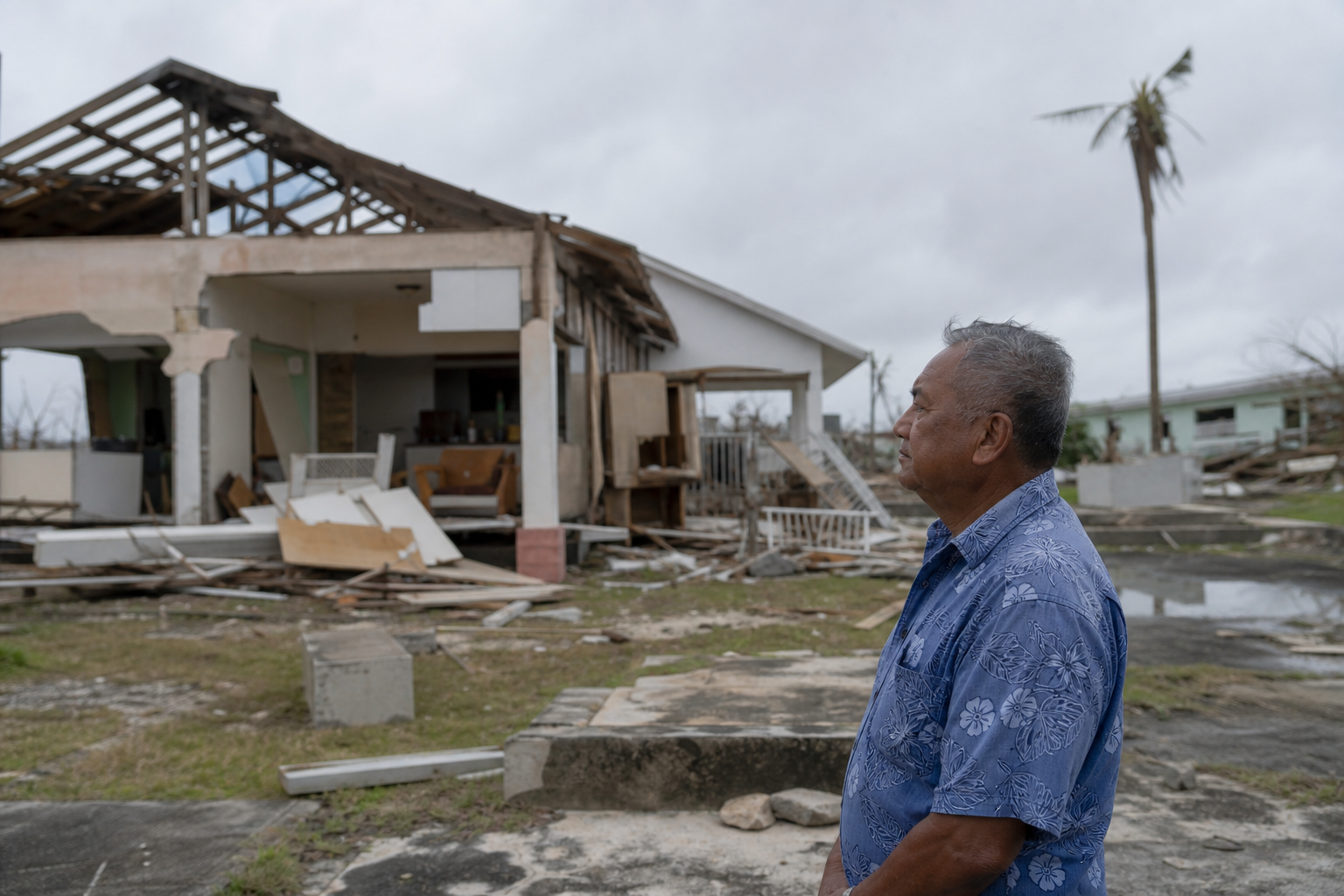
Super Typhoon Bavi did not expose a philosophical puzzle. It exposed a balance sheet problem with a body count attached. When a storm hits a US Pacific island territory like Rota with sustained winds around 290 km/h, about 180 mph, and gusts reaching roughly 350 km/h, the question is no longer whether stronger infrastructure is desirable. The question is who keeps absorbing the cost of weak infrastructure, and how many times we are willing to pay it.
The resolution is that the US federal government should mandate enhanced typhoon-resistant infrastructure standards for all Pacific island territories. It should. Not because centralization is always elegant, not because federal mandates are inherently virtuous, and not because every island should be forced into a rigid template. It should because the federal government already sits on the hook as the insurer of last resort, the disaster responder of first resort, and the reconstruction financier after the fact. If Washington keeps paying to rebuild roads, power systems, ports, water facilities, schools, clinics, and public buildings after predictable super typhoons, then Washington has every fiscal and moral reason to demand better minimum standards before the next storm arrives.
That is the core practical point opponents never escape. They want local discretion on the front end and federal rescue on the back end. That is not self-government in any serious budgetary sense. That is cost externalization.
The best objection is not that stronger standards are unnecessary. Bavi ended that argument. The best objection is that a federal mandate can become clumsy, over-engineered, and blind to local conditions. That concern is real. Pacific island territories are not interchangeable. Geography varies. Elevation varies. Existing building stock varies. Construction supply chains vary. Labor pools vary. Some islands may face more exposure to extreme wind; others may have different vulnerabilities in drainage, grid fragility, or coastal facilities. A dumb one-size-fits-all rule could waste money in one place and underperform in another.
Concede that fully. Then keep going.
A federal mandate does not have to mean one design for every roof, road, and transmission line. It means a federal floor, not a federal straitjacket. The right model is performance-based: infrastructure in US Pacific territories must withstand specified typhoon conditions, maintain critical functionality, and meet hardened standards for essential systems, with local engineering adaptation allowed, and expected, to meet those targets. Washington should set outcomes and minimum resilience thresholds. Territorial agencies, engineers, and builders should decide many of the means within that framework.
That is how you answer the strongest anti-mandate critique without surrendering the policy. You do not reject standards because standardization can be crude. You write better standards.
The anti-mandate camp also leans hard on local autonomy. Again, there is a narrow point worth granting. Local officials often know more than distant agencies about terrain, building practices, logistics, and what actually breaks in a storm. They should have a major role in implementation. But autonomy arguments weaken fast when local decisions impose recurring liabilities on national taxpayers. If a territory had fully internalized disaster costs, the debate would look different. But that is not the world we live in. Federal disaster aid, emergency logistics, and rebuilding funds are not hypothetical. They are routine. Once the national government is effectively underwriting the risk, it has a legitimate interest in loss prevention.
Think of it like insurance underwriting, because that is functionally what this is. Insurers do not cut checks forever while pretending construction quality is somebody else’s business. They price risk, impose conditions, and reduce repeated payouts where they can. The federal government should do the same. A mandate for enhanced typhoon-resistant infrastructure standards is just disciplined underwriting applied to public infrastructure.
Critics worry about cost inflation, contractor gaming, and bureaucracy. Fair enough. Those are not fantasy risks. Federal construction can absolutely become a parade of delays, inflated bids, and compliance theater. But that is an argument for disciplined procurement and auditing, not for accepting physically fragile infrastructure in known typhoon zones. The answer to waste is cost control, competitive bidding, model codes, standardized resilient designs where appropriate, and clear prioritization of critical assets. The answer is not to rebuild the same failures after the next landfall.
And prioritization matters. “All infrastructure” should not be interpreted as gold-plating everything at once. The highest ROI comes from hardening assets whose failure produces cascading losses: hospitals, emergency shelters, ports, water systems, power distribution, communications, schools that double as shelters, and key transportation links. A snapped grid or disabled port can multiply the economic damage of any storm and slow every other recovery function. In resilience planning, some assets are force multipliers. Harden those first, then scale.
There is also a broader incentive problem. If standards remain weak or optional, rebuilding money can become a perverse substitute for resilience. Everybody prefers prevention in theory, but institutions drift toward response because emergency spending is politically easier than long-horizon hardening. Disasters create urgency. Mitigation requires discipline. A federal mandate corrects that bias by converting resilience from a nice-to-have into a precondition of responsible public investment.
The equity argument, while often overstated in policy debates, is also straightforward here. Rota is a US territory. Residents of Pacific island territories should not be treated as permanently discount-rate populations, people for whom lower infrastructure survival standards are quietly tolerated until the next catastrophic storm proves the price of that neglect. If the wind speeds are foreseeable, and on typhoon-prone islands they clearly are, then building public infrastructure below resilient standards is not thrift. It is deferred failure.
Some readers will hear all this and still recoil at the word mandate. Fine. Replace the word if it helps. Call it a federal resilience condition attached to infrastructure funding, disaster recovery eligibility, and territorial capital planning. The mechanism matters less than the practical result: no more federal dollars cycling through predictable destruction without upgraded standards attached.
That is why this resolution wins on the merits. The case for local flexibility is real but secondary. The case against bureaucratic overreach is useful but manageable. The case for enhanced typhoon-resistant infrastructure standards, federally required across US Pacific island territories, is stronger because it aligns incentives with who pays, addresses a known recurring hazard, and reduces long-run losses in money, service disruption, and human harm.
Super Typhoon Bavi was not an anomaly in the only sense that matters for policy. It was a warning attached to an invoice. Washington can keep reimbursing failure, or it can require resilience. For any government that expects to keep writing the checks, the cheaper path is obvious.