
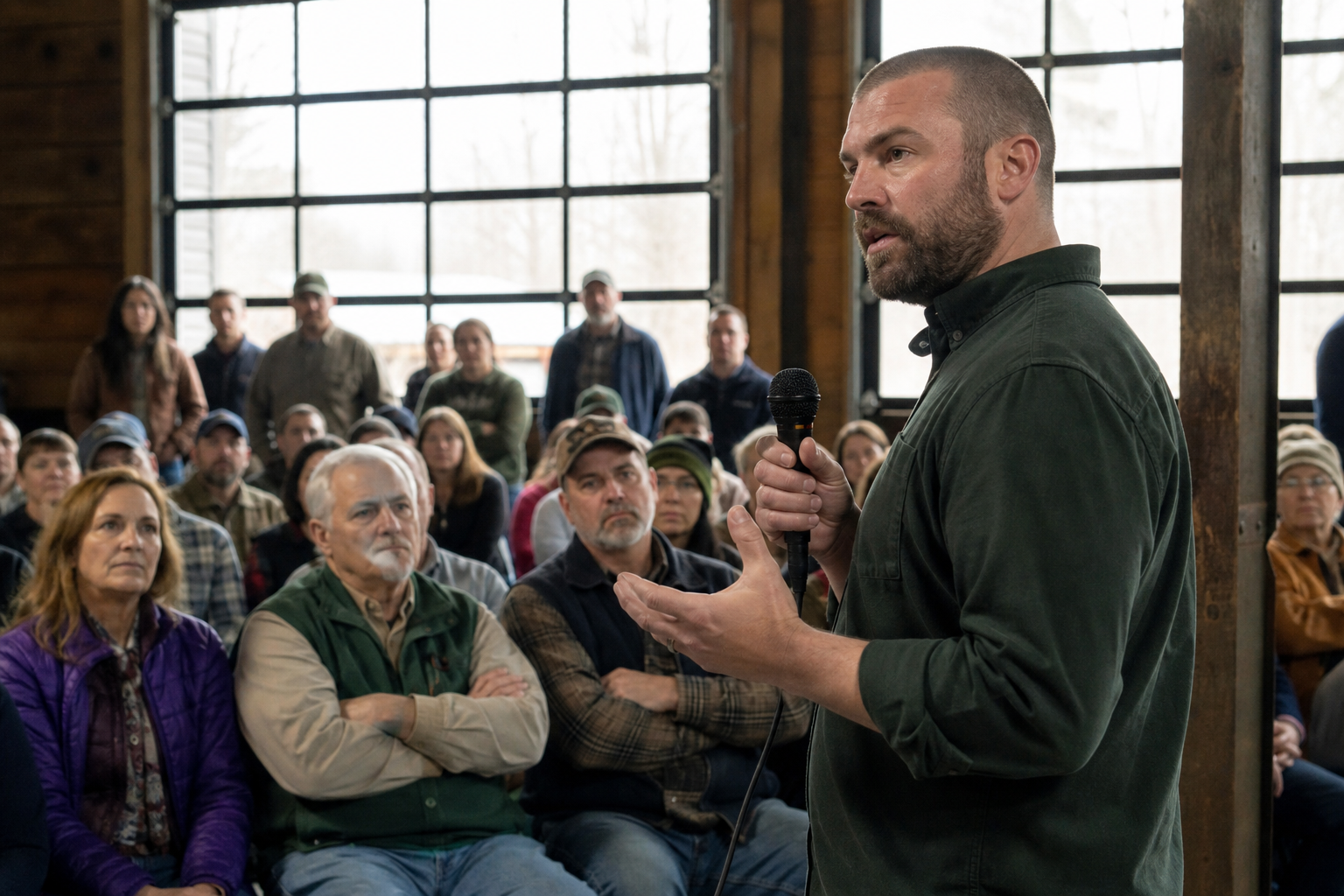
Graham Platner’s exit from a Maine Senate race creates the kind of decision that parties often pretend is philosophical when it is actually organizational. The Maine Democratic Party is now considering its options. One option is to treat Platner’s withdrawal as a clean break and start over with a candidate selected on generalized electability grounds. The other is to prioritize recruiting a candidate who can retain the grassroots support base Platner built. The party should choose the second path, not out of sentiment, but out of institutional competence.
The key fact in this debate is not merely that Platner withdrew. Candidates leave races all the time. The key fact is that he had already generated significant grassroots support in Maine. That means something tangible existed before his exit: volunteer relationships, small donor habits, local trust networks, issue enthusiasm, event infrastructure, and a sense of shared political purpose. In a state party system where attention, labor, and money are all finite, that is not background noise. It is an asset.
The strongest argument against prioritizing that asset is easy to state and worth taking seriously. Grassroots support is often personal. It can be attached to a specific candidate’s style, biography, or message. It is not a bank account that can be transferred by party memo. A party that tries too obviously to inherit a movement can look opportunistic, even manipulative. Some Platner supporters may resent any attempt to package their enthusiasm as a commodity. And of course, a candidate chosen only because they seem Platner-adjacent could turn out to be weaker in a general election than another contender with broader appeal.
Those are real risks. They are not, however, arguments for indifference. They are arguments for doing the work well.
Critics of this resolution tend to slip from one valid point, that grassroots support cannot simply be commanded from above, into one invalid conclusion, that party recruitment should therefore ignore whether a candidate can keep that support together. But politics is not a choice between total control and total spontaneity. State parties exist precisely because collective action problems are real. Without coordination, assets dissipate. Volunteers drift. Donors pause. County committees wait for signals. Rival campaigns duplicate outreach. Media narratives harden around disarray. In the name of authenticity, fragmentation sets in.
That fragmentation has costs, and those costs are not evenly distributed. Well-connected insiders can survive a messy transition. New volunteers cannot. Small donors cannot. Casual supporters who were energized for the first time often do not migrate neatly to the next option. They disappear. The consequence is not some romantic decentralization. It is a weaker party, a narrower electorate, and a campaign apparatus forced to rebuild capacity that already existed a week earlier.
This is why the word prioritize matters. The resolution does not say the Maine Democratic Party should recruit only a candidate who can retain Platner’s grassroots support. It says the party should prioritize that criterion. That is exactly right. Prioritize does not mean blind obedience to one factor. It means giving substantial weight to the preservation of proven organizing capacity when the field has suddenly changed.
A smart party should still ask every basic question. Can the candidate raise money beyond the activist base? Can they speak to statewide concerns? Can they withstand scrutiny? Can they unify Democrats who were never with Platner in the first place? Of course. No competent institution picks a nominee as a museum curator preserves a relic. But neither should it throw away a functioning network in pursuit of a hypothetical better fit whose superiority exists only on paper.
There is also a strategic error in the claim that Democrats should focus on a candidate who can build something new rather than retain what Platner built. In campaign planning, this is often a false distinction. The most efficient growth usually begins with conservation. A campaign that holds an existing base has a foundation from which to expand. A campaign that neglects it has to spend time and money replacing lost ground before it can grow at all. Retention is not the enemy of expansion. It is often the precondition for expansion.
This matters especially in Maine, where personal connection, local credibility, and retail politics carry unusual weight. A significant grassroots movement in Maine is not just a list of names. It is a social structure. It may include house party hosts, town-level validators, recurring donors, and volunteers willing to do the slow work of persuasion. Those capacities are difficult to build and easy to waste. When a candidate like Platner exits, the party’s first responsibility is not to admire the movement from afar. It is to stabilize the system so that energy becomes durable capacity rather than a brief episode.
Some will say this approach risks selecting an imitator, someone recruited to mimic Platner rather than lead in their own voice. That would indeed be a mistake. The candidate Maine Democrats should recruit is not a clone. The party should seek someone who can credibly respect Platner’s supporters, speak to the concerns that animated them, and integrate that network into a broader coalition. Retention requires authenticity, but authenticity is not a reason to abandon organization. It is a reason to recruit carefully.
Others will argue that the party’s only real goal is winning the Senate seat, and that any loyalty to a previous grassroots movement is sentimental. This sounds hard-headed, but it confuses means and ends. Winning is not undermined by preserving grassroots support. In most plausible scenarios, preserving a significant grassroots base increases the probability of winning because it lowers organizational costs, reduces early uncertainty, and signals unity after a disruptive withdrawal. Electoral success is not produced by abstract electability metrics alone. It is produced by functioning systems of mobilization.
This is where institutional judgment matters. The Maine Democratic Party should not behave as if Platner’s grassroots support will transfer automatically. It should behave as if transfer is possible only through prompt, disciplined, and respectful recruitment. That means choosing a candidate who can meet supporters where they are, absorb key organizers, maintain communication channels, and offer continuity without stagnation. It means treating grassroots energy as a public good within the party coalition, something that can be stewarded for shared benefit if leadership acts in time.
Parties are often criticized for being too controlling. Sometimes that criticism is deserved. But the answer to poor coordination is not no coordination. It is better coordination. When a candidate exits after building a significant grassroots base, the responsible course is to prevent needless loss. In this case, the Maine Democratic Party should prioritize recruiting a candidate who can retain Platner’s grassroots support because institutions are tested not when everything goes according to plan, but when they must convert disruption into continuity.
That is the real choice now in Maine. Not whether grassroots politics matters, everyone agrees it does. The choice is whether the party will act like the steward of a valuable collective asset, or stand aside while that asset disperses in the name of purity. Serious political organizations do not let proven capacity evaporate. They organize to keep it, then build on it.