
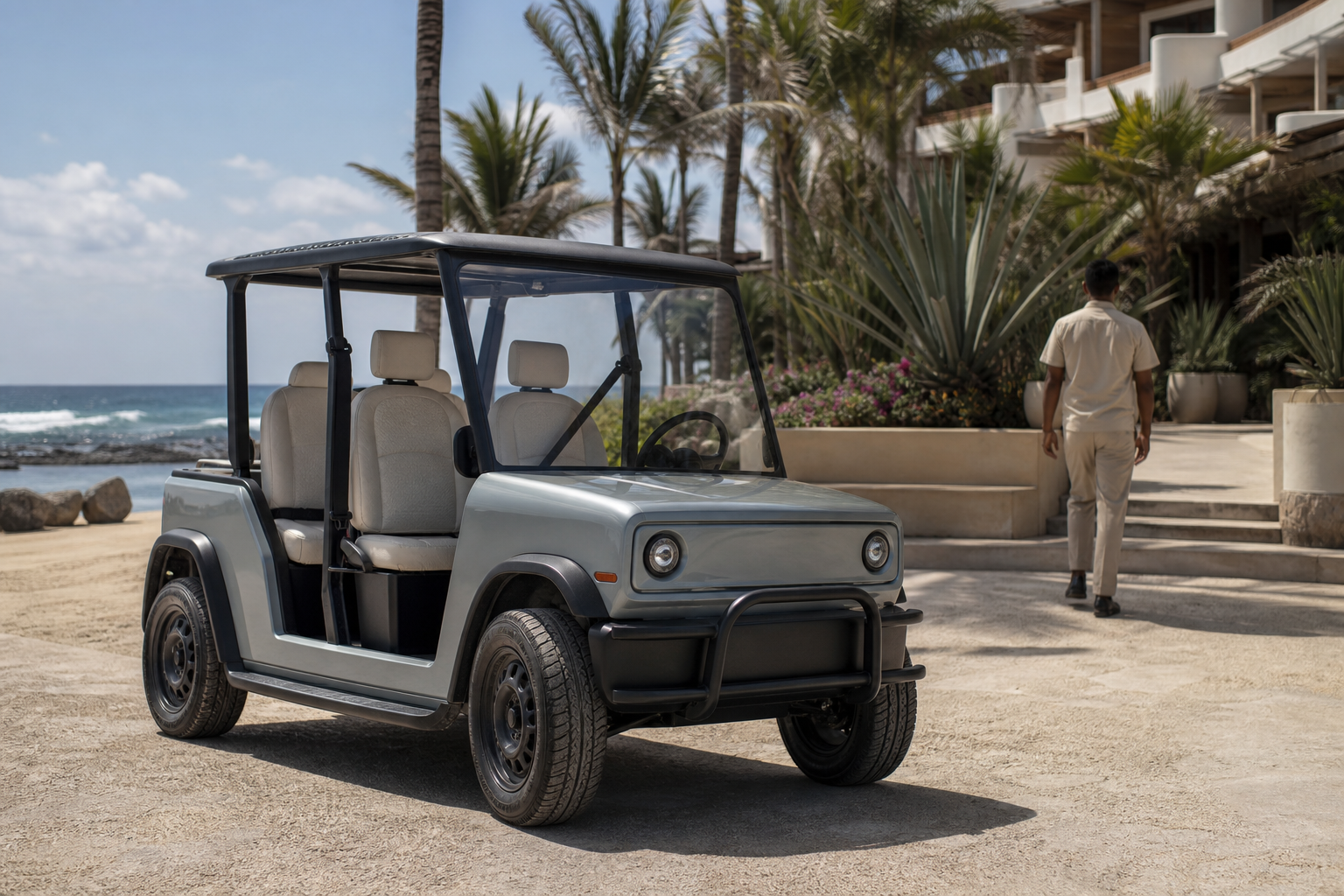
The argument over the Amble One is really an argument about what counts as a viable automotive business. If viability means becoming the next Tesla, the answer is no. If viability means building a durable, profitable company around a narrow but identifiable market, the answer is much closer to yes.
That distinction matters because the facts here point to a very specific product for a very specific buyer. Former Apple and Audi employees developed the Amble One, an electric buggy with lunar rover styling. It is street-legal. It retails for $25,000. The target market is luxury resorts. This is not a commuter sedan, not a mass fleet van, and not a general consumer EV. It is a design-led, low-speed, experience-oriented electric vehicle aimed at hospitality operators who buy transportation as part of the guest experience.
The strongest critics in this debate were right to reject startup fantasy. Niche luxury vehicle markets are small. Automotive manufacturing has ugly fixed costs. Support, parts, liability, and compliance do not disappear because a product looks like a buggy instead of a crossover. A resort buyer may love a lunar rover aesthetic, but that does not guarantee recurring orders, healthy resale value, or enough volume to support an independent manufacturer. Those are real constraints, not negativity.
The safety critique also deserves serious treatment. Street-legal status is not magic. Resorts care intensely about guest safety, brand protection, and operational reliability. A single highly visible accident, battery failure, or maintenance breakdown can travel farther than the vehicle itself. Luxury hospitality is a reputation business. An automotive startup that treats resorts as forgiving beta testers is not building an antifragile company, it is building a litigation funnel.
And the scale critique goes to the heart of the case. Luxury resorts are not a mass market. Procurement is fragmented. Orders may come in small batches. A startup selling a few vehicles here and there can mistake enthusiasm for a business. Many clever transportation products die in exactly this gap between attention and repeatable economics.
Those objections prevail against the wrong version of the resolution. They do not defeat the actual one.
The resolution is not whether luxury resort EVs are a path to automotive dominance. It is whether they represent a viable business model for automotive startups. A viable model does not need to maximize addressable market. It needs to match product architecture, customer type, and support structure well enough to generate sustainable revenue without requiring impossible scale.
On that narrower and more realistic question, the resort niche makes more sense than skeptics allow.
First, luxury resorts are one of the few vehicle markets where aesthetics and utility genuinely merge. Most commercial fleet buyers optimize heavily for cost and standardization. Most consumer buyers compare broad alternatives. Resorts are different. They sell atmosphere. They sell memories, photos, status, and internal mobility as part of a curated environment. A vehicle that looks distinctive and feels bespoke can have operating value beyond transportation. The lunar rover design is not merely decoration if it helps a property differentiate the guest experience.
Second, the buyer is an institution, not a random household. That matters. A resort can purchase in small fleets, maintain vehicles on-site, schedule charging centrally, and deploy the buggies in predictable use cases. That is a much easier beachhead than persuading thousands of individual consumers through expensive marketing and dealer channels. In network terms, each resort is an adoption node with recurring operational needs and feedback. The startup does not need national consumer awareness to win. It needs a repeatable sales playbook for a concentrated class of customers.
Third, the product seems designed to avoid the worst traps of mainstream automotive competition. At $25,000, the Amble One is expensive for a buggy and cheap for a street-legal EV. That awkward middle is actually useful here. It leaves room for premium positioning without forcing the company into the capital war required to build a full-featured passenger car competing against giant manufacturers. The startup is not trying to out-Toyota Toyota. It is trying to sell a purpose-built electric vehicle into environments where lower-speed operation, short trips, and controlled charging are features, not compromises.
Fourth, viability improves when the niche is allowed to remain a niche. This was the key divide in the debate. Critics kept importing the assumptions of a centralized, scale-hungry car company. They assumed the Amble One only works if it eventually grows beyond resort fleets into something much larger. But that is often how startups destroy themselves. They chase volume, add complexity, widen the product, and inherit the brittle overhead of the incumbents they were supposed to outmaneuver.
A more resilient strategy is to keep the system modular. Sell to resort clusters, property managers, high-end rental operators, and similar low-speed premium mobility buyers. Standardize parts. Make maintenance training simple. Build service through regional partners and fleet contracts rather than an enormous owned network. Use a narrow set of operating environments to improve reliability before expanding use cases. In other words, let the market be distributed even if the company remains disciplined.
This does not mean every such startup will succeed. It means the model itself is credible. There is a difference.
The best rebuttal is that localized support and resort maintenance cannot replace a real automotive service organization. Fair enough. Physical products are not open-source software. Customers will need parts, diagnostics, warranty handling, and accountability. But the lesson is not that the model fails. The lesson is that the company must design for serviceability from the start. The resort niche helps here because fleet buyers can tolerate contract-based support and planned maintenance better than ordinary consumers can. A startup serving fifty serious institutional customers can be more supportable than one serving five thousand scattered retail owners.
Another fair objection is that the total addressable market may be too small. Perhaps. But startups do not go bankrupt from having a small market alone. They go bankrupt from building a cost structure that assumes a bigger one. If the Amble One team prices honestly, limits product sprawl, and treats the resort market as the business rather than a stepping stone to mass-market glory, the economics can work.
That is the broader lesson. In transportation, viable startups are often not the ones promising universal replacement. They are the ones that identify a bounded mobility problem, build a product that fits it exactly, and refuse the intoxicating logic of premature scale. Luxury resort electric vehicles are unlikely to reorder the car industry. They do not need to. They only need to solve a premium fleet use case better than generic carts and with more character than commodity EVs.
So yes, luxury electric vehicles designed for niche resort markets represent a viable business model for automotive startups, with an asterisk that is really the whole story. They are viable if founders respect the topology of the market. Many independent buyers, limited but clear use cases, repeatable fleet sales, local maintenance capacity, and differentiated design can form a stable mesh. Pretending this is the first rung on a ladder to universal automotive scale would turn that mesh back into a brittle tower.
The Amble One makes sense not because it escapes the limits of niche business, but because it embraces them. In an industry obsessed with size, that may be the most rational design choice of all.