
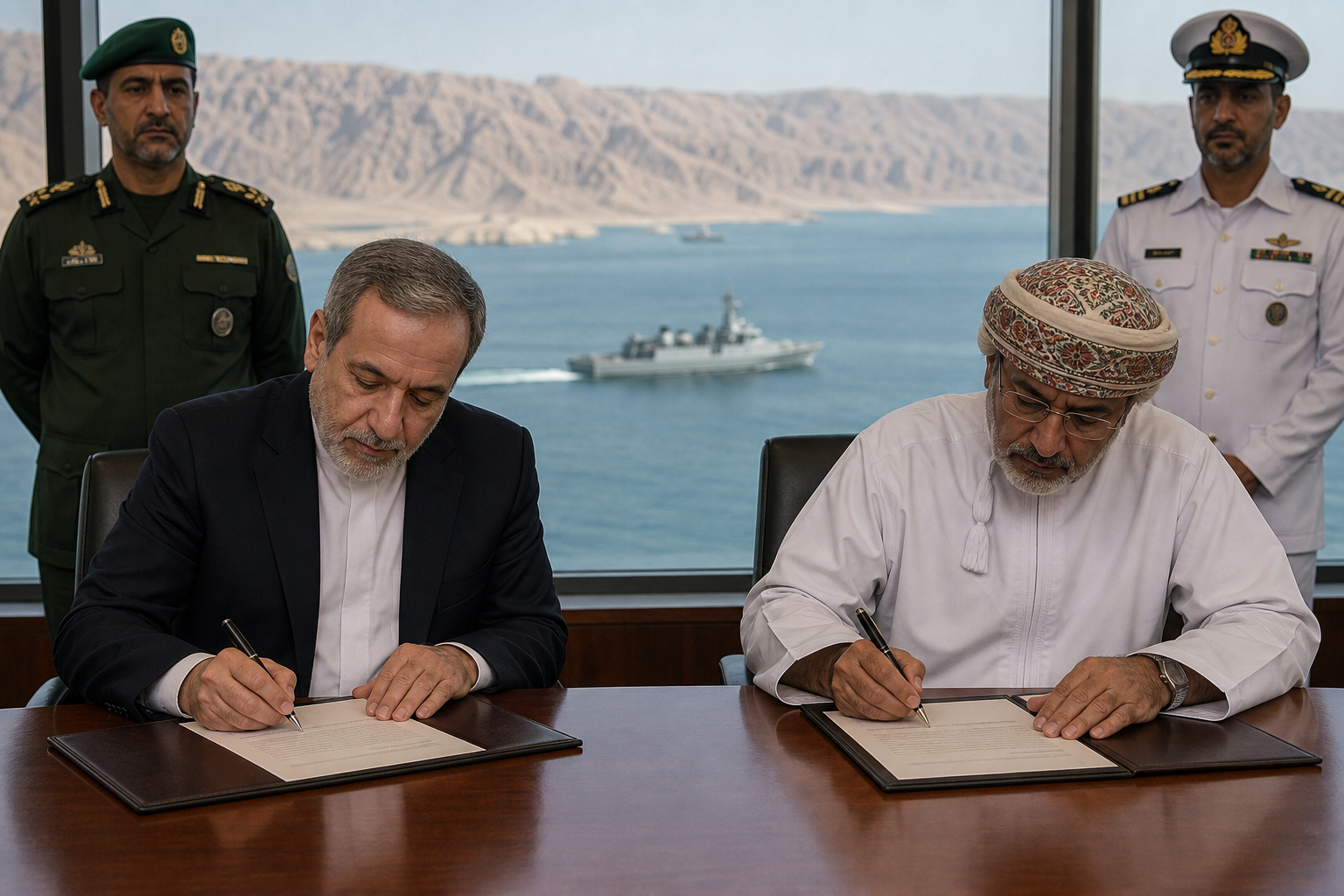
Iran says a deal with Oman on the Strait of Hormuz is in its final stages. Oman has not commented. The United States has not commented. That silence will tempt many analysts to treat the proposed agreement as suspicious by default. It is fair to be cautious. The Strait of Hormuz is a vital waterway, and any arrangement touching it affects far more than the two states on its shores. But the resolution is not whether a bilateral agreement is ideal in theory. It is whether Iran and Oman should finalize one. On that question, the answer is yes.
The reason is simple: in a chokepoint this important, ambiguity is expensive. Unclear rules, undefined expectations, and constant geopolitical signaling all impose costs long before a single ship is delayed. Shipping companies price risk. Insurers price risk. Energy traders price risk. Navies plan around risk. Every additional layer of uncertainty becomes a tax on global commerce. A workable bilateral framework that clarifies responsibilities in the Strait of Hormuz is therefore valuable even before anyone reads the fine print, because it replaces improvisation with procedure.
The strongest argument against finalizing such a deal is not crazy. Critics say a bilateral agreement could let Iran and Oman act like gatekeepers over an international passage. They worry about a de facto condominium over a global commons, one negotiated without broader buy-in from maritime powers and user states. They also warn that a narrow deal might conflict with established international norms on navigation, or create an opaque mechanism vulnerable to coercion, capture, or unilateral reinterpretation later. That is the best case against the agreement, and it deserves more respect than easy talking points about sovereignty or regional pride.
But those objections still lose on cost-benefit grounds.
First, the relevant comparison is not between this bilateral agreement and some flawless multilateral convention. The real comparison is between this bilateral agreement and the status quo. The status quo is not a clean, neutral system operating without friction. It is an unstable mix of customary expectations, military deterrence, political signaling, and periodic uncertainty surrounding one of the world’s most important waterways. Opponents keep comparing the proposed deal to an idealized international framework. Markets do not trade on ideals. They trade on what exists. Right now, what exists is ambiguity.
Second, the states with the strongest immediate incentive to keep transit functioning are Iran and Oman themselves. That does not make them saints. It makes them legible. They live with the operational consequences of tension in the Strait of Hormuz in a way distant commentators do not. If passage becomes more volatile, they absorb security risk, diplomatic strain, and commercial disruption first. Those incentives matter. A bilateral agreement works not because the parties are universally trusted, but because they have skin in the game.
Third, speed matters. In critical infrastructure and maritime transit, a decent agreement now often beats a perfect agreement never. Multilateral processes sound noble, but they are frequently slow, performative, and clogged by actors who bear little of the immediate cost. If the practical choice is between a bilateral framework in the near term and endless calls for a broader arrangement that may never materialize, throughput favors the bilateral framework. You can improve a deal after it exists. You cannot operationalize a panel discussion.
To be clear, there are real risks in finalizing the agreement. A bad deal could add bureaucracy without improving security. It could create confusion if it appears to supersede existing rights of passage rather than codify procedures around them. It could also be used rhetorically by Iran to imply more control than the international community accepts. Those are not trivial concerns. But they are arguments for how to structure and interpret the agreement, not for refusing to finalize one at all.
The practical standard should be straightforward. Any Iran-Oman Strait of Hormuz agreement should reduce uncertainty, not monetize it. It should clarify navigational procedures, communication channels, incident management, and deconfliction protocols. It should lower the probability of miscalculation. It should make shipping risk more measurable. It should not create arbitrary tollbooths, discretionary restrictions, or vague political conditions attached to transit. In other words, the deal should function like infrastructure governance, not leverage theater.
That is where many critics overreach. They hear “governing the Strait of Hormuz” and assume it must mean monopolizing it. Not necessarily. Governance can mean coordination. It can mean defined responsibilities for safety, traffic management, emergency response, and dispute handling. In commercial systems, governance is often most useful when it narrows discretion and standardizes expectations. If Iran and Oman are formalizing such rules, that is a gain for predictability.
The silence from Oman and the United States does not change the core calculus much. Oman’s silence may simply reflect diplomatic sequencing. Washington’s silence may reflect caution, disinterest, or a desire not to prejudge an unfinished text. None of that proves the agreement is good, but neither does it prove the agreement is a trap. The fact we do know is enough to reach a policy judgment: the Strait of Hormuz is vital, and a bilateral deal is reportedly close. In that context, finalization is preferable to drift.
There is also a broader lesson here about international order. Too many debates treat local agreements and global norms as mutually exclusive. They are not. A bilateral arrangement can sit beneath wider principles of navigation rather than replacing them. In practice, most functioning systems combine general norms with local operating rules. Airlines do not abolish international aviation standards by agreeing on airport procedures. Ports do not erase maritime law by coordinating pilotage and traffic control. The question is whether the local arrangement improves actual performance. If it does, the market will feel it quickly in reduced uncertainty.
This is why the anti-agreement case, while intellectually tidy, remains strategically weak. It assumes that because the Strait of Hormuz matters to the world, only a world-sized negotiating format is legitimate. That confuses scope with feasibility. Plenty of globally important systems are stabilized by narrower agreements among the actors who can actually implement them. In this case, Iran and Oman are not random participants. They are the relevant parties with the geography, the exposure, and the immediate incentives to set basic operating terms.
The best outcome would be a bilateral agreement that is boring. Boring is underrated. Boring means ships move, insurers can model risk, energy markets face fewer panic premiums, and naval posturing yields to paperwork. For a vital waterway, boring is success.
So yes, Iran and Oman should finalize a bilateral agreement governing the Strait of Hormuz. Not because bilateralism is morally superior, and not because the agreement will solve every dispute around a strategic chokepoint. They should finalize it because uncertainty is costly, because direct stakeholders are the fastest route to an actionable framework, and because in the real world the efficient improvement beats the imaginary perfect solution. On a waterway this vital, less ambiguity is not a luxury. It is the product.