
The cleanest way to see this debate is to strip away the romance and ask a pricing question. If a club, sponsor, or investor has to decide what a professional athlete is worth, what evidence gives the best signal per unit of attention, money, and uncertainty? On that question, international tournament performance deserves to be the primary driver of market valuation, even if not the only one.
The fact pattern here is simple. Cape Verde is scheduled to play Saudi Arabia. Vozinha is a goalkeeper for Cape Verde's national team. His reported valuation is $17 million, and that valuation is associated with World Cup participation. That is not a proof that tournament play should always override everything else. But it is a useful clue about how markets behave when the stakes, audience, and information density spike all at once.
Opponents of the resolution made their best point clearly. A player is not a stock that should swing wildly because of three good games in June. A career is built in club football, in weekly minutes, repeatable output, fitness, tactical consistency, and years of development. International tournaments are short. They are noisy. They can turn on a deflection, a referee error, an unlucky draw, or the simple fact that one player was born into a weak national team. Those are real objections, and any serious valuation framework has to respect them.
But those objections still do not defeat the core case for giving international tournaments the most weight. They merely show why "primarily determined" cannot mean "exclusively determined." That distinction matters. A sensible market does not throw away club data. It ranks signals. And among all available signals, tournament performance often has the best cost-benefit ratio.
Why? First, international tournaments compress scouting. A buyer can watch players from many leagues, against varied opposition, under maximum pressure, in a globally legible format. That sharply reduces information asymmetry. Club football produces mountains of data, but also context problems. A player can look elite inside a dominant system, inside a weaker league, or next to superior teammates who hide flaws. Tournament football is not perfectly neutral, but it strips away some of the scaffolding. When a player performs under concentrated scrutiny, with little tactical padding and everything on the line, the market learns a lot very quickly.
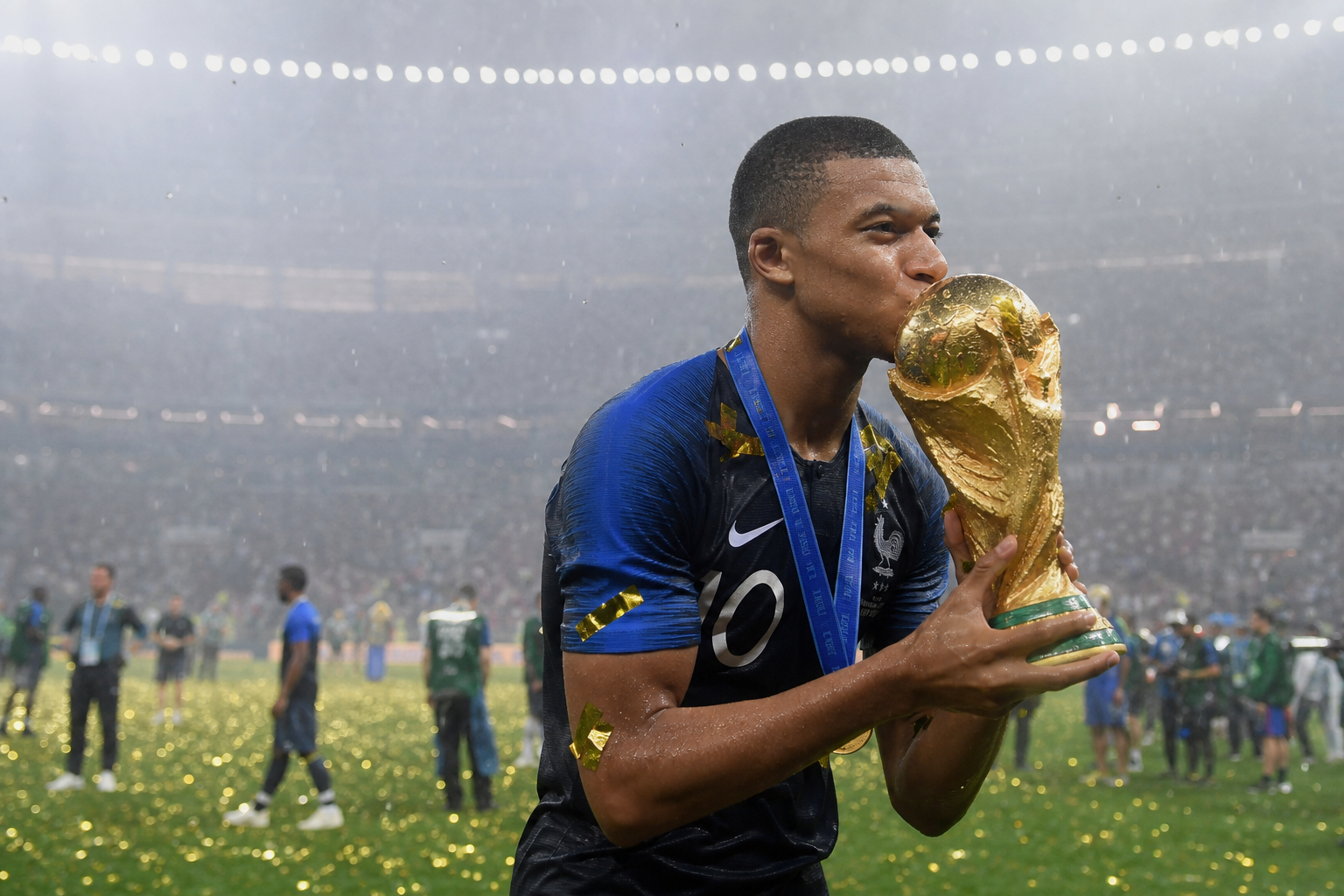
Second, international tournaments measure a scarce trait that clubs actually pay for, performance under pressure. The marginal value of an athlete is not just their median output on a calm Tuesday. It is what they do when every possession is expensive, every mistake is amplified, and every opponent is fully prepared. Clubs spend vast sums chasing players who can hold level in knockout conditions. A World Cup, continental championship, or similar tournament is one of the few environments that simulates that pressure at scale. If the market weights that heavily, it is not irrational hype. It is paying for a rare, decision-relevant signal.
Third, tournament performance is unusually efficient for surfacing talent from outside the glamour pipeline. This is where the Cape Verde example matters. Players from smaller football nations and less marketed leagues often suffer from a visibility discount. Their club form may be real, but the audience evaluating it is narrower, and the skepticism tax is higher. International competition partially corrects that. If a Cape Verde goalkeeper or midfielder performs credibly on the world stage, the market gets a globally trusted reference point. That is not charity and it is not central planning. It is a market mechanism that broadens discovery.
The other side warns that this creates volatility. True. But volatility by itself is not the enemy. Mispricing is. If tournaments reveal information that routine club play obscures, then some repricing is healthy. The better question is whether the volatility is worth the informational gain. Usually, yes. A market that updates too slowly is not stable in a virtuous sense. It is stale. It leaves undervalued talent stranded and overvalues system players whose production does not travel.
There is also a practical point the critics underplay. Market valuation is not a moral reward for hard work. It is a forecast of future revenue contribution, transfer leverage, and scarcity. A player who shines in an international tournament tends to gain more than applause. He gains sponsor interest, shirt sales, negotiating power, audience familiarity, and proof of relevance to high-pressure competition. Those are monetizable outcomes. If valuation is supposed to capture earning potential, tournament performance deserves a premium and, yes, often the largest premium.
Still, the opposition is right about one thing that enthusiasts often ignore. Tournament results are team-dependent. A brilliant player from a weak national side may get fewer matches, worse teammates, and less tactical support than a merely good player from a powerhouse. That is a real distortion. It is why the best version of this resolution is not a crude medal count approach or a highlight-reel economy. The relevant variable is not simply whether a nation advanced. It is how the athlete performed in that international setting, adjusted for role, opposition, and team context. A goalkeeper like Vozinha should not be priced only by wins and losses. He should be priced by what tournament performance reveals that club play could not reveal as clearly.
This is the pragmatic middle, but it is still a clear yes to the resolution. Professional athletes' market valuations should be primarily determined by international tournament performance because that is where the market gets the fastest, broadest, most decision-useful information. Club performance remains essential as the base layer. Age, injury history, tactical fit, and contract terms still matter. But when the question is which evidence should carry the most weight, the answer is the evidence generated in the highest-leverage environment.
Vozinha's reported $17 million valuation, associated with World Cup participation, is not an anomaly to explain away. It is the market telling you what it values when attention, pressure, and comparability peak. The lesson is not that every hot tournament run deserves a blank check. The lesson is that short, intense, globally visible competition can reveal more actionable truth than months of locally filtered data.
That makes some people uncomfortable because it sounds like spectacle driving price. Sometimes it is. But often spectacle is just concentrated information. And in valuation, concentrated information is gold.
So if Cape Verde plays Saudi Arabia and a player like Vozinha performs at a level that travels across contexts, the market should respond aggressively. Not sentimentally, not blindly, and not forever. Aggressively because that is where the signal is strongest. In a business built on uncertainty, the best market is not the one that looks the fairest in theory. It is the one that prices real performance fastest, with the fewest illusions. International tournaments do that better than any other stage in sport.