
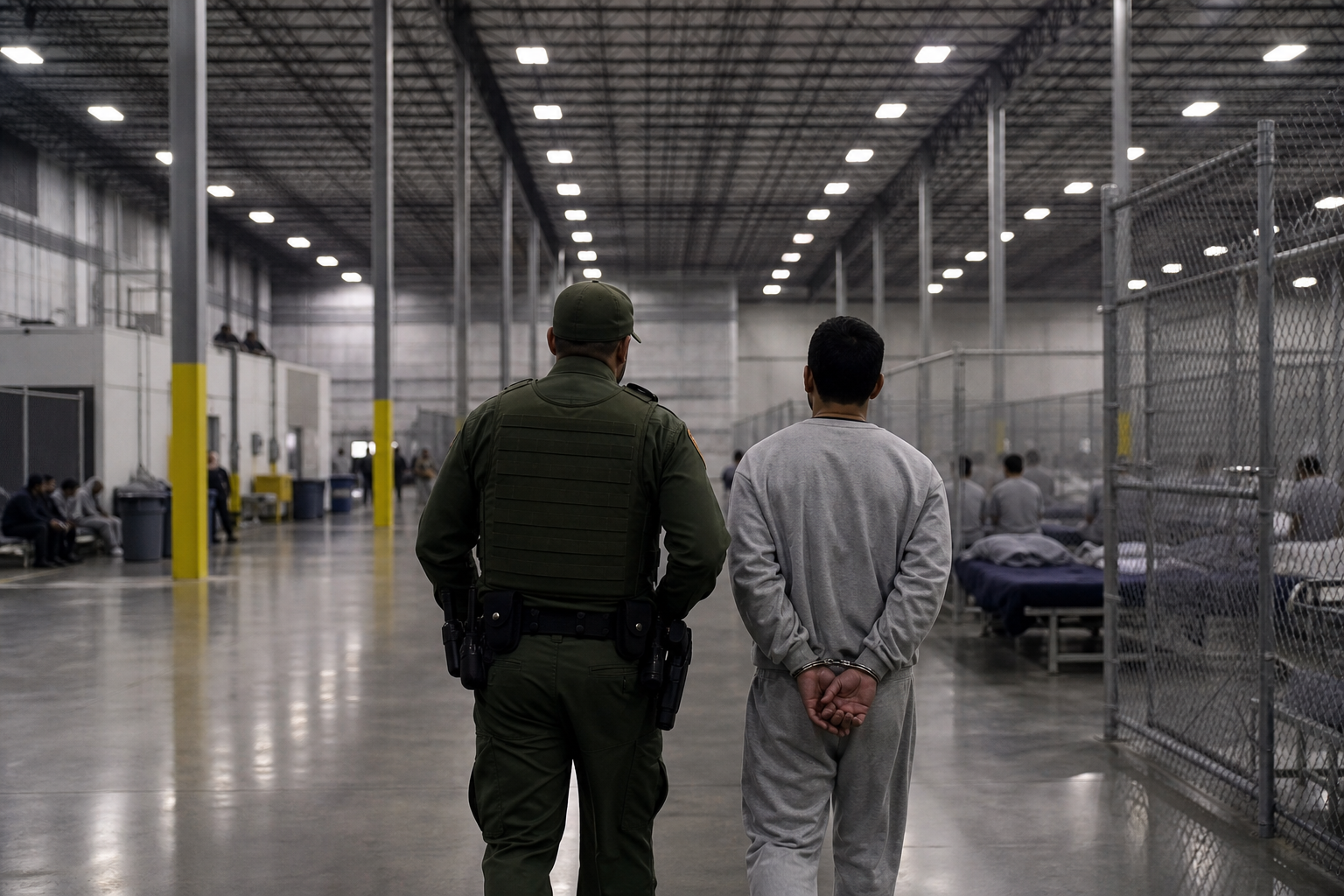
The Immigration and Customs Enforcement agency's decision to divest eleven detention warehouses, acquired for $700 million, represents more than a policy reversal. It stands as definitive evidence of what happens when institutional planning is subordinated to political volatility and market ideology. While critics celebrate this divestment as liberation from centralized control or praise it as pragmatic resource reallocation, the reality is far more sobering: we are witnessing the dismantling of coordinated federal capacity with no viable alternative in sight.
The case for divestment rests on several seductive but ultimately hollow arguments. Pragmatists invoke the sunk cost fallacy, insisting that past expenditures are irrelevant to future decisions. Decentralists celebrate the collapse of "coercive infrastructure" as a victory for community-based alternatives. Market enthusiasts promise that private contractors and local actors will efficiently fill any capacity gaps. Each argument sounds reasonable in isolation. Each crumbles under operational scrutiny.
Consider first the economic argument. Yes, sunk costs should not dictate future decisions—but institutional accountability demands we understand how three-quarters of a billion dollars in public investment was planned, executed, and then abandoned within a single policy cycle. This isn't merely about recouping losses on specialized facilities with severely limited resale markets. It's about the signal sent to every federal agency: long-term infrastructure planning is futile when political winds can reverse years of systematic development overnight. The result is predictable—agencies will avoid capital investments entirely, defaulting to expensive short-term contracts that maximize flexibility while minimizing institutional capacity.
The pragmatist's alternative—electronic monitoring and flexible arrangements—sounds efficient until confronted with operational reality. Electronic monitoring achieves approximately 95% compliance rates only among voluntary participants already embedded in communities with stable addresses and family ties. For initial processing of arriving populations, for contested removal cases, for individuals deemed flight risks under legal standards, physical custody remains operationally necessary. Technology cannot substitute for infrastructure when dealing with populations who lack community ties or face imminent removal. The choice isn't between warehouses and innovation; it's between federal facilities with transparent oversight and a fragmented patchwork of county jails and private contractors operating under inconsistent standards.
This brings us to the decentralist critique, which mistakes the abandonment of federal capacity for the distribution of power. The romantic vision of community networks and mutual aid organizations replacing detention infrastructure ignores scale entirely. These organizations—vital as they are—handle perhaps two to three percent of annual immigration enforcement cases. They provide supplementary support, legal assistance, and humanitarian aid. They cannot and should not be expected to replace systematic processing capacity for hundreds of thousands of cases annually. When federal infrastructure disappears, the vacuum is filled not by horizontal peer networks but by private contractors and local sheriffs operating with less oversight, higher costs, and perverse profit incentives.
The irony is profound: those celebrating decentralization as liberation from federal authority are enabling the worst form of fragmented control. Without federal standards, detention conditions vary wildly by jurisdiction. Without centralized oversight, transparency disappears into a maze of local contracts and private facilities. Without coordinated capacity planning, costs escalate as agencies scramble for emergency arrangements. The decentralist vision of "antifragility" through institutional collapse is actually a recipe for regulatory arbitrage, where the most vulnerable populations become subject to whoever holds the local contract.
What the divestment reveals is not the failure of federal detention infrastructure but the failure of institutional commitment. The warehouses were acquired through evidence-based assessment of capacity needs, designed to provide uniform conditions, transparent reporting, and economies of scale impossible to achieve through scattered private arrangements. Their abandonment doesn't solve the underlying challenge of immigration enforcement—it simply externalizes the costs and obscures the accountability.
The strongest argument for divestment—that detention itself is unnecessary or unjust—founders on legal and operational reality. Immigration law requires physical custody for removal proceedings, initial processing, and cases involving flight risk or public safety concerns. One can advocate for changing these laws, but until they change, enforcement requires infrastructure. The choice is between federal facilities with enforceable standards or private alternatives with profit motives. The choice is between transparent, accountable management or opaque local arrangements. The choice is between systematic capacity planning or permanent crisis improvisation.
The path forward is not divestment but optimization. Federal ownership of detention infrastructure allows for uniform health protocols, consistent legal access, transparent oversight, and long-term cost efficiency. It enables systematic quality control impossible in fragmented private markets. It provides the institutional capacity necessary for managing migration flows that fluctuate but never disappear. Electronic monitoring, community-based alternatives, and humanitarian support should complement—not replace—this core infrastructure.
The $700 million loss is not merely financial. It represents the abandonment of institutional planning in favor of political expediency. It demonstrates what happens when systematic capacity building is sacrificed to ideological purity or market fantasy. It proves that without sustained federal investment and professional management, immigration enforcement devolves into an expensive, inhumane patchwork that serves no one well.
ICE's warehouse divestment will be studied in public administration courses as a textbook case of institutional failure—not because the facilities were built, but because they were abandoned. The lesson is clear: complex social challenges require coordinated institutional responses, sustained investment, and planning horizons that extend beyond political cycles. Markets don't solve detention. Local improvisation doesn't replace federal capacity. And celebrating the collapse of systematic infrastructure as liberation is a dangerous delusion that leaves the most vulnerable to bear the costs of our institutional abdication.