
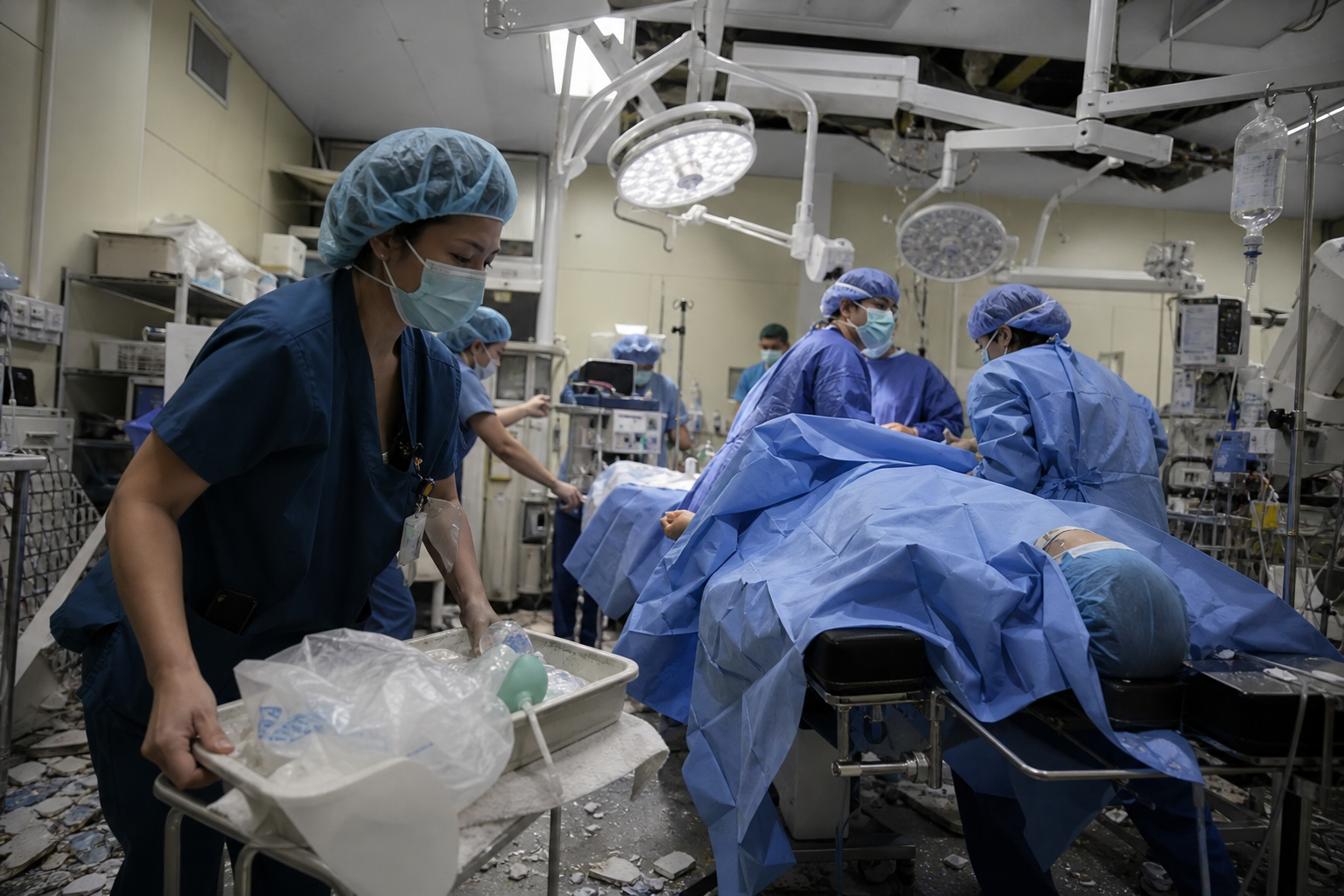
The most important detail in the Kumamoto General Hospital footage is not the shaking walls. It is the operating table. A patient was open, anesthetized, immobile, and wholly dependent on everyone and everything in that room when a magnitude 6.8 earthquake hit Japan last month. Doctors did what decent people do under pressure, they physically shielded the patient. Their conduct was admirable. It was also an indictment.
A health system should not have to rely on spontaneous heroism as its safety plan for an earthquake during surgery.
That is why hospitals in seismically active regions should be required to implement mandatory earthquake-specific protocols for ongoing surgical procedures. Not because every mandate is wise, and not because every dramatic video proves a policy vacuum, but because this particular risk is foreseeable, the patients are uniquely vulnerable, and the costs of minimal standardization are lower than the costs of preventable chaos.
The best argument against a mandate deserves to be taken seriously. Critics raise three fair concerns. First, earthquakes do not strike operating rooms every day, so a new requirement may look like a low-frequency rule chasing a vivid news event. Second, hospitals already have emergency preparedness plans, backup power systems, and building codes, so an earthquake surgery protocol might duplicate existing obligations. Third, a badly designed mandate could become paperwork theater, consuming time and money without improving outcomes.
Those are real concerns. They are not enough to defeat the resolution.
Start with the nature of the risk. This is not a speculative danger invented by regulators looking for a new compliance category. Hospitals in seismic zones know earthquakes will happen. Hospitals also know surgeries continue every day. The overlap is not fanciful. It is a foreseeable operational scenario. The fact that it may be infrequent at any single hospital does not make it negligible, because the patient on the table faces concentrated catastrophic risk. In ordinary emergency planning, staff can evacuate, take cover, or suspend activity. In an active surgical procedure, the patient cannot protect themselves, cannot consent in real time, and may die or suffer permanent injury if the room devolves into improvisation for even a few seconds.
That asymmetry matters. A delayed benefit from avoiding regulation is diffuse. A preventable catastrophe during surgery is acute, individualized, and irreversible. Duty of care is not measured only by average event frequency. It is measured by foreseeable vulnerability under known conditions.
The strongest market-oriented objection is that hospitals already have incentives to get this right through insurance, accreditation, and reputation. In theory, perhaps. In practice, that is exactly the kind of area where markets underperform. The patient choosing a hospital rarely has visibility into whether an operating room has a procedure for instrument stabilization during shaking, a chain of command for whether to pause or close, or rehearsed steps for securing anesthesia equipment and sterile fields during a seismic event. These are hidden safety practices. They are difficult for consumers to evaluate and easy for institutions to underinvest in when budgets tighten. That is a textbook case for a baseline requirement.
The next objection is more practical: if the real problem is structural vulnerability, shouldn't we focus on buildings, equipment anchoring, and emergency power rather than protocols? Yes, absolutely, and this is where advocates of mandatory protocols should be disciplined. Earthquake-specific surgery procedures are not a substitute for seismic retrofits, resilient infrastructure, or redundancy in power and oxygen systems. They are a complement. Buildings protect the shell. Protocols protect the patient inside the shell when the shell still moves, lights flicker, alarms sound, carts shift, and the surgeon's hands are in someone's body.
The footage from Kumamoto makes this plain. Even if the structure remains standing, an operating room can instantly become a contested environment where staff must decide what to hold, what to shut off, whether to continue, whether to close quickly, who secures the airway, who stabilizes equipment, and how to communicate over noise and fear. Those are precisely the moments when preassigned roles and drilled responses matter most.
Opponents also warn that a mandate could become one-size-fits-all, insensitive to differences among hospitals, specialties, and procedures. That caution is warranted. A protocol for neurosurgery will not look identical to one for a cesarean section or orthopedic trauma. A tertiary care center and a small regional hospital will not have identical equipment layouts. But this is an argument for smart regulation, not for no regulation.
A sound requirement would set minimum elements, not a single script. For example, hospitals in seismically active regions could be required to maintain earthquake-specific plans for ongoing surgical procedures that address role assignment, patient shielding, instrument and equipment stabilization, anesthesia continuity, criteria for temporary pause versus rapid closure, backup lighting and communication, and post-quake sterility and damage assessment before proceeding or transfer. They should train on those plans, adapt them by service line, and integrate them with broader disaster preparedness. That is not bureaucratic fantasy. It is what competent risk management looks like.
Notice what this approach avoids. It does not pretend that a protocol can stop a major building collapse. It does not criminalize judgment. It does not require a surgeon to follow a checklist blindly while the ceiling falls. It requires preparation for a known class of emergency so that judgment operates within structure rather than vacuum.
The argument that the Kumamoto doctors "successfully adapted" also misses the ethical point. Success in a near miss is not evidence that the system was adequate. It may simply mean that good people compensated for weak planning. We should be careful about converting visible bravery into policy complacency. Heroism is a failing test result when institutions treat it as the control measure.
There is also an equity dimension that should not be ignored. Without a mandate, preparedness will vary by budget, leadership culture, and risk tolerance. Prestigious hospitals may develop excellent internal procedures. Others may assume their general disaster manual is enough. The result is unequal protection for patients facing the same medical vulnerability in the same seismic region. Baseline rules exist to reduce that lottery.
Some will ask for perfect evidence before acting, perhaps a large dataset proving that a specific earthquake operating room protocol reduces mortality or complications. In a narrow scientific sense, that evidence may be limited, because these events are episodic and heterogeneous. But regulation often has to proceed on engineering logic, human factors, and foreseeable harm, especially where randomized proof is impossible or unethical. We do not wait for repeated surgical disasters to discover that role clarity and drills matter under extreme stress.
The choice here is not between freedom and overreach. It is between ad hoc response and minimum preparedness. Between hoping every operating room team will improvise brilliantly under violent shaking and requiring hospitals in earthquake-prone areas to think in advance about what happens when the earth moves mid-incision.
The Kumamoto video should not be treated as a viral curiosity. It should be treated as a warning from a system that briefly exposed its most vulnerable point. A patient under anesthesia during an earthquake has no market power, no autonomy in the moment, and no margin for institutional shrugging. That is exactly when regulation earns its keep.
Mandatory earthquake-specific protocols for ongoing surgical procedures will not eliminate seismic danger. Nothing can. But they can replace uncertainty with preparation, narrow the space for avoidable error, and honor the basic principle that foreseeable risk to captive patients is not something hospitals get to manage informally. In seismically active regions, that should no longer be optional.