
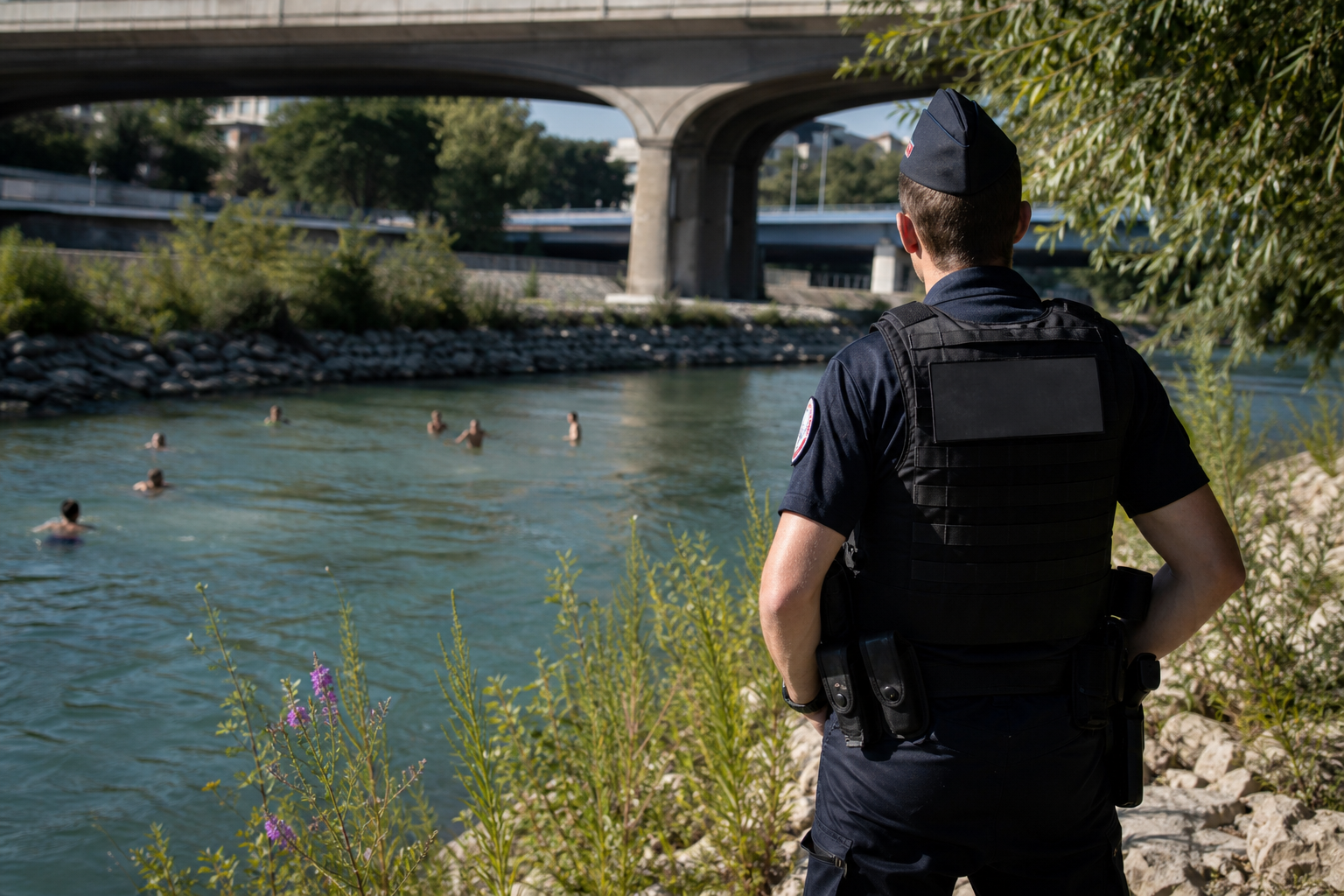
Forty people drowned in France between Thursday and the statement date during a period of elevated temperatures in Europe. Prime Minister Sébastien Lecornu attributed the deaths to heatwave conditions. That should end any complacent fiction that a heatwave is merely uncomfortable weather and that water safety during extreme heat is a matter for private judgment alone. When official heatwave periods drive large numbers of people toward rivers, lakes, beaches, canals, and other swimming areas at the same time, risk ceases to be isolated. It becomes systemic. And systemic risk requires a public response that is coordinated, mandatory, and designed to work at population scale.
The resolution is straightforward: governments should implement mandatory water safety restrictions during official heatwave periods. The point is not to criminalize recreation or to infantilize adults. The point is to reduce predictable, preventable deaths when extreme heat changes behavior, overloads emergency systems, and pushes people toward hazardous water conditions. In this context, a restriction is not an ideological indulgence. It is a targeted public safety tool, no different in principle from closing a dangerous road, banning swimming during contamination, or suspending access to wildfire zones.
The strongest objection is also the most emotionally resonant: liberty. Critics argue that adults are capable of assessing their own risks, that a distant bureaucracy should not decide what is safe, and that mandatory rules are always the thin edge of overreach. This argument flatters the individual while ignoring the structure of the event. Heatwaves distort judgment, compress decision-making, and create surge behavior. People seek immediate relief. Families travel to unfamiliar water. Crowds gather at unsupervised sites. Alcohol consumption rises. Supervision weakens. Rescue services are stretched. Under those conditions, the state is not replacing some pristine realm of rational autonomy. It is intervening in a mass-casualty risk environment where private incentives and fragmented judgment predictably fail.
The freedom at issue is also often misdescribed. Freedom is not secured by allowing obviously preventable drownings under extreme conditions. Freedom is secured when public institutions maintain the baseline conditions of survival and safety. A temporary rule during an official heatwave period does not abolish liberty; it preserves the public order on which meaningful liberty depends. The dead are not freer for having been unregulated.
A second objection comes dressed in the language of efficiency. Why not rely on public information campaigns, voluntary advisories, warning signs, lifeguard reminders, and better messaging first? Why impose the costs of enforcement or inconvenience without perfect evidence about which specific restrictions would have prevented which specific deaths? This sounds prudent until one notices what it presumes: that voluntary compliance will be high enough, fast enough, and evenly distributed enough to manage a fast-moving hazard during a weather emergency.
That presumption is exactly what public administration should reject. Voluntary advisories routinely underperform in the very moments when collective action matters most. The people least likely to understand risk, least likely to see warnings, or most likely to discount them are precisely those who remain exposed. That is the classic pattern of underprovided public goods and externalized costs. Emergency responders, hospitals, municipalities, and grieving families absorb the consequences of a policy architecture built on suggestion where obligation is required.
This is why centralized rules matter. Mandatory water safety restrictions create clarity, uniformity, and speed. They remove ambiguity about whether dangerous areas are closed, whether jumping from embankments is prohibited, whether nighttime swimming is allowed, whether alcohol-related enforcement is heightened, whether access to known hazard sites is temporarily blocked, and whether local authorities have to wait for bespoke approvals. A national or regional heatwave trigger connected to predefined safety protocols is not bureaucratic excess. It is competent governance.
There is, to be fair, a more sophisticated criticism. Some opponents warn that blanket restrictions can backfire by pushing people away from supervised beaches or monitored swimming areas into isolated, unsupervised water. That is a real implementation risk, and serious policy should acknowledge it. But it is an argument for smarter mandatory restrictions, not for the absence of them. Governments can and should differentiate between high-risk and lower-risk sites, close hazardous locations first, expand supervised cooling access where possible, deploy temporary barriers and patrols, and pair restrictions with public cooling alternatives. A capable state does not answer complexity with paralysis. It plans around displacement effects and manages them.
Indeed, one of the more revealing weaknesses in the anti-restriction case is its tendency to treat any mandate as inherently blunt. In reality, centralized government is the only actor with the legal authority, geographic reach, communications infrastructure, and emergency coordination capacity to calibrate restrictions across an entire heatwave event. Local improvisation has value, but fragmentation produces postcode safety: one municipality acts, another delays, one police unit enforces, another shrugs, one beach closes, another remains open despite comparable risk. People move across boundaries; risk moves with them. Equity demands that protection not depend on local competence, wealth, or luck.
Another line of opposition says we do not yet know enough. We have a tragedy in France, yes, but not a full causal map of every drowning. Were these deaths caused by poor judgment, bad infrastructure, lack of supervision, dangerous currents, alcohol, fatigue, or panic? The answer, almost certainly, is some combination. But this is not an argument against restrictions during official heatwave periods. It is the argument for them. Public health regularly acts under conditions of converging risk factors rather than perfect causal isolation. When a heatwave demonstrably coincides with a spike in exposure to dangerous water environments, the state need not wait for an academic postmortem before reducing that exposure.
The precautionary principle is not hysteria. It is the mature recognition that policy is judged not only by what it knows with certainty, but by how responsibly it acts under foreseeable danger. Forty drownings in France during a heatwave are not background noise. They are a warning. If governments know that official heatwave periods increase the likelihood of unsafe water behavior and deadly outcomes, then failure to impose temporary safety restrictions is not neutrality. It is abdication.
It is also important to say what this policy is not. It is not a substitute for investment. Governments should improve water safety infrastructure, fund lifeguards, map dangerous sites, strengthen signage, expand shaded cooling centers, and design urban heat responses that reduce desperate flight to hazardous water. But long-term investment and short-term restriction are complements, not alternatives. The state must be able to build durable capacity and to act decisively in acute danger.
The debate, at bottom, is about what we believe government is for. If government exists merely to issue advisories while predictable deaths mount, then the opponents are right to prefer voluntary caution and local patchwork. But if government exists to coordinate expertise, distribute protection equitably, and reduce mass risk when conditions become exceptional, then mandatory water safety restrictions during official heatwave periods are not only justified. They are overdue.
The France drownings exposed a familiar truth. In moments of environmental stress, individual choice does not aggregate into safety. It aggregates into uneven exposure, avoidable rescue burdens, and preventable funerals. The state’s duty is not to admire that fragmentation from a distance. It is to govern it. During a heatwave, that means mandatory water safety restrictions designed in advance, triggered automatically, enforced consistently, and paired with safe alternatives. Public order is not the enemy of human freedom. In a deadly heatwave, it is the condition for keeping people alive.