
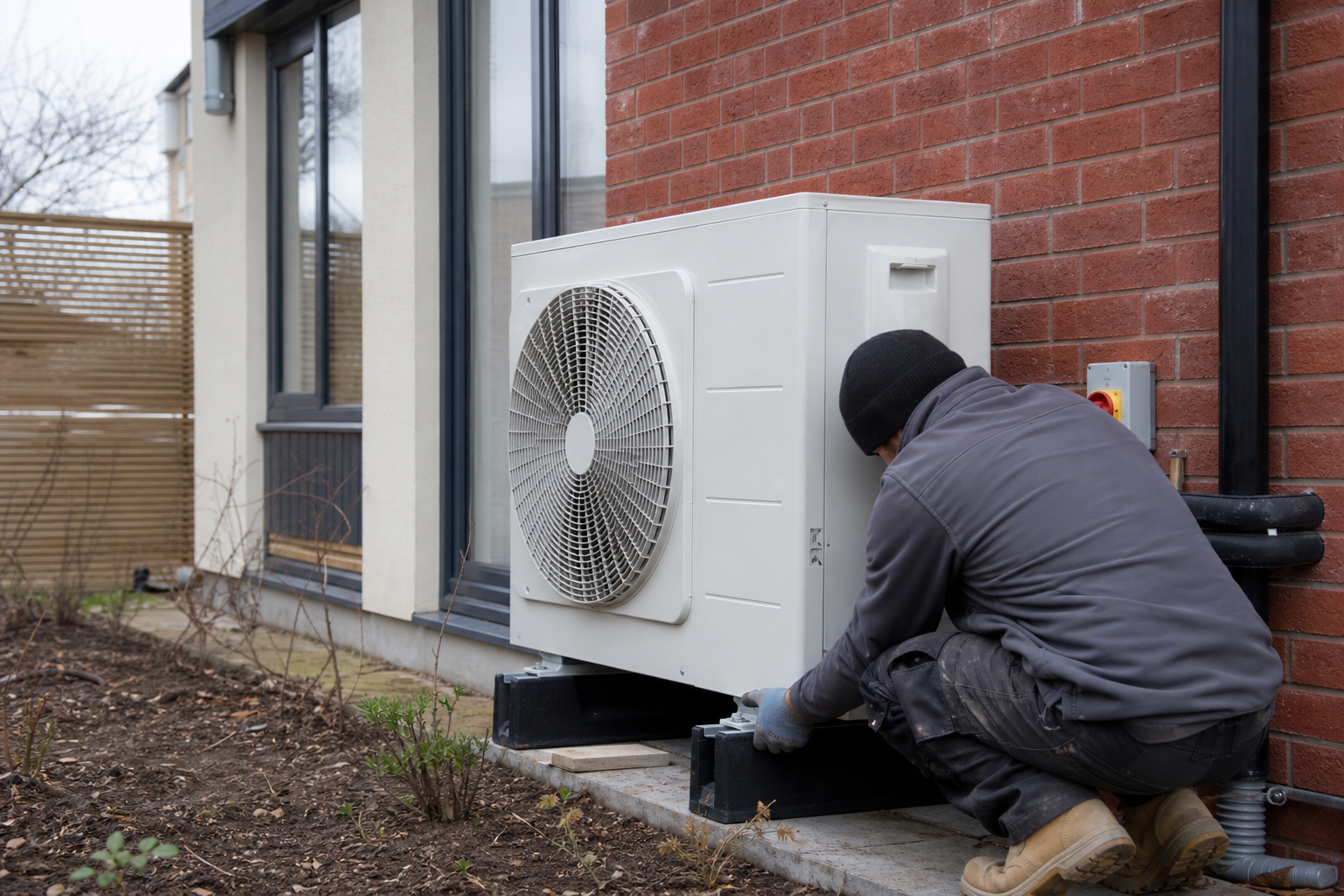
The case for government subsidies for residential heat pump adoption begins with a simple, inconvenient fact. A grant programme was reduced or eliminated, and heat pump sales growth slowed after it was cut. A climate watchdog then warned about that slowdown. For anyone still tempted to treat home heating decarbonization as a matter that can be left to individual consumer choice and market timing, this is the relevant lesson from the news cycle: when public support receded, adoption weakened.
That should not be surprising. Residential heat pumps deliver benefits that spill well beyond the household that installs them. They can reduce emissions, improve energy efficiency, and help shift the housing stock away from fossil fuel heating. But the purchase decision is still made one kitchen table at a time, under the pressure of household budgets, contractor availability, financing constraints, and uncertainty about payback. In that setting, high upfront cost predictably suppresses uptake even when the long run social return is strong. That is precisely the kind of coordination problem governments exist to solve.
The strongest opposing argument deserves serious attention. Critics of subsidies say the post-cut sales slowdown proves not market failure, but policy-induced dependency. On this view, if a technology loses momentum once grants are reduced, then the state has merely propped up an artificial market. The answer, they argue, is not renewed subsidy for heat pumps, but a more self-sustaining market shaped by lower costs, better products, and organic demand.
There is a narrow truth buried in that objection. Poorly designed subsidies can be wasteful. A grant programme can be too blunt, too regressive, too vulnerable to price inflation by installers, or too detached from supply-side realities such as workforce shortages and permitting delays. A government should not write blank checks and call it climate policy. It should measure take-up, installation quality, geographic equity, and value for money.
But that concession does not rescue the anti-subsidy case. It defeats it. If the complaint is that the previous grant programme may have been imperfect, the remedy is to improve public policy, not to abandon it. The fact that sales growth slowed after the programme was cut is evidence that the subsidy was doing meaningful work. It was lowering the barrier that the market had failed to clear on its own. One does not look at a bridge that carried traffic, then infer from congestion after its closure that bridges are a mistake.
This is where the pragmatic anti-subsidy position often becomes too clever by half. It says, correctly, that policymakers should ask what is the cheapest and fastest way to get more heat pumps installed. Then it treats that question as if it points away from subsidies. The available facts point in the opposite direction. We have a direct observed policy change, a reduction or elimination of a government grant, followed by a slowdown in sales growth. In public policy, one rarely gets such a clean signal. If the policy objective is more residential heat pump adoption, financial subsidies have already demonstrated that they materially affect behavior.
That does not mean demand-side grants are the only tool. It means they are an essential tool. The better institutional argument is not for subsidy in isolation, nor for subsidy as permanent life support, but for subsidy as part of an orderly transition strategy. A serious government should provide consumer rebates or grants for heat pump installation, especially for low and middle income households; it should pair those subsidies with installer training, transparent standards, and program oversight; and it should use stable multi-year policy rather than improvisation. The market signal that matters most is not merely the sticker price of a heat pump. It is whether households, manufacturers, lenders, and contractors can trust that the state will maintain a coherent direction long enough for the sector to scale.
The dependency critique also mistakes timing for pathology. Every major infrastructure and energy transition passes through a stage in which public support is necessary to move from early adoption to mass deployment. That is not a sign of weakness. It is what happens when private decision-makers face high upfront costs while the benefits are distributed across the wider economy and over many years. Home retrofits, insulation, grid expansion, wastewater treatment, vaccination, broadband rollout, all of these involve public investment because fragmentation underprovides them. Residential heating is no different.
There is also an equity issue that opponents often glide past. Without subsidies, heat pump adoption tends to favor households with cash reserves, access to credit, and the confidence to navigate a complicated purchase. Everyone else waits, often in older homes with less efficient systems and higher energy burdens. A cut to a grant programme does not just reduce sales. It redistributes opportunity upward, turning decarbonization into a premium consumer choice rather than a broadly shared public project. If governments are serious about the clean heat transition, they cannot leave access to capital as the gatekeeper.
Some critics propose alternatives such as deregulation, tax credits, supply chain reform, or broad industrial measures instead of direct financial subsidies. Several of those ideas are useful, and a mature policy should incorporate them where appropriate. Streamlined permitting can help. More trained installers can help. Better financing can help. But none of these rebut the central case for subsidies. They complement it. A household deciding whether to replace a boiler or furnace with a heat pump still confronts an upfront cost problem, and the recent sales slowdown after grant cuts tells us that this problem remains decisive.
The larger policy failure here was not that governments once subsidized heat pumps. It was that they allowed support to become uncertain. Stop-start policy is expensive because it interrupts consumer confidence, supply planning, and installer demand. It creates exactly the kind of fragility critics decry. If a government wants a self-sustaining market, it should not jerk the steering wheel and then announce that the skid proves planning is futile. It should set a clear destination and hold the line.
So the resolution is correct. Governments should provide financial subsidies for residential heat pump adoption. Not because grants are magical, and not because every public programme deserves defense in its first form, but because the public interest is clear and the market, left to its own devices, has again shown its limits. The climate watchdog's warning should be read less as an alarm about one product category than as a reminder about governance. When policy support was cut, progress slowed. That is what underinvestment in public goods looks like in real time.
The task now is not ideological handwringing about whether the state has intruded too far into the home heating market. The task is administrative competence. Build a stable subsidy programme. Target it well. Audit outcomes. Protect consumers. Coordinate supply and installation capacity. And keep the transition moving. A decarbonized housing stock will not emerge from wishful thinking or atomized choices alone. It will be built, deliberately, by institutions willing to align private incentives with public need.