
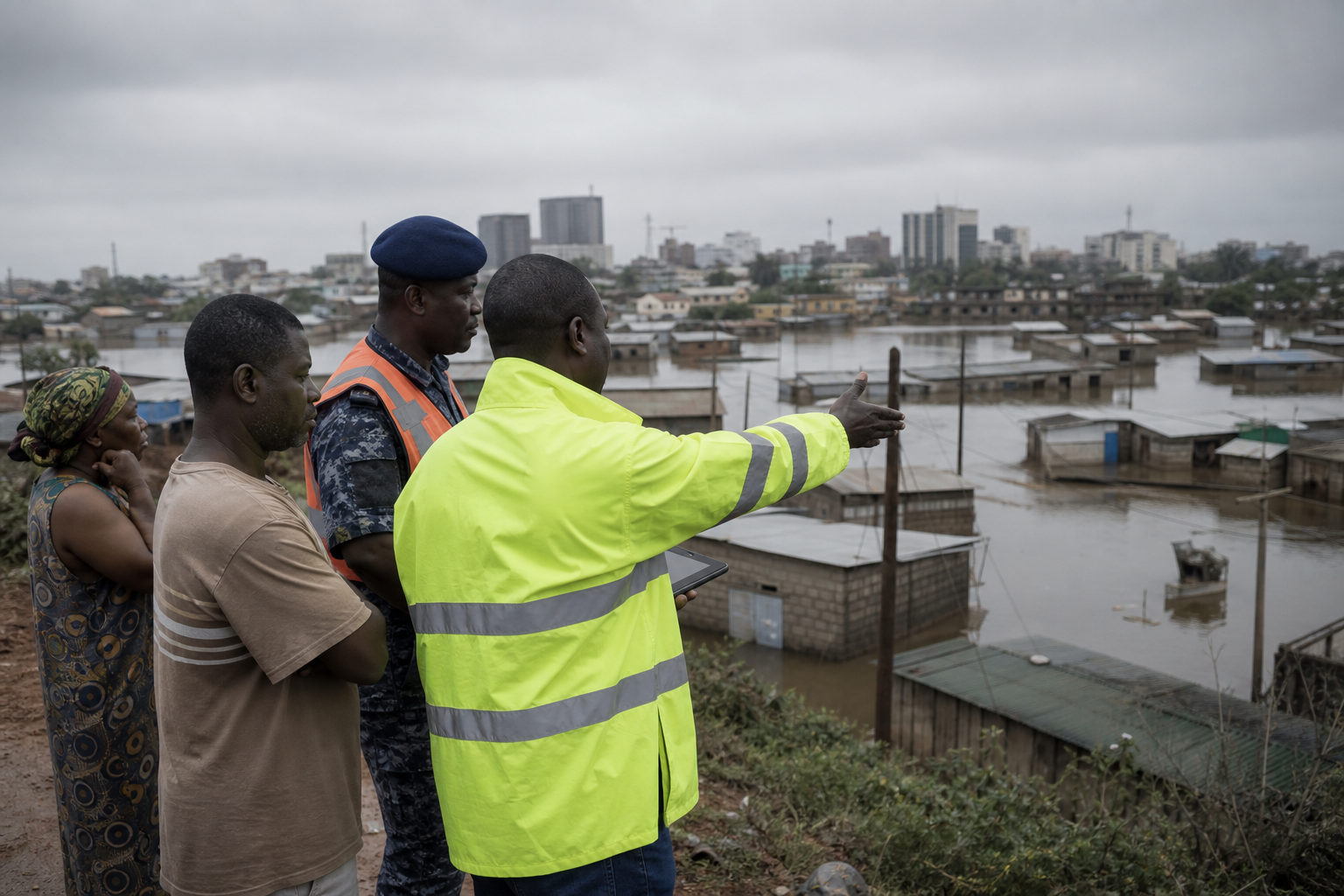
Thirteen people are dead after flooding in Ghana's capital city. Authorities urged residents to relocate to high ground or remain indoors. Additional storm and rainfall is forecast. Those facts are immediate, local, and tragic. They also illuminate a larger policy failure that extends far beyond one storm or one city: when governments know an urban area is flood-prone, advisories and emergency response are not enough. National governments should mandate relocation from flood-prone urban areas, and they should do so through law, planning, compensation, and public investment, not through improvisation after each disaster.
The hardest part of this argument is not seeing the danger. It is accepting what serious prevention requires. Opponents of mandated relocation raise concerns that are neither frivolous nor cruel. They warn about coercion, property loss, social disruption, bureaucratic abuse, and the historic record of states moving people badly. They point out, correctly, that a relocation order without housing, jobs, transit, schools, sanitation, and compensation is not protection. It is displacement. They also argue that less disruptive tools exist: early warning systems, drainage upgrades, stronger building codes, zoning enforcement, flood barriers, and voluntary buyouts for households in the highest-risk locations.
Those objections matter. A government that simply declares neighborhoods uninhabitable and pushes poor families elsewhere has not solved flood risk. It has redistributed suffering. Due process matters. Transparent hazard mapping matters. Fair compensation matters. Community continuity matters. In some places, infrastructure can reduce risk enough to avoid large-scale retreat. In others, evacuation orders during acute emergencies will remain necessary even after long-term planning begins.
But none of those caveats rescues the case against a mandate. They simply define what a legitimate mandate must include.
The central question in this debate is not whether relocation is costly. Of course it is. The question is whether national governments should continue allowing dense urban settlement in places where recurrent flooding makes mass casualty, chronic asset loss, disease risk, school disruption, and infrastructure destruction foreseeable. On that question, voluntary and piecemeal approaches repeatedly fail for structural reasons.
First, individual choice does not operate on a level field. People do not remain in flood-prone urban areas because they misread weather bulletins. They remain because jobs, transport links, family networks, schools, and informal economies are already there. Rent may be cheaper in risky areas. Land tenure may be insecure everywhere, not just in the floodplain. Credit constraints prevent households from moving preemptively. In short, what looks like free choice is often constraint dressed up as autonomy. Advisories assume people can act on information. Many cannot.
Second, local and voluntary solutions underprovide safety because the benefits of retreat are collective while the costs are concentrated. One household that moves bears immediate losses in income, commute time, and social ties. The benefits of reduced emergency burden, lower infrastructure exposure, and fewer rescue operations are spread across the city and the treasury. This is the classic logic of public goods and externalized risk. It is precisely where national government has to act. Markets price the private transaction in front of them. They do not reliably absorb downstream fiscal and human costs of repeated disaster.
Third, flood risk management in major cities cannot be solved parcel by parcel. Drainage systems, transport corridors, stormwater basins, land-use rules, public housing, utility relocation, and emergency logistics are network problems. If half a neighborhood leaves and half remains, the state still has to maintain roads, power, water, and rescue access in a hazardous area. If a city relies only on voluntary buyouts, retreat is slow, patchy, and politically easy to postpone. The result is the worst of both worlds: recurring floods and endless rebuilding.
This is why the strongest anti-mandate argument, the pragmatic one, ultimately collapses under the weight of scale. It says a mandate should be a last resort after infrastructure and incentives are exhausted. Fair enough in theory. In practice, flood-prone urbanization is often the accumulated product of decades of underenforced zoning, informal settlement, weak drainage, and fragmented authority. By the time people are dying and more rainfall is forecast, the state is already paying the price of delay. Waiting to prove that every less disruptive option has been fully attempted becomes its own form of negligence.
The better approach is staged, national, and explicit. Governments should identify high-risk urban flood zones using public criteria. They should classify areas by severity: protectable, conditionally habitable, and unsuitable for continued residence. In protectable zones, invest aggressively in drainage, barriers, and building standards. In conditionally habitable zones, impose clear occupancy rules, insurance conditions where relevant, and time-bound mitigation requirements. In unsuitable zones, mandate relocation with compensation, replacement housing, transport access, livelihood support, school continuity, and legal appeals.
That is not blunt force. It is administrative seriousness.
Critics often contrast coercion with dignity, as if the humane alternative were to leave families in place until the next flood and send rescuers again. But there is no dignity in predictable abandonment. There is no freedom in having to choose between drowning risk and destitution. There is no justice in a system where the poorest residents absorb the consequences of hazardous land use while the broader public finances emergency response and reconstruction on repeat.
A national mandate also answers a problem localism cannot. Municipal authorities are often trapped by tax bases, informal settlement politics, and short electoral horizons. They may know retreat is necessary and still lack the fiscal capacity or legal authority to execute it. National government can pool risk across regions, raise capital at scale, standardize compensation, coordinate ministries, and ensure that receiving communities have infrastructure before relocation begins. That is what capacity looks like in the real world, not in theory.
Ghana's flooding should not be used to justify rash, improvised removals. It should be used to retire the comforting fiction that warning people is the same as protecting them. Advisories save some lives in the moment. They do not solve known geographic exposure. If additional storms are forecast for a flood-prone urban area, the state has two responsibilities at once: immediate emergency management and long-range removal of residents from intolerable risk.
Mandated relocation is politically difficult because it forces governments to admit a costly truth: some urban land should no longer be lived on. Yet that honesty is preferable to the cheaper lie that resilience can always be engineered in place, or that voluntary movement will happen at the speed danger requires. Sometimes it can. Often it will not.
The measure of a serious government is not how eloquently it issues warnings when the water rises. It is whether it acts before the next forecast becomes the next obituary. In flood-prone urban areas, national governments should mandate relocation, and they should do it lawfully, generously, and at scale.