
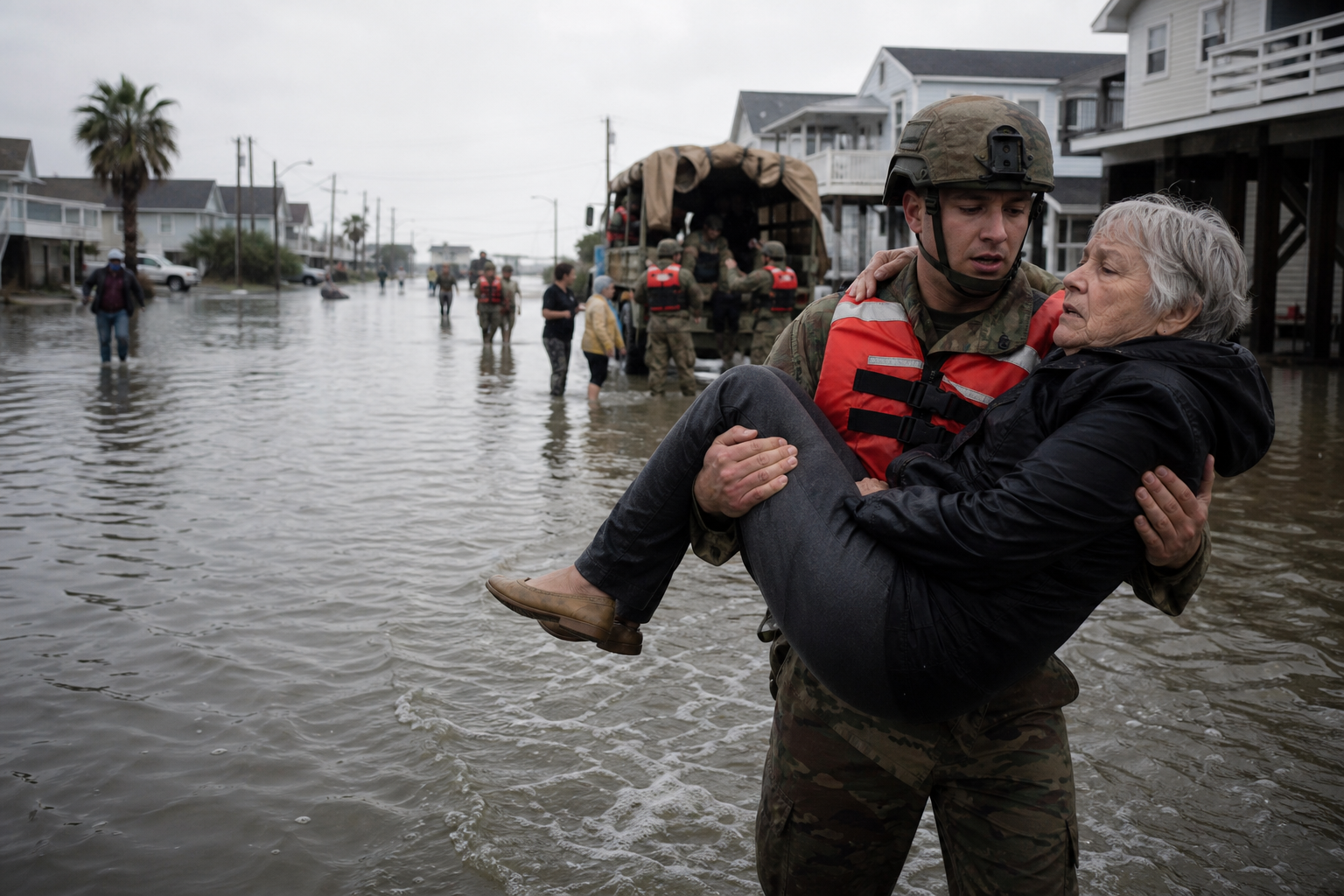
When a severe weather event is strong enough to threaten mass casualty, governments should mandate evacuations. Not because the state is always wise, and not because liberty stops mattering in a storm, but because typhoons, hurricanes, floods, and wildfire-driven weather emergencies create a brutal policy reality: delay compounds damage, and individual choice in a disaster often imposes costs on everyone else.
The recent typhoon response in Zhejiang province makes the stakes concrete. China evacuated nearly two million people. Schools were suspended. Work activities were suspended. Outdoor activities were suspended. Transport services were cancelled. That is an enormous interruption to daily life and economic activity. It is also what serious risk management looks like when the downside is measured in lives, trapped families, overwhelmed emergency crews, and destroyed infrastructure.
The cleanest argument against mandatory evacuation is also the most emotionally powerful. People know their own homes, businesses, relatives, medications, pets, and escape routes better than any distant official. A mass evacuation order can be overbroad. Forecasts can be wrong at the margins. A small business owner may lose critical income. A family may fear looting or the loss of fragile property. Critics are right to say that government power should not be romanticized, especially when it can shut schools, halt work, stop transport, and move millions of people on command.
That critique deserves more respect than evacuation advocates sometimes give it. A mandatory order is not costless. It can be clumsy. It can be overused. It can become theater if officials issue sweeping commands merely to avoid blame. And if governments want public trust, they must pair mandates with logistics, shelter capacity, compensation mechanisms where possible, clear communication, and narrow tailoring to actual risk zones.
But none of those caveats overturns the basic case for mandates in severe weather. They clarify how to do it well.
The strongest substantive argument against mandatory evacuation is that a voluntary, information-rich system could produce the same safety benefits with less coercion. Give people accurate forecasts, open routes, clear shelters, and real-time alerts, and most will leave. That sounds attractive, efficient, and modern. In many lower-risk events, it may be enough.
The problem is that the resolution is about severe weather events, not ordinary bad weather. Severity changes the math. Once the risk crosses a threshold, voluntary systems break in predictable ways. Some residents underestimate danger. Some wait too long. Some assume the storm will turn. Some lack transportation. Some stay for work. Some stay to guard property. Some stay because every previous warning felt survivable. The result is not simply a private gamble. It is a public liability.
That is the core point too many anti-mandate arguments evade. When people remain in evacuation zones during a major typhoon or hurricane, their decision does not end at their property line. It creates rescue demand. It exposes police, firefighters, medical teams, and search crews to avoidable danger. It clogs roads later. It delays utility restoration. It can force governments into riskier, more expensive operations in the middle of floodwater, storm surge, or debris. In economic terms, the choice to stay externalizes cost. In moral terms, it asks others to absorb the consequences.
This is why the usual freedom frame is too thin. A mandatory evacuation is not primarily about government asserting symbolic control. It is about coordinating behavior fast enough to prevent a system-wide cascade. Transport cancellations, school closures, and work suspensions are disruptive, yes, but they also perform a vital function. They clear the field. They reduce reasons to remain. They free roads and public capacity. They turn scattered intention into actual movement.
Critics call this a blunt instrument. Sometimes it is. But bluntness is not always a vice in emergency management. When a storm window is closing, precision can become procrastination by another name. The cost of being slightly overinclusive for 24 or 48 hours is often dramatically lower than the cost of being slightly underinclusive when water rises, power fails, and evacuation routes collapse.
There is also a deeper growth argument here, one that matters if we care about prosperity rather than merely survival. Human capital is the ultimate compounding asset. Workers, students, parents, caregivers, and skilled responders are the machinery of every economy. A mandated evacuation that preserves life is not anti-growth. It is a temporary brake that prevents a high-speed crash. The suspensions in Zhejiang province, of schools, work, outdoor activity, and transport, were not evidence of civilizational retreat. They were the operating cost of preserving capacity so recovery can begin from a far stronger baseline.
This is where the accelerationist instinct, properly understood, points toward mandates rather than away from them. The fastest society is not the one that refuses to pause; it is the one that knows when an orderly pause prevents catastrophic loss. Resilience is not pretending every system can run through a typhoon. Resilience is building institutions capable of decisive, credible coordination when nature presents a hard constraint.
The better objection is not that governments should never mandate evacuation. It is that they should do so under disciplined rules. That is right. Mandatory evacuation should be tied to severe, evidence-based thresholds. Orders should be geographically specific when possible. Officials should communicate timelines, routes, and shelter options clearly. Governments should support vulnerable residents, including the elderly, disabled people, hospital patients, and those without cars or money for lodging. And after the event, there should be public accounting about whether the mandate was proportionate and effective.
In other words, the answer to potential overreach is not paralysis. It is competence.
The China case, evacuating nearly two million people in Zhejiang province ahead of a typhoon, shows both the scale of disruption and the scale of state capacity required by modern weather risk. Climate volatility, coastal density, and interconnected infrastructure mean the stakes are getting larger, not smaller. As storms intensify and urban corridors concentrate more people and assets, the fantasy that severe weather can be managed through advisory-only governance becomes less plausible.
Governments exist in part to solve collective action problems under time pressure. Severe weather is exactly that kind of problem. A voluntary evacuation can work when danger is moderate and time is abundant. A mandatory evacuation is justified when danger is extreme and the cost of hesitation explodes.
So yes, governments should mandate mass evacuations for severe weather events, carefully, transparently, and with material support. The alternative is to confuse liberty with the right to create avoidable casualties, avoidable rescues, and avoidable collapse. In a true weather emergency, speed saves lives, and coordinated disruption now is the price of preventing far greater ruin later.