
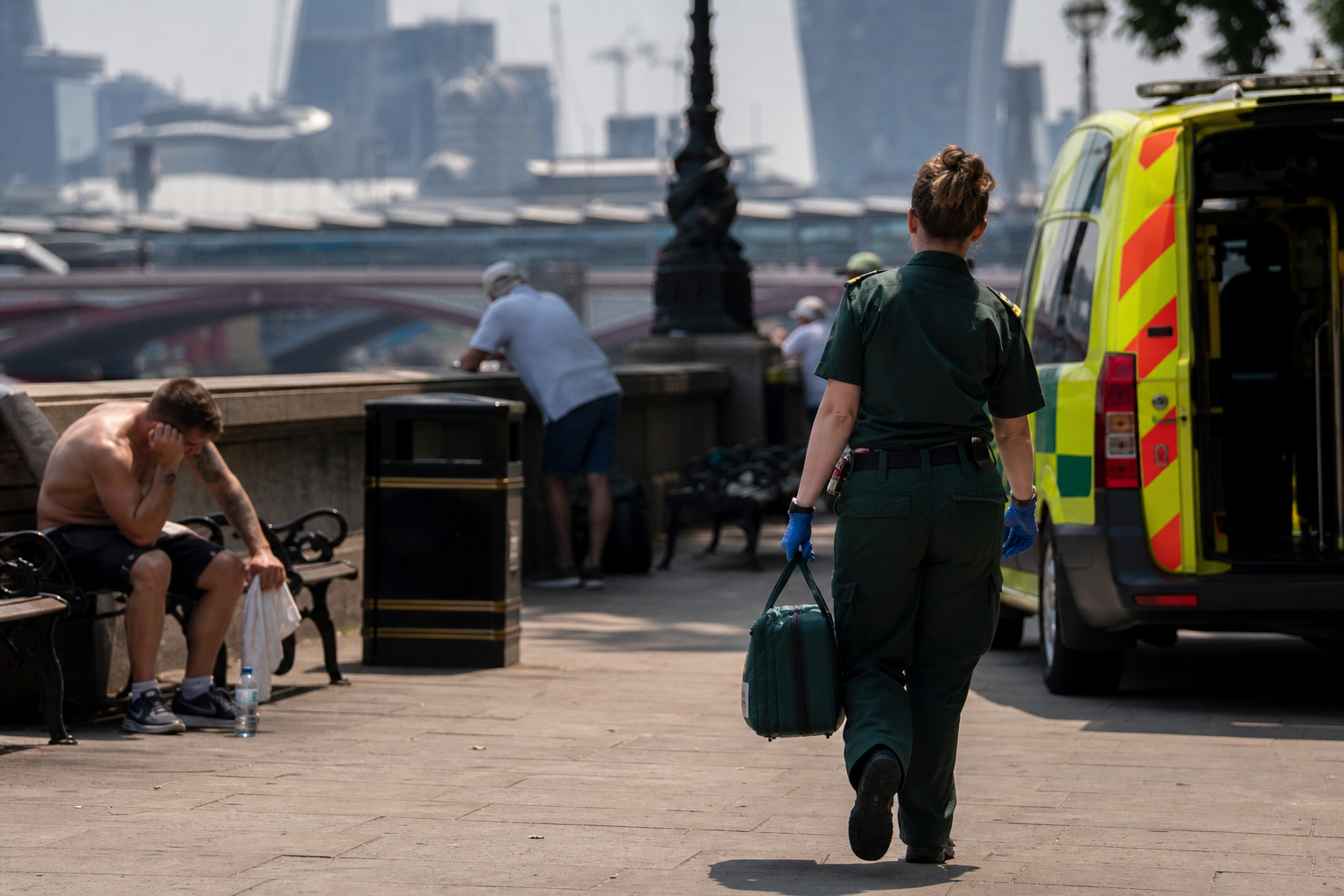
When Britain issued a red weather warning during June as temperatures reached record-breaking levels across much of the UK, it did more than update a forecast. It marked a threshold. A rare warning in the UK system told schools, hospitals, transport operators, care providers, employers, and households that this was not ordinary summer discomfort. It was a widespread public risk requiring unusual measures.
That is why governments should issue red-level weather warnings for extreme heat events. Not because a warning solves heat by itself, and not because the state should dramatize every hazard, but because extreme heat is one of those threats where delayed coordination costs lives. A red warning is a governance tool. It translates meteorological data into a common operating picture for institutions and the public. Without it, response fragments, responsibility diffuses, and the most vulnerable people pay for everyone else's ambiguity.
The strongest objections deserve serious attention. One critique says red warnings are performative, a cheap substitute for serious investment in heat-resilient housing, stronger energy systems, urban shade, and long-term climate adaptation. There is truth in part of that. Governments cannot issue an alert and call the job done. If warnings become a public relations shield for failed infrastructure policy, they will deserve criticism.
But this is not an argument against issuing red warnings. It is an argument against issuing warnings alone. In public administration, immediate risk communication and structural investment are complements, not substitutes. A government that fails to build resilience is negligent. A government that also fails to warn during record-breaking heat is doubly negligent. The existence of a deeper policy agenda does not erase the need for an emergency signal when dangerous conditions are already here.
Another objection is more procedural and, on its face, more careful. Red warnings are powerful. They can trigger disruption, affect travel, alter business operations, unsettle families, and redirect public resources. So, critics say, governments should be cautious. They should establish transparent criteria, educate the public about what red means, and avoid overuse that could breed desensitization.
This, too, is substantially right, but it supports the case for red warnings more than it weakens it. Of course the threshold should be rigorous. Of course the criteria should be transparent. Of course rarity matters. The UK fact pattern is instructive precisely because the warning system already treats red as rare, and the June event was record-breaking and affected much of the country. That is what warning systems are for, to distinguish exceptional danger from routine inconvenience. The answer to the risk of misuse is disciplined use, not institutional silence.
A third critique comes from those who prefer decentralized information. Why rely on a national warning when local authorities, community networks, hyper-local sensors, and individuals can assess their own circumstances? Because heat risk is both local in experience and systemic in consequence. A frail older adult in a top-floor flat, a rail operator managing track buckling, an NHS trust preparing for patient surges, and a school deciding whether indoor classrooms are safe all face different exposures. But they are linked by the same weather event, the same electricity demand, the same health system constraints, and the same need for simultaneous action.
Decentralized information is useful, but it is not enough. It does not set common thresholds across institutions. It does not synchronize decisions among agencies. It does not reliably reach those with the least time, least mobility, weakest social networks, or poorest housing. Markets underprovide public alerts because no single actor captures the full benefit of a population that changes behavior in time. Local actors can innovate at the margins, but they cannot replace a national signal when the event itself is national.
This is the central point in the debate: a red warning is not merely advice to drink water and stay in the shade. It is an administrative trigger. It authorizes escalation. It tells health services to prepare for heat-related illness, social care systems to check vulnerable residents, transport agencies to activate contingency plans, and employers to reconsider ordinary routines. It gives broadcasters a clear standard for prominent coverage. It gives local officials political and bureaucratic permission to act early rather than justify themselves afterward.
Critics often describe this as paternalism, as if citizens are being told how to experience the weather. That is too thin a reading of what modern government does. The state is not confiscating private judgment when it issues a red weather warning. It is correcting a coordination failure. In any extreme event, each person sees only part of the risk, and each institution hesitates if it thinks others will stay open, stay quiet, or stay normal. The result is underreaction. A central warning reduces that hesitation by making the scale of danger legible to everyone at once.
The equity dimension is equally important. Heat does not fall evenly. The harm is concentrated among older people, disabled people, infants, outdoor workers, low-income renters, people in poorly insulated homes, and communities with less green space. The comfortable columnist can say that individuals should judge for themselves. The family in an overheated flat, the care home with staffing pressures, and the worker who cannot simply opt out of a shift understand the limits of that advice. Government warnings matter most where private margin for error is smallest.
There is a temptation, especially in cooler countries, to treat heat as less serious than storms or floods because it can look less dramatic on camera. No roof is torn off by sunshine. No street fills visibly with water. But a hazard need not be theatrical to be deadly. That is exactly why warning systems must evolve. If record-breaking June temperatures affect much of the UK, government has a duty to communicate that the threat is exceptional, not familiar.
The sensible standard is not to issue red warnings often. It is to issue them when the evidence supports them, when heat is extreme, widespread, and likely to produce severe disruption or danger. In those circumstances, caution does not mean restraint in messaging. It means precision in threshold setting and seriousness in follow-through. The warning should be rare, clear, and tied to concrete institutional actions.
Britain's June red weather warning should be understood in that spirit. It was not proof of panic. It was proof of a state using a calibrated instrument as intended. The real failure would have been to possess a warning system capable of signaling exceptional danger, then refuse to use it when the danger arrived.
Governments should issue red-level weather warnings for extreme heat events because the public does not need quieter forecasts in extraordinary conditions. It needs an honest signal proportionate to the risk, and a state capable of turning that signal into coordinated protection. In the contest between fragmented discretion and organized preparedness, the humane choice is not difficult.